Human Exposure to Novel Bartonella Species from Contact with Fruit Bats
- PMID: 30457529
- PMCID: PMC6256376
- DOI: 10.3201/eid2412.181204
Human Exposure to Novel Bartonella Species from Contact with Fruit Bats
Abstract
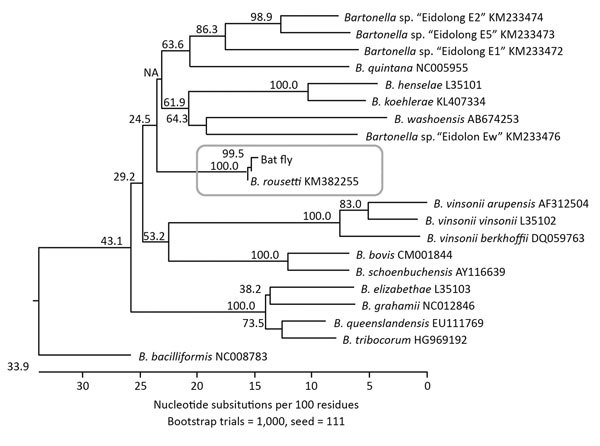
Twice a year in southwestern Nigeria, during a traditional bat festival, community participants enter designated caves to capture bats, which are then consumed for food or traded. We investigated the presence of Bartonella species in Egyptian fruit bats (Rousettus aegyptiacus) and bat flies (Eucampsipoda africana) from these caves and assessed whether Bartonella infections had occurred in persons from the surrounding communities. Our results indicate that these bats and flies harbor Bartonella strains, which multilocus sequence typing indicated probably represent a novel Bartonella species, proposed as Bartonella rousetti. In serum from 8 of 204 persons, we detected antibodies to B. rousetti without cross-reactivity to other Bartonella species. This work suggests that bat-associated Bartonella strains might be capable of infecting humans.
Keywords: Bartonella; Nigeria; bacteria; bat festival; bat flies; bats; human; vector-borne infections; zoonoses.
Figures
References
-
- Mickleburgh S, Waylen K, Racey P. Bats as bushmeat: a global review. Oryx. 2009;43:217–34. 10.1017/S0030605308000938 - DOI
-
- Osinubi MO, Recuenco S, Kuzmin I, Haberling DL, Blau DM, Davis LB, et al. Knowledge, attitudes and practices among populations exposed to bats in southern Nigeria. Revista de Educação Continuada em Medicina Veterinária e Zootecnia do CRMV-SP. 2012;10, n. 2/3.
-
- Kwiecinski GG, Griffiths TA. Rousettus egyptiacus. Mamm Species. 1999;611:1–9. 10.2307/3504411 - DOI
Publication types
MeSH terms
Substances
LinkOut - more resources
Full Text Sources