


Cross-site Monitoring and Evaluation of the Care and Prevention in the United States Demonstration Project, 2012-2016: Selected Process and Short-term Outcomes
- PMID: 30457956
- PMCID: PMC6262513
- DOI: 10.1177/0033354918803368
Cross-site Monitoring and Evaluation of the Care and Prevention in the United States Demonstration Project, 2012-2016: Selected Process and Short-term Outcomes
Abstract
Objective: The Care and Prevention in the United States (CAPUS) Demonstration Project was a 4-year (2012-2016) cross-agency demonstration project that aimed to reduce HIV/AIDS-related morbidity and mortality among racial/ethnic minority groups in 8 states (Georgia, Illinois, Louisiana, Mississippi, Missouri, North Carolina, Tennessee, and Virginia). Its goals were to increase the identification of undiagnosed HIV infections and optimize the linkage to, reengagement with, and retention in care and prevention services for people with HIV (PWH). We present descriptive findings to answer selected cross-site process and short-term outcome monitoring and evaluation questions.
Methods: We answered a set of monitoring and evaluation questions by using data submitted by grantees. We used a descriptive qualitative method to identify key themes of activities implemented and summarized quantitative data to describe program outputs and outcomes.
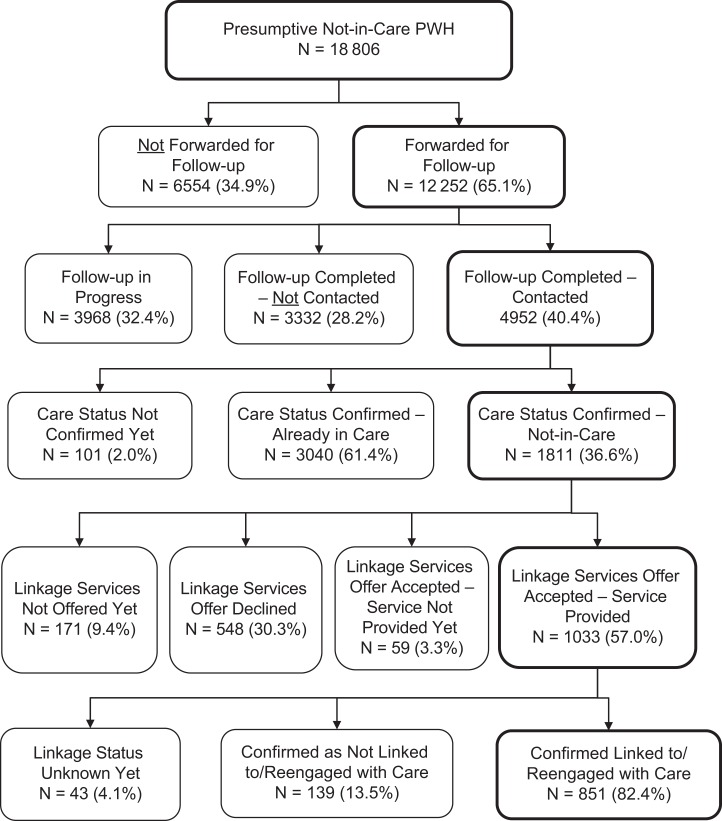
Results: Of 155 343 total HIV tests conducted by all grantees, 558 (0.36%) tests identified people with newly diagnosed HIV infection. Of 4952 PWH who were presumptively not in care, 1811 (36.6%) were confirmed as not in care through Data to Care programs. Navigation and other linkage, retention, and reengagement programs reached 10 382 people and linked to or reengaged with care 5425 of 7017 (77.3%) PWH who were never in care or who had dropped out of care. Programs offered capacity-building trainings to providers to improve cultural competency, developed social marketing and social media campaigns to destigmatize HIV testing and care, and expanded access to support services, such as transitional housing and vocational training.
Conclusions: CAPUS grantees substantially expanded their capacity to deliver HIV-related services and reach racial/ethnic minority groups at risk for or living with HIV infection. Our findings demonstrate the feasibility of implementing novel and integrated programs that address social and structural barriers to HIV care and prevention.
Keywords: CAPUS; Care and Prevention in the United States; HIV prevention and care; demonstration project; project monitoring and evaluation; racial/ethnic minorities.
Conflict of interest statement
Figures
References
-
- Centers for Disease Control and Prevention. Diagnoses of HIV infection in the United States and dependent areas, 2016. HIV Surveill Suppl Rep. 2017;28:1–125.
-
- Centers for Disease Control and Prevention. Monitoring selected national HIV prevention and care objectives by using HIV surveillance data—United States and 6 dependent areas, 2015. HIV Surveill Suppl Rep. 2017;22(2):1–63.
-
- Centers for Disease Control and Prevention. Program collaboration and service integration: enhancing the prevention and control of HIV/AIDS, viral hepatitis, sexually transmitted diseases, and tuberculosis in the United States. Published 2009. https://www.cdc.gov/nchhstp/programintegration/docs/207181-c_nchhstp_pcs.... Accessed September 22, 2018.
Publication types
MeSH terms
LinkOut - more resources
Full Text Sources
Medical
