


Assessing men with erectile dysfunction before and after living donor liver transplantation in real-world practice: Integrating laboratories into clinical settings
- PMID: 30458009
- PMCID: PMC6245674
- DOI: 10.1371/journal.pone.0206438
Assessing men with erectile dysfunction before and after living donor liver transplantation in real-world practice: Integrating laboratories into clinical settings
Abstract
Objective: To evaluate the predictive role of the Model for End-Stage Liver Disease (MELD) score concerning changes in testosterone levels following living donor liver transplantation (LDLT) and the effects of LDLT on total testosterone and sex hormone-binding globulin (SHBG) levels, the free androgen index (FAI) and erectile function in LDLT recipients.
Participants: 41 adult male recipients of LDLT were evaluated before transplantation and six months after LDLT.
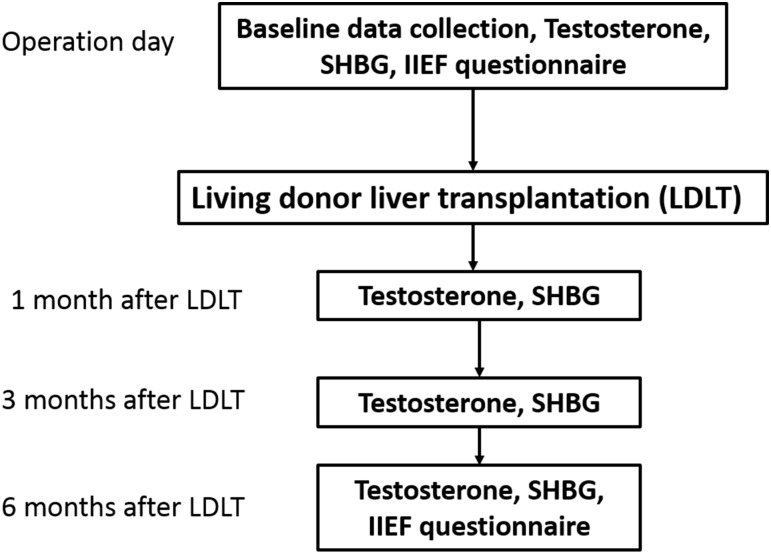
Main outcome measures: We evaluated the effects of LDLT on total testosterone and SHBG levels, the FAI and erectile function in LDLT recipients. In this prospective study, MELD score, serum total testosterone, SHBG levels and FAI were measured in the morning of the operation day and 1 month, 3 months and 6 months after LDLT. The 5-item version of the International Index of Erectile Function (IIEF-5) questionnaire was administered before LDLT and six months after LDLT to evaluate erectile function.
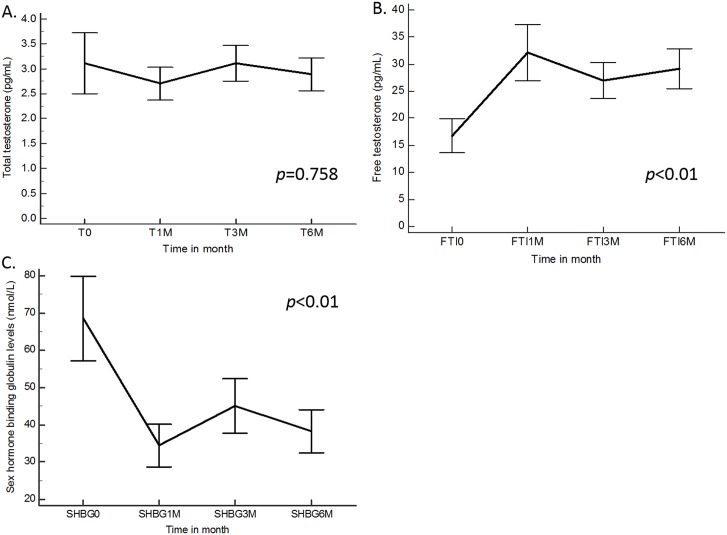
Results: The main outcome measure was dynamic parameter changes of total testosterone, SHBG, FAI and erectile dysfunction. The mean FAI value before LDLT was 16.75±10.10. The mean FAI was significantly higher 1 month (32.75±15.56; p < 0.01), 3 months (25.23±10.26; p < 0.01) and 6 months (29.16±11.05; p < 0.01) after LDLT. Mean IIEF-5 scores significantly increased after LDLT (from 11.7±7.7 before LDLT to 14.7±7.5, p< 0.01).
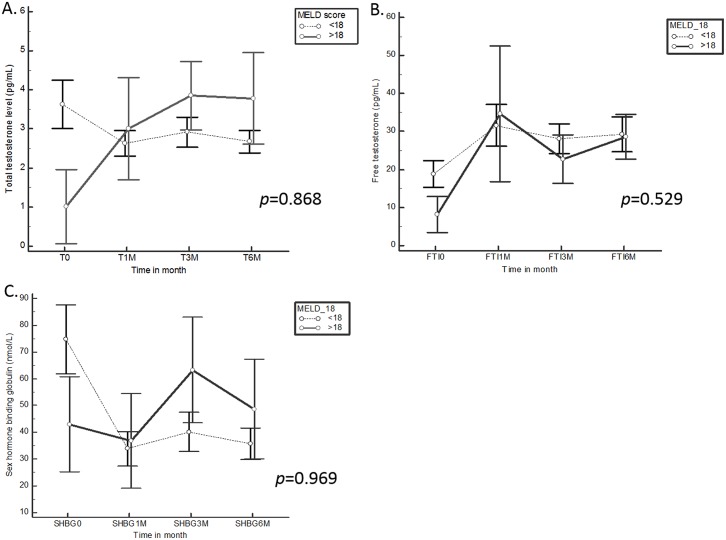
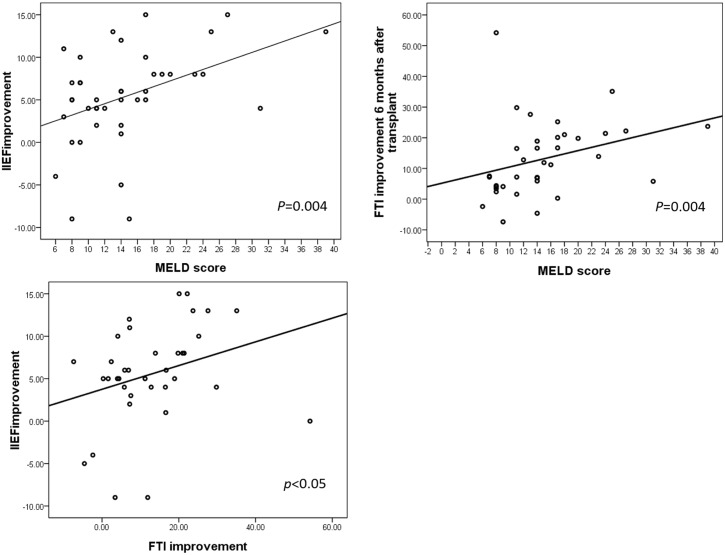
Conclusions: MELD score correlates with severity of hypogonadism in men with end-stage liver disease. LDLT results in a reduction in serum levels of SHBG, an increase in FAI and improvement in erectile function.
Conflict of interest statement
The authors have declared that no competing interests exist.
Figures
References
-
- Potosek J, Curry M, Buss M, Chittenden E. Integration of palliative care in end-stage liver disease and liver transplantation. 2014;17(11): 1271–1277. 10.1089/jpm.2013.0167 - DOI - PMC - PubMed
-
- Malinchoc M, Kamath PS, Gordon FD, Peine CJ, Rank J, et al. A model to predict poor survival in patients undergoing transjugular intrahepatic portosystemic shunts. 2000;31(4): 864–871. 10.1053/he.2000.5852 - DOI - PubMed
-
- Monegal A, Navasa M, Guanabens N, Peris P, Pons F, et al. Bone disease after liver transplantation: a long-term prospective study of bone mass changes, hormonal status and histomorphometric characteristics. 2001;12(6): 484–492. 10.1007/s001980170094 - DOI - PubMed
-
- Sinclair M, Grossmann M, Gow PJ, Angus PW. Testosterone in men with advanced liver disease: abnormalities and implications. 2015;30(2): 244–251. 10.1111/jgh.12695 - DOI - PubMed
-
- Grossmann M, Hoermann R, Gani L, Chan I, Cheung A, et al. Low testosterone levels as an independent predictor of mortality in men with chronic liver disease. 2012;77(2): 323–328. 10.1111/j.1365-2265.2012.04347.x - DOI - PubMed
Publication types
MeSH terms
Substances
LinkOut - more resources
Full Text Sources
Medical
Miscellaneous
