Review
. 2019 Oct 15;145(8):2021-2031.
doi: 10.1002/ijc.32003. Epub 2018 Dec 30.

Fecal microbiota transplantation in cancer management: Current status and perspectives

Affiliations
Review

Fecal microbiota transplantation in cancer management: Current status and perspectives

Danfeng Chen et al. Int J Cancer. .

Abstract

The human gut is home to a large and diverse microbial community, comprising about 1,000 bacterial species. The gut microbiota exists in a symbiotic relationship with its host, playing a decisive role in the host's nutrition, immunity and metabolism. Accumulating studies have revealed the associations between gut dysbiosis or some special bacteria and various cancers. Emerging data suggest that gut microbiota can modulate the effectiveness of cancer therapies, especially immunotherapy. Manipulating the microbial populations with therapeutic intent has become a hot topic of cancer research, and the most dramatic manipulation of gut microbiota refers to fecal microbiota transplantation (FMT) from healthy individuals to patients. FMT has demonstrated remarkable clinical efficacy against Clostridium difficile infection (CDI) and it is highly recommended for the treatment of recurrent or refractory CDI. Lately, interest is growing in the therapeutic potential of FMT for other diseases, including cancers. We briefly reviewed the current researches about gut microbiota and its link to cancer, and then summarized the recent preclinical and clinical evidence to indicate the potential of FMT in cancer management as well as cancer-treatment associated complications. We also presented the rationale of FMT for cancer management such as reconstruction of intestinal microbiota, amelioration of bile acid metabolism, and modulation of immunotherapy efficacy. This article would help to better understand this new therapeutic approach for cancer patients by targeting gut microbiota.

Keywords: cancer; dysbiosis; fecal microbiota transplantation; gut microbiota; therapy.


Figures

Figure 1
Figure 1
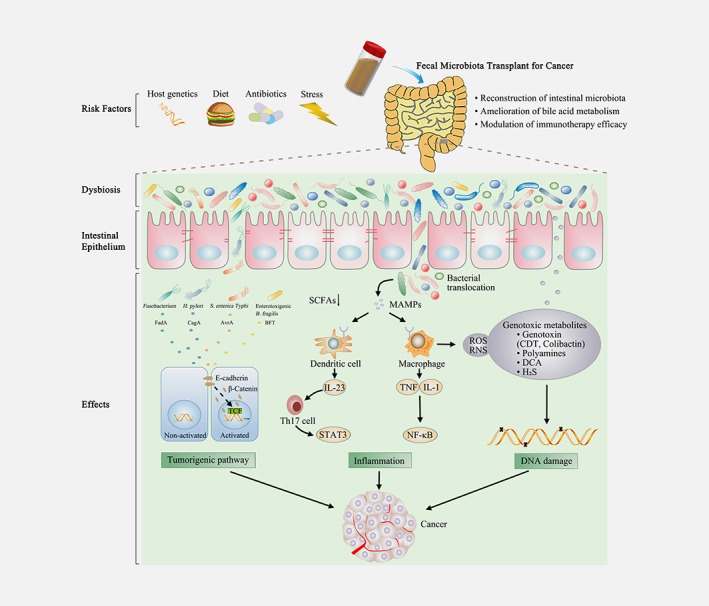
Management of cancer by fecal microbiota transplant. FMT represents a potential therapeutic strategy for cancer by reconstruction of intestinal microbiota, amelioration of bile acid metabolism and modulation of immunotherapy efficacy. Various factors such as host genetics, diet, antibiotics and stress could lead to alterations of gut microbiota, named as gut dysbiosis. Microbial dysbiosis and special bacteria in the gut are capable of affecting cancer development and progression via activating tumorigenic pathway, inducing inflammation and damaging host DNA. Special bacterial products, such as FadA toxin from Fusobacterium nucleatum, CagA protein from Helicobacter pylori, AvrA protein from S. enterica Typhi, and BFT from Enterotoxigenic Bacteroides fragilis can promote the separation of β‐catenin from E‐cadherin, which can trigger β‐catenin activation and contribute to tumorigenesis. The beneficial component in bacterial metabolites, such as SCFAs, is also decreased in microbial dysbiosis. Intestinal dysbiosis may be conducive to bacterial translocation, exerting pro‐inflammatory effects, which is mediated by MAMPs that activate TLRs in macrophages and dendritic cells. TLR signaling promotes the expression of the pro‐inflammatory factors, including IL‐23, TNF and IL‐1, thereby promoting carcinogenesis. Several microbial metabolites can directly or indirectly damage host DNA, fueling carcinogenesis. Special microbial toxins (CDT and colibactin) could directly induce DNA damage. Furthermore, gut bacteria also damage DNA indirectly via polyamines, DCA, ROS, RNS and H2S. FMT, fecal microbiota transplantation; BFT, Bacteroides fragilis toxin; SCFAs, short‐chain fatty acids; MAMP, microbe‐associated molecular pattern; TLR, Toll‐like receptor; IL‐23, interleukin 23; TNF, tumor necrosis factor; IL‐1, interleukin; Th17, T helper 17; STAT3, signal transducer and activator of transcription 3; NF‐κB, nuclear factor‐κB; CDT, cytolethal distending toxins; DCA, deoxycholic acid; H2S, hydrogen sulphide; RNS, reactive nitrogen species; ROS, reactive oxygen species. [Color figure can be viewed at wileyonlinelibrary.com]

References

    1. Sender R, Fuchs S, Milo R. Are we really vastly outnumbered? Revisiting the ratio of bacterial to host cells in humans. Cell 2016;164:337–40. - PubMed
    1. Lozupone CA, Stombaugh JI, Gordon JI, et al. Diversity, stability and resilience of the human gut microbiota. Nature 2012;489:220–30. - PMC - PubMed
    1. Wang L, Cao H, Liu L, et al. Activation of epidermal growth factor receptor mediates mucin production stimulated by p40, a lactobacillus rhamnosus GG‐derived protein. J Biol Chem 2014;289:20234–44. - PMC - PubMed
    1. Rooks MG, Garrett WS. Gut microbiota, metabolites and host immunity. Nat Rev Immunol 2016;16:341–52. - PMC - PubMed
    1. Cao H, Liu X, An Y, et al. Dysbiosis contributes to chronic constipation development via regulation of serotonin transporter in the intestine. Sci Rep 2017;7:10322. - PMC - PubMed

Publication types

MeSH terms