Review
. 2019 Sep:151:92-108.
doi: 10.1016/j.brainresbull.2018.10.016. Epub 2018 Nov 17.

Purinergic signaling in the retina: From development to disease

Affiliations
Review

Purinergic signaling in the retina: From development to disease

Ana Lucia Marques Ventura et al. Brain Res Bull. 2019 Sep.

Abstract

Retinal injuries and diseases are major causes of human disability involving vision impairment by the progressive and permanent loss of retinal neurons. During development, assembly of this tissue entails a successive and overlapping, signal-regulated engagement of complex events that include proliferation of progenitors, neurogenesis, cell death, neurochemical differentiation and synaptogenesis. During retinal damage, several of these events are re-activated with both protective and detrimental consequences. Purines and pyrimidines, along with their metabolites are emerging as important molecules regulating both retinal development and the tissue's responses to damage. The present review provides an overview of the purinergic signaling in the developing and injured retina. Recent findings on the presence of vesicular and channel-mediated ATP release by retinal and retinal pigment epithelial cells, adenosine synthesis and release, expression of receptors and intracellular signaling pathways activated by purinergic signaling in retinal cells are reported. The pathways by which purinergic receptors modulate retinal cell proliferation, migration and death of retinal cells during development and injury are summarized. The contribution of nucleotides to the self-repair of the injured zebrafish retina is also discussed.

Keywords: ATP; Adenosine; Nucleotides; P1 receptors; P2 receptors; Retina diseases.


Figures

Fig-1.
Fig-1.
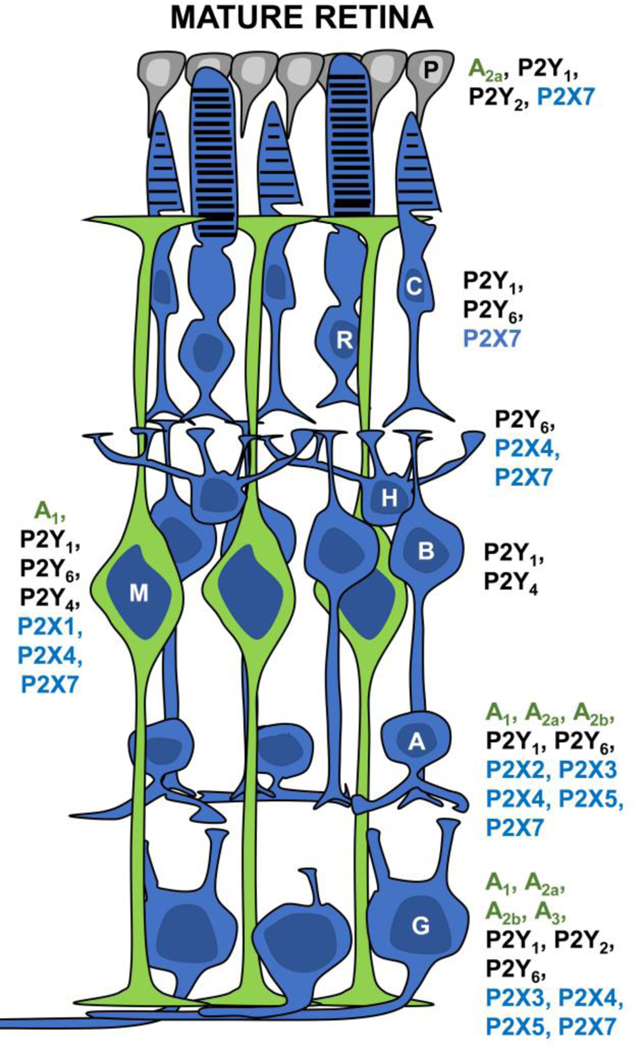
Schematic representation illustrating the expression of purinergic receptors in the adult retina and RPE. Cellular expression of P1 (green), P2Y (black) and P2X (blue) purinergic receptor subtypes is shown close to the indicated cell body of the retina cell type. P, Pigmented epithelium cell; R, rod cell; C, cone cell; H, horizontal cell; B, bipolar cell; M, Müller cell; A, amacrine cell; G, ganglion cell. Receptor subtype expression in the synaptic layers and cell processes is described in text (Section 3).
Fig.2.
Fig.2.
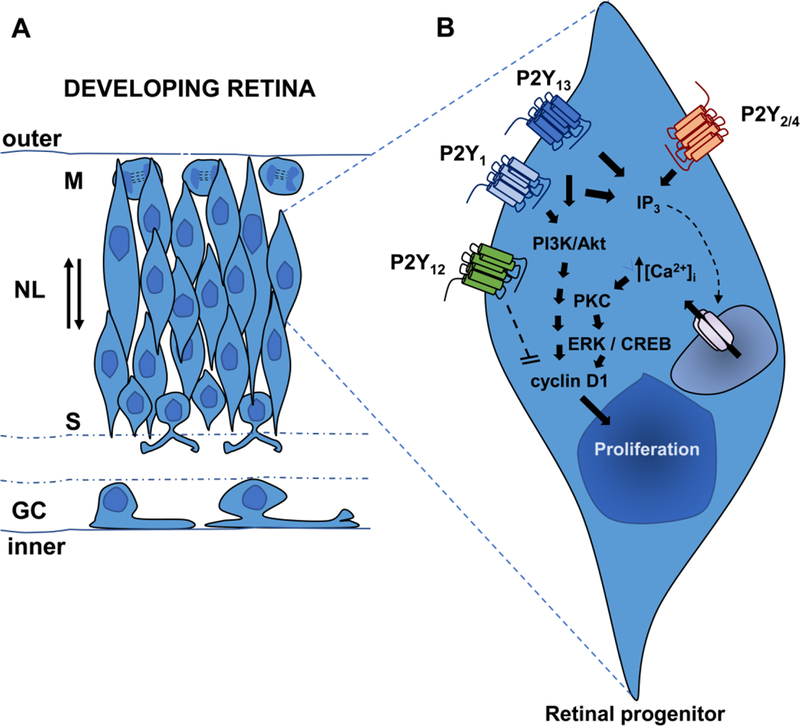
Schematic drawing illustrating progenitors undergoing interkinetic nuclear movement in the neuroblastic layer (NL) of the developing retina (A). Major nucleotide receptor subtypes and intracellular signaling pathways involved in cell proliferation in the developing retina (B). GC, Ganglion Cell Layer; S, S- phase; M, M-phase. See text for detailed discussion on the intracellular signaling pathways activated by nucleotides during retinal cell proliferation (Section 4).
Fig.3.
Fig.3.
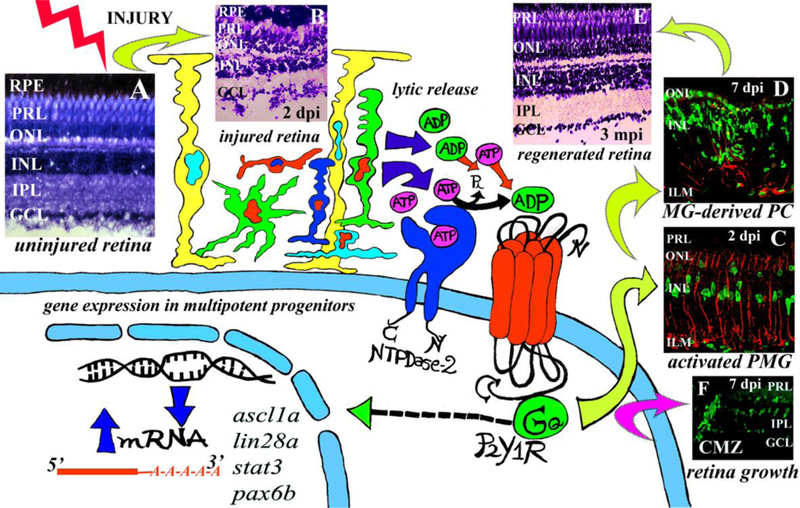
Extracellular adenine nucleotides, NTPDases and P2Y receptors are necessary signals to induce progenitor cell proliferation and retina repair in the injured zebrafish retina. (A) Histological image of an uninjured retina. Injury was induced with one injection within the vitreous of a cytotoxic agent (6 μM ouabain). Injury provokes retina cell death and lytic release of nucleotides. NTPDase2 hydrolyses ATP to produce extracellular ADP. P2Y1 receptor activation chiefly by ADP provokes pluripotency gene expression in progenitor Müller glia (PMG) and Müller glia-derived progenitor cells (MG-derived PC). (B) Histological image of a retina 2 days after injury (dpi) with ouabain. (C) Confocal image of a retina at 2 dpi. PMG mitotically activates shortly after injury. (D) Confocal image of a retina 7 dpi with ouabain. MG-derived progenitors greatly amplify between 5 to 7 dpi. (E) Retina repair is achieved around 3 months after injury (mpi). (F) Confocal image of a retina 7 dpi with ouabain. Progenitor cells in the ciliary marginal zone (CMZ) are activated showing enhanced retina growth after injury. In (C) and (D) GFAP-positive MG is depicted in red to show glial activation. In (C), (D) and (F) BrdU-positive proliferative nuclei are depicted in green. RPE: retinal pigment epithelium; PRL: photoreceptor segment layer; ONL: outer nuclear layer; INL: inner nuclear layer; IPL: inner plexiform layer; GCL: ganglion cell layer; ILM: inner limiting membrane.

References

    1. Agte S, Pannicke T, Ulbricht E, Reichenbach A, Bringmann A, 2017. Two different mechanosensitive calcium responses in Muller glial cells of the guinea pig retina: Differential dependence on purinergic receptor signaling. Glia 65(1), 62–74. - PubMed
    1. Ahmad S, Fatteh N, El-Sherbiny NM, Naime M, Ibrahim AS, El- Sherbini AM, El-Shafey SA, Khan S, Fulzele S, Gonzales J, Liou GI, 2013. Potential role of A2A adenosine receptor in traumatic optic neuropathy. J. Neuroimmunol. 264, 54–64. - PubMed
    1. Albalawi F, Lu W, Beckel JM Lim JC, McCaughey SA, Mitchell CH, 2017. The P2X7 Receptor Primes IL-1beta and the NLRP3 Inflammasome in Astrocytes Exposed to Mechanical Strain. Front. Cell Neurosci. 11, 227. - PMC - PubMed
    1. Almeida-Pereira L, Magalhães CF, Repossi MG, Thorstenberg MLP, Sholl-Franco A, Coutinho-Silva R, Ventura ALM, Fragel-Madeira F, 2017. Adenine nucleotides control proliferation in vivo of rat retinal progenitors by P2Y1 receptor. Molec. Neurobiol. 54(7), 5142–5155. - PubMed
    1. Almeida-Pereira L, Repossi MG, Magalhães CF, Azevedo RF, Corrêa- Velloso JC, Ulrich H, Ventura ALM, Fragel-Madeira L, 2018. P2Y12 but not P2Y13 Purinergic Receptor Controls Postnatal Rat Retinogenesis In Vivo. Molec. Neurobiol. DOI 10.1007/s12035-018-1012-1. - DOI - PubMed

Publication types