


Targeted gene panel for genetic testing of south Indian children with steroid resistant nephrotic syndrome
- PMID: 30458709
- PMCID: PMC6245897
- DOI: 10.1186/s12881-018-0714-6
Targeted gene panel for genetic testing of south Indian children with steroid resistant nephrotic syndrome
Abstract
Background: Steroid resistant nephrotic syndrome (SRNS) is a genetically heterogeneous disease with significant phenotypic variability. More than 53 podocyte-expressed genes are implicated in SRNS which complicates the routine use of genetic screening in the clinic. Next generation sequencing technology (NGS) allows rapid screening of multiple genes in large number of patients in a cost-effective manner.
Methods: We developed a targeted panel of 17 genes to determine relative frequency of mutations in south Indian ethnicity and feasibility of using the assay in a clinical setting. Twenty-five children with SRNS and 3 healthy individuals were screened.
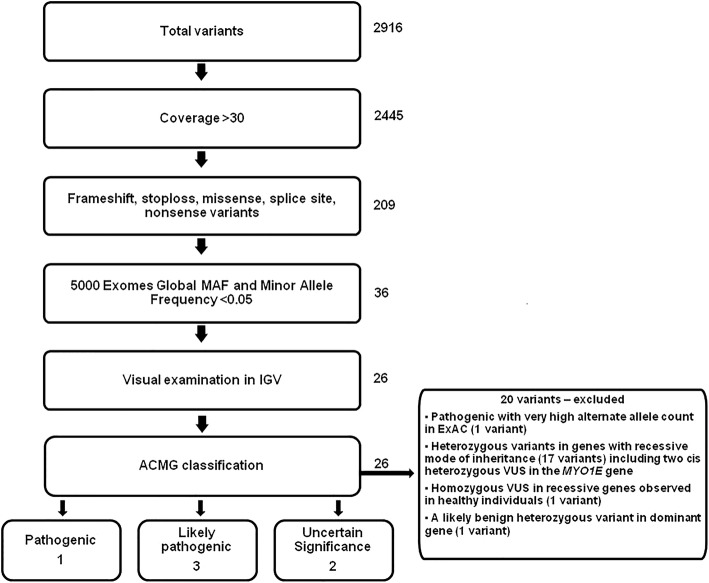
Results: In this study, novel variants including 1 pathogenic variant (2 patients) and 3 likely pathogenic variants (3 patients) were identified. In addition, 2 novel variants of unknown significance (VUS) in 2 patients (8% of total patients) were also identified.
Conclusions: The results show that genetic screening in SRNS using NGS is feasible in a clinical setting. However the panel needs to be screened in a larger cohort of children with SRNS in order to assess the utility of the customised targeted panel in Indian children with SRNS. Determining the prevalence of variants in Indian population and improvising the bioinformatics-based filtering strategy for a more accurate differentiation of pathogenic variants from those that are benign among the VUS will help in improving medical and genetic counselling in SRNS.
Keywords: Indian population; NGS; SRNS; Targeted re-sequencing.
Conflict of interest statement
Ethics approval and consent to participate
The Institutional Ethics Committee, St. John’s Medical College, Bangalore, India, approved the study and all participants were recruited after informed consent. The approval number for the study was 171/ 2012. Parents of the children (under the age of 16) consented to participate in the study.
Consent for publication
Not applicable.
Competing interests
The authors declare that they have no competing interest.
Publisher’s Note
Springer Nature remains neutral with regard to jurisdictional claims in published maps and institutional affiliations.
Figures
References
-
- Mekahli D, Liutkus A, Ranchin B, Yu A, Bessenay L, Girardin E, Van Damme-Lombaerts R, Palcoux J-B, Cachat F, Lavocat M-P, Bourdat-Michel G, Nobili F, Cochat P. Long-term outcome of idiopathic steroid-resistant nephrotic syndrome: a multicenter study. Pediatr Nephrol. 2009;24:1525–1532. doi: 10.1007/s00467-009-1138-5. - DOI - PubMed
-
- Ding WY, Koziell A, McCarthy HJ, Bierzynska A, Bhagavatula MK, Dudley JA, Inward CD, Coward RJ, Tizard J, Reid C, Antignac C, Boyer O, Saleem MA. Initial steroid sensitivity in children with steroid-resistant nephrotic syndrome predicts post-transplant recurrence. J Am Soc Nephrol. 2014;25:1342–1348. doi: 10.1681/ASN.2013080852. - DOI - PMC - PubMed
-
- Bierzynska A, McCarthy HJ, Soderquest K, Sen ES, Colby E, Ding WY, Nabhan MM, Kerecuk L, Hegde S, Hughes D, Marks S, Feather S, Jones C, Webb NJA, Ognjanovic M, Christian M, Gilbert RD, Sinha MD, Lord GM, Simpson M, Koziell AB, Welsh GI, Saleem MA. Genomic and clinical profiling of a national nephrotic syndrome cohort advocates a precision medicine approach to disease management. Kidney Int. 2017;94:884–890. - PubMed
-
- Sen ES, Dean P, Yarram-Smith L, Bierzynska A, Woodward G, Buxton C, Dennis G, Welsh GI, Williams M, Saleem MA. Clinical genetic testing using a custom-designed steroid-resistant nephrotic syndrome gene panel: analysis and recommendations. J Med Genet. 2017;54(12):795–804. doi: 10.1136/jmedgenet-2017-104811. - DOI - PMC - PubMed
Publication types
MeSH terms
Substances
Supplementary concepts
LinkOut - more resources
Full Text Sources
Medical
