


Examining the relationship of vaping to smoking initiation among US youth and young adults: a reality check
- PMID: 30459182
- PMCID: PMC6860409
- DOI: 10.1136/tobaccocontrol-2018-054446
Examining the relationship of vaping to smoking initiation among US youth and young adults: a reality check
Abstract
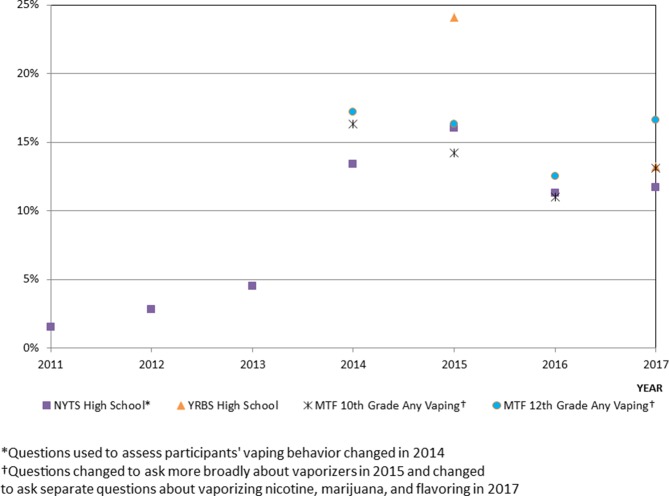
Background: The 2018 National Academies of Sciences, Engineering, and Medicine Report found substantial evidence that electronic cigarette use (vaping) by youth is strongly associated with an increased risk of ever using cigarettes (smoking) and moderately associated with progressing to more established smoking. However, the Report also noted that recent increases in vaping have been associated with declining rates of youth smoking. This paper examines the temporal relationship between vaping and youth smoking using multiple data sets to explore the question of whether vaping promotes smoking initiation in the USA.
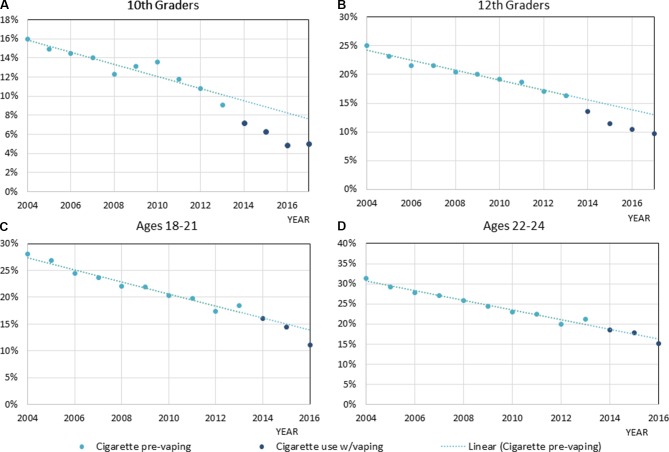
Methods: Using publicly available, nationally representative data on smoking and vaping among youth and young adults, we conducted a trend line analysis of deviations from long-term trends in smoking starting from when vaping became more prevalent.
Results: There was a substantial increase in youth vaping prevalence beginning in about 2014. Time trend analyses showed that the decline in past 30-day smoking prevalence accelerated by two to four times after 2014. Indicators of more established smoking rates, including the proportion of daily smokers among past 30-day smokers, also decreased more rapidly as vaping became more prevalent.
Conclusions: The inverse relationship between vaping and smoking was robust across different data sets for both youth and young adults and for current and more established smoking. While trying electronic cigarettes may causally increase smoking among some youth, the aggregate effect at the population level appears to be negligible given the reduction in smoking initiation during the period of vaping's ascendance.
Keywords: electronic nicotine delivery devices; harm reduction; surveillance and monitoring.
© Author(s) (or their employer(s)) 2019. Re-use permitted under CC BY-NC. No commercial re-use. See rights and permissions. Published by BMJ.
Conflict of interest statement
Competing interests: MLG was a member of the National Academies of Sciences, Engineering, and Medicine (NASEM) Committee on the Review of the Health Effects of Electronic Nicotine Delivery Systems who wrote the report. The report was funded by the Food and Drug Administration (FDA), but the FDA was not involved in the drafting or review of the NASEM Report or this manuscript. The policy implications written in this manuscript are the views of the authors and do not necessarily represent the views of the other members of the Committee, the NASEM or the FDA. MLG also received a research grant and served as an advisory board member to pharmaceutical companies that manufacture smoking cessation medications. KMC and DH have served as an expert witness in litigation against the cigarette industry.
Figures
References
-
- Academy of Sciences Enigneering and Medicine. Public Health Consequences of E-Cigarettes. Washington, DC: The National Academies Press, 2018. - PubMed
-
- U.S. Department of Health and Human Services. E-Cigarette Use Among Youth and Young Adults. A Report of the Surgeon General. Atlanta, GA: U.S. Department of Health and Human Services, 2016.
Publication types
MeSH terms
Grants and funding
LinkOut - more resources
Full Text Sources
Medical
Miscellaneous
