. 2018 Nov 20;9(6):e02248-18.
doi: 10.1128/mBio.02248-18.

Diagnostic Potential and Interactive Dynamics of the Colorectal Cancer Virome

Affiliations

Diagnostic Potential and Interactive Dynamics of the Colorectal Cancer Virome

Geoffrey D Hannigan et al. mBio. .

Abstract

Human viruses (those that infect human cells) have been associated with many cancers, largely due to their mutagenic and functionally manipulative abilities. Despite this, cancer microbiome studies have focused almost exclusively on bacteria instead of viruses. We began evaluating the cancer virome by focusing on colorectal cancer, a primary cause of morbidity and mortality throughout the world and a cancer linked to altered colonic bacterial community compositions but with an unknown association with the gut virome. We used 16S rRNA gene, whole shotgun metagenomic, and purified virus metagenomic sequencing of stool to evaluate the differences in human colorectal cancer virus and bacterial community composition. Through random forest modeling, we identified differences in the healthy and colorectal cancer viromes. The cancer-associated virome consisted primarily of temperate bacteriophages that were also predicted to be bacterium-virus community network hubs. These results provide foundational evidence that bacteriophage communities are associated with colorectal cancer and potentially impact cancer progression by altering the bacterial host communities.IMPORTANCE Colorectal cancer is a leading cause of cancer-related death in the United States and worldwide. Its risk and severity have been linked to colonic bacterial community composition. Although human-specific viruses have been linked to other cancers and diseases, little is known about colorectal cancer virus communities. We addressed this knowledge gap by identifying differences in colonic virus communities in the stool of colorectal cancer patients and how they compared to bacterial community differences. The results suggested an indirect role for the virome in impacting colorectal cancer by modulating the associated bacterial community. These findings both support the idea of a biological role for viruses in colorectal cancer and provide a new understanding of basic colorectal cancer etiology.

Keywords: bacteriophage; colorectal cancer; diagnostic; microbial ecology; microbiome; microbiota; random forest; virome.


Figures

FIG 1
FIG 1
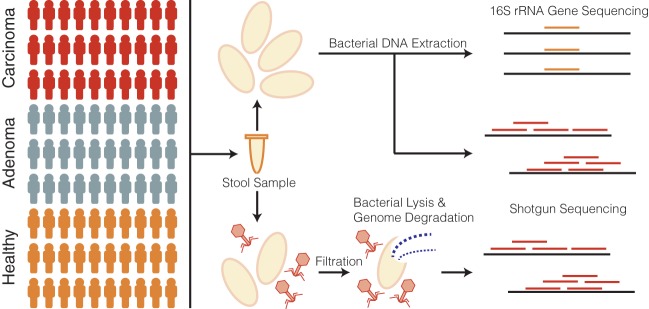
Cohort and sample processing outline. Thirty subject stool samples were collected from healthy subjects and adenoma (precancer) and carcinoma (cancer) patients. Stool samples were split into two aliquots, the first of which was used for bacterial sequencing and the second of which was used for virus sequencing. Bacterial sequencing was done using both 16S rRNA amplicon and whole-metagenomic shotgun sequencing techniques. Virus samples were purified for viruses using filtration and a combination of chloroform (bacterial lysis) and DNase (exposed genomic DNA degradation). The resulting encapsulated virus DNA was sequenced using whole-metagenomic shotgun sequencing.
FIG 2
FIG 2
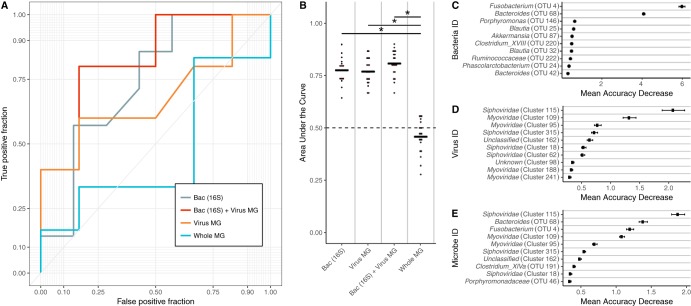
Results from healthy versus cancer classification models built using virome signatures, bacterial 16S rRNA gene sequence signatures, whole-metagenomic signatures, and a combination of virome and 16S rRNA gene sequence signatures. (A) An example receiver operating characteristic (ROC) curve for visualizing the performance of each of the models for classifying stool as coming from either an individual with a cancerous colon or an individual with a healthy colon. (B) Quantification of the AUC variation for each model and how it compared to each of the other models based on 15 iterations. A pairwise Wilcoxon test with a false-discovery-rate multiple-hypothesis correction demonstrated that all models are significantly different from each other (P value < 0.01). (C) Mean decrease in accuracy (measurement of importance) of each operational taxonomic unit within the 16S rRNA gene classification model when removed from the classification model. The mean is represented by a point, and bars represent standard errors. ID, identifier. (D) Mean decrease in accuracy of each operational virus unit in the virome classification model. (E) Mean decrease in accuracy of each operational genomic unit and operational taxonomic unit in the model using both 16S rRNA gene and virome features.
FIG 3
FIG 3
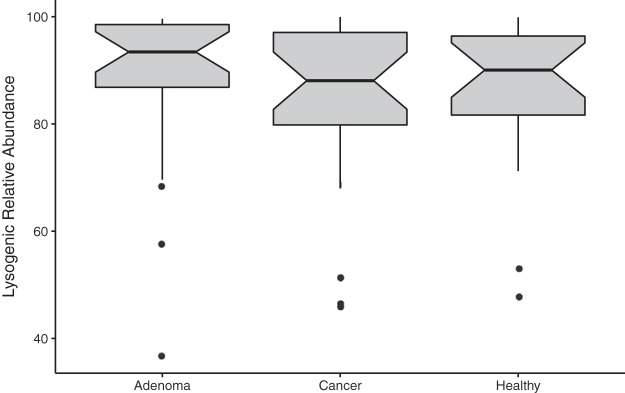
Lysogenic phage relative abundance in disease states. Phage OVUs were predicted to be either lytic or lysogenic, and the relative abundances of lysogenic phages were quantified and are represented as a box plot. None of the data from the disease groups were statistically significant.
FIG 4
FIG 4
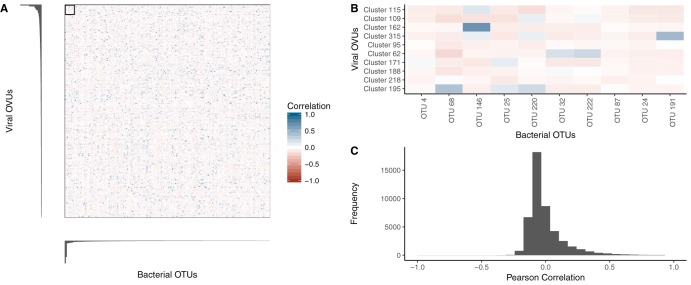
Relative-abundance correlations between bacterial OTUs and virome OVUs. (A) Pearson correlation coefficient values from comparisons between all bacterial OTUs (x axis) and viral OVUs (y axis), with blue representing positive correlations and red representing negative correlations. Bar plots indicate the levels of viral (left) and bacterial (bottom) operational unit importance in their colorectal cancer classification models, such that the most important units are shown in the top left corner. (B) Magnification of the boxed region in panel A, highlighting the correlation between the most important bacterial OTUs and virome OVUs. The most important operational units are shown in the top left corner of the heat map, and the correlation scale is the same as in panel A. (C) Histogram quantifying the frequencies of Pearson correlation coefficients between all bacterial OTUs and virome OVUs.
FIG 5
FIG 5
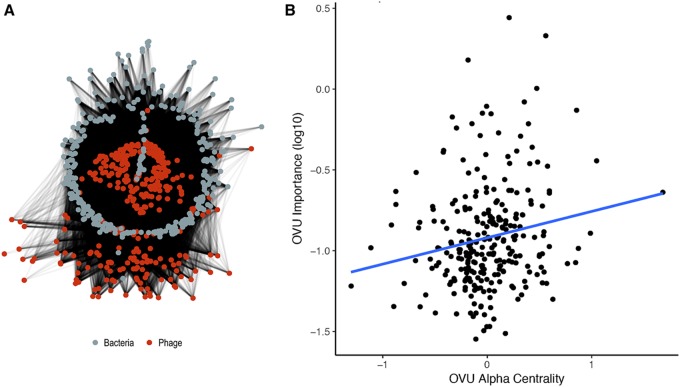
Community network analysis utilizing predicted interactions between bacterial and phage operational genomic units. (A) Visualization of the community network for our colorectal cancer cohort. (B) Scatter plot illustrating the correlation between importance (mean decrease in accuracy) and the degree of centrality for each OVU. A linear regression line was fitted to illustrate the correlations (blue) found to be statistically significantly and weakly correlated (P value = 0.00409, R = 0.176).
FIG 6
FIG 6
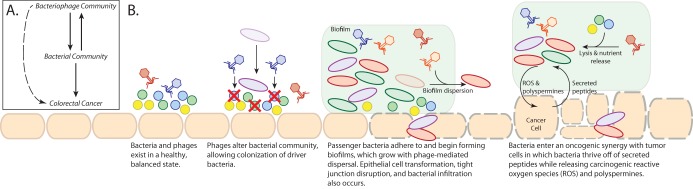
Final working hypothesis from this study. These panels summarize our thoughts on our results and represent interesting future directions that we predict will build on the presented work. (A) Basic model illustrating the connections between the virome, bacterial communities, and colorectal cancer. (B) Working hypothesis of how the bacteriophage community is associated with colorectal cancer and the associated bacterial community. ROS, reactive oxygen species.

Comment in

References

    1. Feng H, Shuda M, Chang Y, Moore PS. 2008. Clonal integration of a polyomavirus in human Merkel cell carcinoma. Science 319:1096–1100. doi: 10.1126/science.1152586. - DOI - PMC - PubMed
    1. Shuda M, Kwun HJ, Feng H, Chang Y, Moore PS. 2011. Human Merkel cell polyomavirus small T antigen is an oncoprotein targeting the 4E-BP1 translation regulator. J Clin Invest 121:3623–3634. doi: 10.1172/JCI46323. - DOI - PMC - PubMed
    1. Schiller JT, Castellsagué X, Garland SM. 2012. A review of clinical trials of human papillomavirus prophylactic vaccines. Vaccine 30:F123–F138. doi: 10.1016/j.vaccine.2012.04.108. - DOI - PMC - PubMed
    1. Chang Y, Cesarman E, Pessin MS, Lee F, Culpepper J, Knowles DM, Moore PS. 1994. Identification of herpesvirus-like DNA sequences in AIDS-associated Kaposi’s sarcoma. Science 266:1865–1869. doi: 10.1126/science.7997879. - DOI - PubMed
    1. Harcombe WR, Bull JJ. 2005. Impact of phages on two-species bacterial communities. Appl Environ Microbiol 71:5254–5259. doi: 10.1128/AEM.71.9.5254-5259.2005. - DOI - PMC - PubMed

Publication types

Substances