. 2018 Nov 20;9(1):4891.
doi: 10.1038/s41467-018-07290-y.

Bimodal sensing of guidance cues in mechanically distinct microenvironments

Affiliations

Bimodal sensing of guidance cues in mechanically distinct microenvironments

Erdem D Tabdanov et al. Nat Commun. .

Abstract

Contact guidance due to extracellular matrix architecture is a key regulator of carcinoma invasion and metastasis, yet our understanding of how cells sense guidance cues is limited. Here, using a platform with variable stiffness that facilitates uniaxial or biaxial matrix cues, or competing E-cadherin adhesions, we demonstrate distinct mechanoresponsive behavior. Through disruption of traction forces, we observe a profound phenotypic shift towards a mode of dendritic protrusion and identify bimodal processes that govern guidance sensing. In contractile cells, guidance sensing is strongly dependent on formins and FAK signaling and can be perturbed by disrupting microtubule dynamics, while low traction conditions initiate fluidic-like dendritic protrusions that are dependent on Arp2/3. Concomitant disruption of these bimodal mechanisms completely abrogates the contact guidance response. Thus, guidance sensing in carcinoma cells depends on both environment architecture and mechanical properties and targeting the bimodal responses may provide a rational strategy for disrupting metastatic behavior.


Conflict of interest statement

The authors declare no competing interests.

Figures
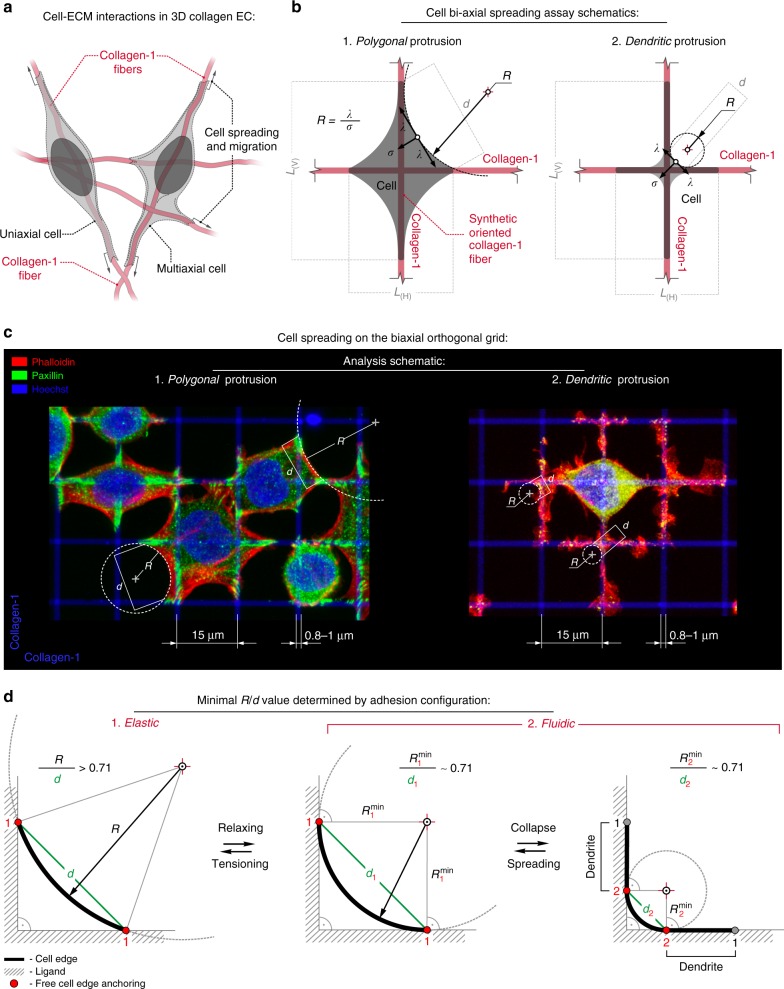
Fig. 1
Fig. 1
Biomimetic platform to define directional and mechanical guidance cues. a Schematic of prominent cell adhesion interactions in 3D fibrous microenvironments. b Schematic of the range of cellular responses to biaxial cues from orthogonally oriented type I collagen lines. See also Supplementary Figure 1 that describes the uniaxial guidance cues employed in this study, which represent anisotropic oriented collagen fibers versus biaxial cues that model non-oriented fibrous matrices. We note that both of these are distinct from quasi-2D conditions that result from closely spaced nanolines. To quantify the mechanical response to soft and stiff substrates, we employ a 2D Laplace law model that describes the relationship between cell shape and cell tension. In the Laplace model, free cell edge curvature radii reflect the balance between the internal tension σ and linear cell edge tension λ following R = λ/σ, where larger R correlates with greater forces at adhesion sites. c Examples of distinct cell architectures (3D reconstructions), corresponding to the schematics outlined in b that we show here can emerge in response to biaxial guidance cues and specific mechanical relationships between the cell and matrix. For analysis of cell mechanics with a 2D Laplace law formulation, the orthogonal guidance cues determine the minimal R/d value (~0.71) for any spanning distance d. For more dominantly elastic behavior, R/d is >0.71 and a polygonal phenotype dominates. In contrast, instability emerges as R/d is at or near the minimum value where protrusions collapse onto the orthogonal lines resulting in more fluidic-like protrusion behavior with a dendritic phenotype
Fig. 2
Fig. 2
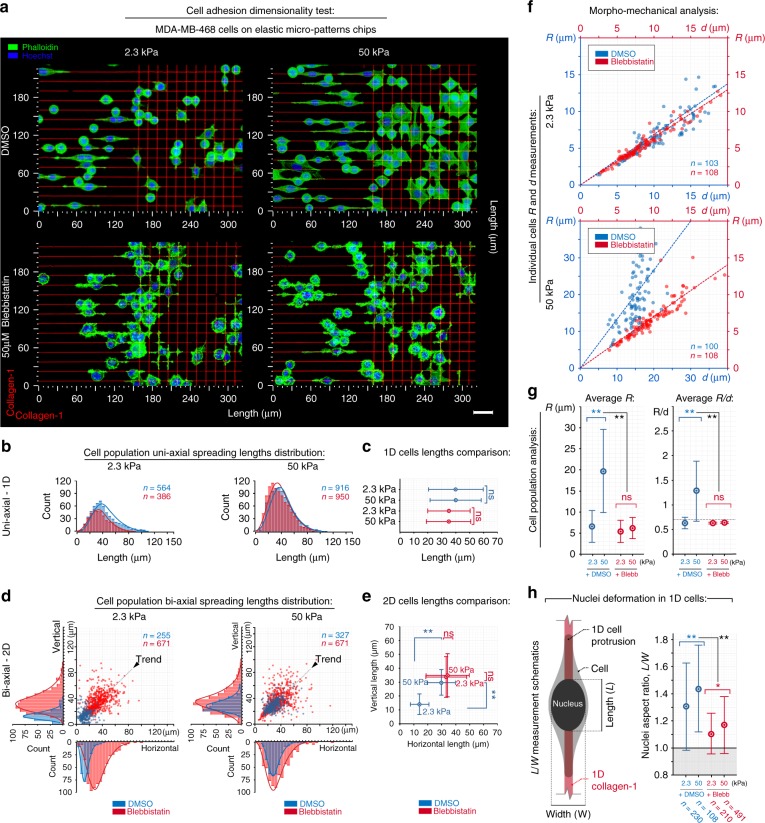
ECM dimensionality and stiffness influence guidance sensing. a MDA-MB-468 breast carcinoma cells sensing and protruding along uniaxial collagen lines that mimic aligned fibers and biaxial cues to mimic fiber networks (left and right halves of each micrograph, respectively; 3D reconstructions) on soft (2.3 kPa) and stiff (50 kPa) substrates under control (DMSO, Supplementary Movies 1,2,3) and blebbistatin-treated conditions. Blebbistatin-treated cells display a dendritic protrusion phenotype in response to uniaxial (Supplementary Movie 4) and biaxial (Supplementary Movie 5) cues on both soft and stiff substrates, suggesting the presence of a bimodal response to guidance cues that depends on cell traction stress magnitudes. b, c Morphometric analysis of cells on soft and stiff uniaxial guidance cues for control conditions (blue) and blebbistatin treatment (red). For both conditions, uniaxial collagen lines induce a robust guidance response with no significant differences in cell protrusion between soft and stiff substrates. All corresponding n values in c are shown in b. d, e Morphometric analysis of cells interacting with biaxial guidance cues in control (blue) and blebbistatin-treated conditions (red), with significantly greater protrusion on stiff versus soft substrates for control cells. Blebbistatin-treated cells display no detectable difference in their biaxial guidance response on soft and stiff substrates. All corresponding n values in e are shown on d. f, g Morpho-mechanical analysis of cells of soft and stiff substrates showing significantly higher values for both R and R/d metrics in response to stiff substrates, representative of higher cell traction forces in response to stiff substrates. In contrast, soft substrates or inhibition of contractile forces result in low R values and mean R/d values near the threshold for elastic cell behavior. All corresponding n values and individual data points in g are shown in f. h Nuclei deformation, where lateral compression results from cell tension alignment, as a reference for contractile force magnitude. Scale bar in a—15 µm. Corresponding n values are shown on the plots. Number of replicates (independent experiments) for all measurements N = 4. Data in c, e, g, h are mean ± s.d.; ns: no significant difference between groups; *p < 0.05, **p < 0.001 (ANOVA)
Fig. 3
Fig. 3
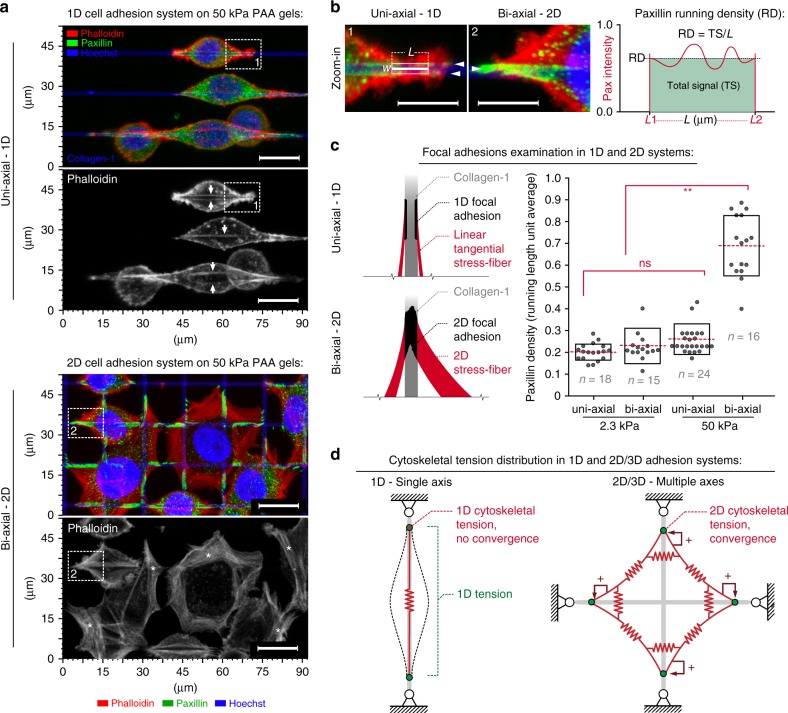
Cell adhesion and mechanical responses to distinct guidance cue dimensionality and rigidity. a Fluorescence 3D reconstruction micrographs of F-actin (phalloidin—red), FAs (paxillin—green), and nuclei (Hoechst—blue) on stiff uniaxial and biaxial platforms reveal a more robust development of the FA and stress-fiber contractile apparatus in response to biaxial cues versus 1D cues. White arrows (top panel) highlight actin fibers. Boxes 1 and 2 are zoomed-in regions shown in b. b Zoomed-in apical regions shown in a. Arrowheads highlight prominent FA development homogeneously filling the line in response to biaxial cues (2) while paxillin distribution for uniaxial cues is more localized at the line edges (1). To capture differences in FAs, we employ a metric of running length density. Paxillin running density is an “intensive” parameter that reflects the total paxillin signal per micron of length along collagen guidance cue axes to characterizes the build-up of FAs in terms of structural density, maturity, and level of integration with contractile stress-fibers (see right panel). c Schematic representation of the observed FA and corresponding stress-fiber architectures for cells encountering uniaxial or biaxial cues and quantification of FA running length densities for soft and stiff 1D and biaxial substrates (**p < 0.001). d Model of the cell mechanical response during sensing of uniaxial and biaxial cues. The uniaxial guidance cues result in highly anisotropic forces guided along adhesions and the actin fiber cytoskeleton (CSK) that are co-aligned with the uniaxial cues such that linear tension (λ) is distributed along the CSK structure. In contrast, biaxial cues provide opposing forces across a wide range of angles and adhesion sites resulting in robust mechanical feedback loops that promote traction stresses, FA maturation, and stress-fiber formation, inducing robust linear tension along arcs and formation of associated stress-fibers (bottom panels of a) that converge to generate higher stress magnitudes at FAs. Scale bars—15 µm. Corresponding n values are shown on the plot. Number of replicates (independent experiments) for all measurements N = 2. Data in c are mean ± s.d (boxes); ns indicates no significant difference between groups; *p < 0.05, **p < 0.001 (ANOVA)
Fig. 4
Fig. 4
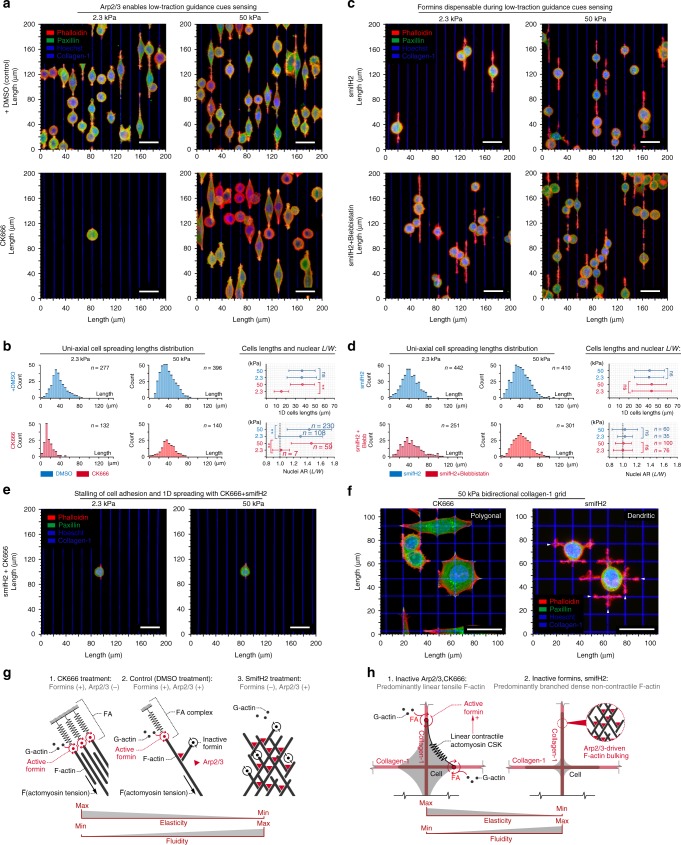
Bimodal sensing of uniaxial contact guidance cues. a Carcinoma cells sense soft (2.3 kPa, Supplementary Movie 1) and stiff (50 kPa, Supplementary Movie 2) uniaxial matrix (top panels; 3D reconstruction). Following Arp2/3 inhibition (bottom panels), cells do not respond to soft uniaxial cues (Supplementary Movie 8) but protrude along stiff substrates (Supplementary Movie 9; Supplementary Figure 4b). b Morphometric analysis of cells on soft and stiff uniaxial guidance cues in control (blue) and CK666-treated conditions (red) showing significantly reduced guidance sensing following Arp2/3 inhibition on soft substrates, where traction forces are relatively low but not on stiff matrix. Likewise, greater nuclei deformation, representative of cell contractility, is observed on stiff substrates, where no difference is observed between control and Arp2/3-inhibited cells, while Arp2/3-inhibited cells on soft substrates show no nuclei deformation (AR ~ 1). c Cells sense soft and stiff uniaxial matrix under formin inhibition (top panels) using the low-traction dendritic protrusion phenotype (3D reconstruction; confirmed by adding blebbistatin—bottom panels). d Morphometric analysis of cells on soft and stiff uniaxial cues with smifH2 (blue) or smifH2+blebbistatin (red). Lack of nuclei deformation (AR ~ 1) highlights the loss of traction from disruption of the force transmission linkage (formins) or motor activity (blebbistatin). e Simultaneous inhibition of the formin-dependent traction-driven and Arp2/3-dependent traction-independent modes of guidance sensing completely abrogates the cell contact guidance response. f Carcinoma cells respond to stiff biaxial cues following Arp2/3 inhibition (Supplementary Movie 12) but switch to the low-traction dendritic protrusion phenotype (white arrowheads) under formin inhibition (Supplementary Movies 10 and 11). g Modalities of F-actin polymerization and cell protrusion. Abrogation of formins leads to solely Arp2/3-driven F-actin polymerization (branching), resulting in dense F-actin bulking that conforms to guidance cues (more fluidic-like behavior). Suppression of Arp2/3 shifts cells to formin-dependent behavior with linear F-actin transmitting forces (elastic dynamics). h Schematics for polygonal and dendritic spreading dynamics controlled by formins and Arp2/3. Scale bars—30 µm. Corresponding n values are shown on the plots. Number of replicates (independent experiments) for all measurements N = 4. Data in b, d are mean ± s.d., ns: no significant difference between groups, *p < 0.05, **p < 0.001 (ANOVA)
Fig. 5
Fig. 5
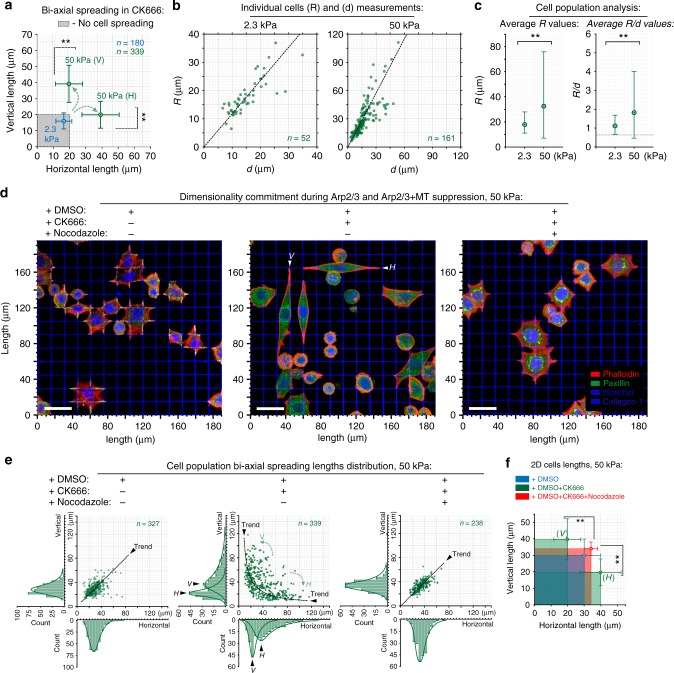
Arp2/3 suppression promotes a microtubule-dependent uniaxial guidance response. a MDA-MB-468 breast carcinoma cells under Arp2/3 complex inhibition (+CK666) sense soft (2.3 kPa) and stiff (50 kPa, Supplementary Movie 12) biaxial collagen guidance cues. Note that cell populations on stiff substrates split into vertical and horizontal cell subpopulations (V vertical cells, H horizontal cells). b Morpho-mechanical analysis of cells populations under Arp2/3 inhibition conditions on soft and stiff biaxial cues: free cell edge curvature radii, R. c Average values of R and R/d in cell under Arp2/3 complex inhibition, showing increased traction on stiffer substrates (see Fig. 2g for comparison). The corresponding n values are shown on b. d, e 3D reconstruction overviews and morphometric analysis of the Arp2/3-inhibited cell population response to biaxial guidance cues. Inactivation of Arp2/3 (+CK666) induces non-equidirectional cell protrusion with random cell commitment to either of the two orthogonal directions (i.e., a uniaxial response). Disruption of intact microtubules in cells with suppressed Arp2/3 complex (+ CK666+nocodazole) rescues biaxial cell spreading. f Average values of cell lengths from protrusion for each of the conditions in d, e (see color code). The corresponding n values are shown on e. Scale bars—30 µm. All corresponding n values are shown on the plots. Number of replicates (independent experiments) for all measurements N = 4. Data in a, c, f are mean ± s.d.; ns: no significant difference between groups; *p < 0.05, **p < 0.001 (c: unpaired t test; a, f: ANOVA)
Fig. 6
Fig. 6
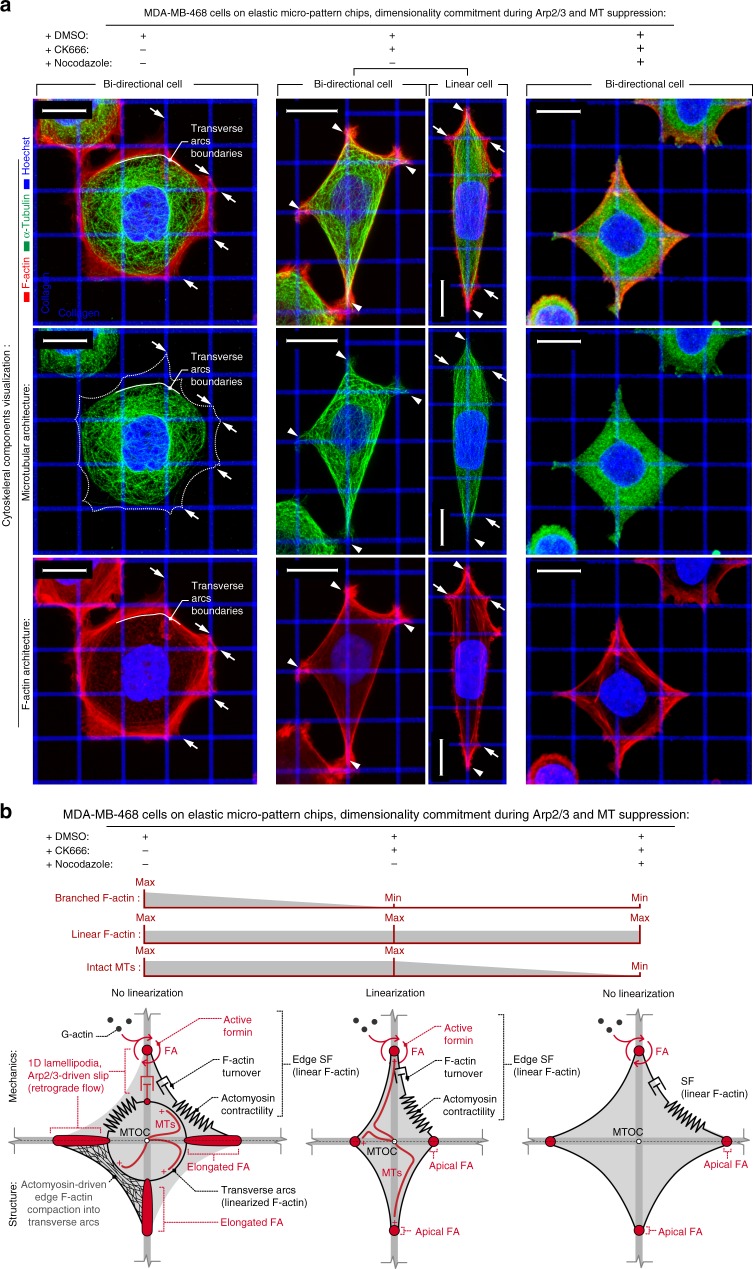
Arp2/3 suppression-induced cytoskeletal and cell architecture reorganization. a 3D reconstructions of MDA-MB-468 cells in control (+DMSO), under Arp2/3 inhibition (+CK666), and Arp2/3 inhibition without intact microtubules (+nocodazole+CK666). Control cells develop peripheral stress-fibers and also transverse arcs (see also Figs. 1c and 3a) that spatially coincide with boundaries of microtubular network, preventing microtubule localization at the cell spreading apices (white arrows), whereas Arp2/3 inhibition shifts the balance toward peripheral stress-fibers and formation of concentrated FAs at the cell periphery at points of the cell–matrix interface (see also Fig. 4f and Supplementary Figure 6). Furthermore, in Arp2/3-abrogated cells, the microtubule network conforms to the boundaries to the peripheral stress-fibers and cell apices (white arrowheads). In contrast, no intact microtubule networks are observed after nocodazole treatment. b Schematic representation of actomyosin and microtubular cytoskeleton components in control cells and in cells under Arp2/3 (±intact MTs) inhibition conditions. Note actomyosin contractility along the peripheral stress-fibers and its compaction along the transverse arcs where the transverse arcs boundaries prevent microtubule localization to the cell adhesion boundaries in control cells. Arp2/3 inhibition causes suppression of transverse arcs, allowing the microtubule network to connect to the cell adhesion boundaries, resulting in more isolated peripheral stress-fibers and diminished 1D lamellipodia slip. Removal of intact MT network rescues cells from CK666-mediated uniaxial linearization. Scale bars—15 µm
Fig. 7
Fig. 7
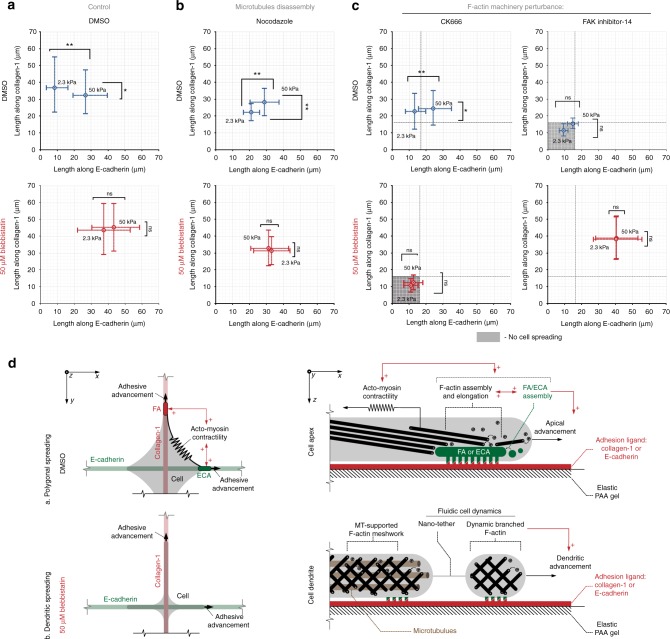
Guidance and stiffness sensing on competing cell–ECM and cell–cell interactions. ad 3D reconstructions of MDA-MB-468 cells spreading on the collagen (vertical, red) versus E-cadherin (horizontal, green) orthogonal elastic grids. a MDA-MB-468 breast carcinoma cell sensing and protruding along competing collagen and E-cadherin cues on soft (2.3 kPa) and stiff (50 kPa) substrates under control conditions and in the presence of blebbistatin, where the dendritic protrusion phenotype emerges in response to both collagen and E-cadherin. Note that cells on soft substrates do not respond to E-cadherin cues. bd Breast carcinoma cell response to collagen and E-cadherin cues on soft and stiff substrates in response to b microtubule disruption (nocodazole), c Arp2/3 inhibition, or d FAK inhibition, with ±blebbistatin treatment for each condition. Following microtubule disruption, cells are no longer biased along collagen on soft substrates but instead respond to both collagen and E-cadherin ligands on both soft and stiff substrates. Inhibition of Arp2/3 complex does not substantially impact contractile cells but ablates low-traction-dependent dendritic protrusions along both collagen and E-cadherin while inhibition of FAK disrupts the guidance sensing response in contractile cells but is dispensable for Arp2/3-dependent dendritic protrusion. e Morpho-mechanical analysis of cells on soft and stiff substrates for each experimental condition. Note, we define cells with R > 10 µm as polygonal and cells with R < 10 µm as dendritic, consistent with the lower limit for R/d as ~0.71. The corresponding n values are shown in Supplementary Figure 10a. Scale bars—15 µm. Number of replicates (independent experiments) for all measurements N = 5. Data in e are mean ± s.d.; ns: no significant difference between groups; *p < 0.05, **p < 0.001 (ANOVA). See also Supplementary Figure 10a for the raw data of population-wide distribution of individual R and d measurements
Fig. 8
Fig. 8
Physical and molecular mechanisms governing bimodal sensing of contact guidance cues in carcinoma cells. ac Summary of the bimodal cellular guidance sensing response for a control conditions, b disruption of microtubules, and c Arp2/3 and FAK inhibition, respectively, demonstrating a bimodal response for sensing guidance cues that depends on the magnitude of cell traction forces and two parallel contractile force-dependent mechanisms where FAK regulates the response in contractile cells and Arp2/3 regulates sensing in the low-traction state. The corresponding n values for ac are shown in Supplementary Figure 10b. d Model of the carcinoma cell-sensing response in the contractile elastic state and the more fluidic-like, low-traction dendritic state where protrusive forces from branched actin network dynamics drive adhesion-directed sensing of guidance cues. Number of replicates (independent experiments) for all measurement N = 5. Data are mean ± s.d., ns: no significant difference between groups, *p < 0.05, **p < 0.001 (ANOVA). See also Supplementary Figure 10b for the raw data of population-wide individual cell spreading length measurements compiled into distribution diagrams

References

    1. Daley WP, Yamada KM. ECM-modulated cellular dynamics as a driving force for tissue morphogenesis. Curr. Opin. Genet. Dev. 2013;23:408–414. doi: 10.1016/j.gde.2013.05.005. - DOI - PMC - PubMed
    1. Rose DM, Alon R, Ginsberg MH. Integrin modulation and signaling in leukocyte adhesion and migration. Immunol. Rev. 2007;218:126–134. doi: 10.1111/j.1600-065X.2007.00536.x. - DOI - PubMed
    1. Keller R. Cell migration during gastrulation. Curr. Opin. Cell Biol. 2005;17:533–541. doi: 10.1016/j.ceb.2005.08.006. - DOI - PubMed
    1. Yamaguchi H, Wyckoff J, Condeelis J. Cell migration in tumors. Curr. Opin. Cell Biol. 2005;17:559–564. doi: 10.1016/j.ceb.2005.08.002. - DOI - PubMed
    1. Provenzano PP, Eliceiri KW, Keely PJ. Shining new light on 3D cell motility and the metastatic process. Trends Cell Biol. 2009;19:638–648. doi: 10.1016/j.tcb.2009.08.009. - DOI - PMC - PubMed

Publication types