. 2018 Nov 20;8(1):17104.
doi: 10.1038/s41598-018-35435-y.

Activation Stoichiometry and Pore Architecture of TRPA1 Probed with Channel Concatemers

Affiliations

Activation Stoichiometry and Pore Architecture of TRPA1 Probed with Channel Concatemers

Wenlei Ye et al. Sci Rep. .

Abstract

The nociceptor ion channel TRPA1 detects a wide range of hazardous chemicals, including reactive electrophiles such as cinnamaldehyde, which gate the channel allowing Na+ and Ca2+ entry. TRPA1 assembles as a tetramer, with a central pore within which an aspartate residue (D918) determines Ca2+ permeability. Here, we report that introduction of histidine at this position, D918H, makes TRPA1 channels sensitive to block by nanomolar concentration of Zn2+ and can be used to functionally tag subunits in concatemers. Concatemers with increasing numbers of D918H subunits display increasing sensitivity to Zn2+ inhibition, indicating that the four side chains at position 918 of the tetramer directly coordinate Zn2+ and other permeating divalent cations. In the published structure of TRPA1, this requires a rearrangement of the pore region which may represent the true open state of the channel. Concatemeric channels containing subunits mutated to be insensitive to reactive electrophiles (C622S) could be activated by cinnamaldehyde when as few as two subunits contained intact ligand binding sites. Activation upon liganding of just two of the four possible subunits may represent an optimal strategy to rapidly and reliably detect noxious chemicals.


Conflict of interest statement

The authors declare no competing interests.

Figures
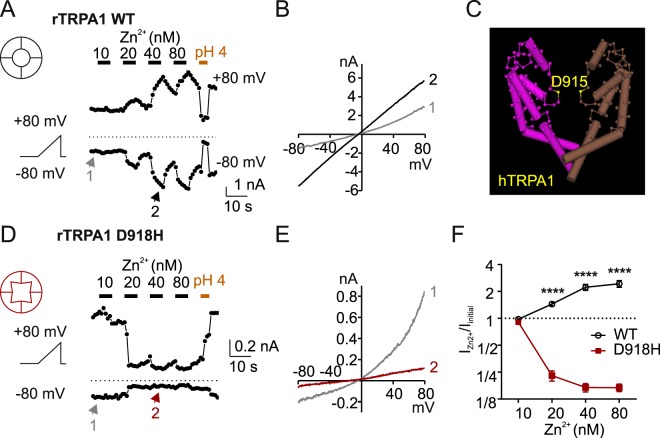
Figure 1
Figure 1
Histidine substitution at D918 in TRPA1 generates a high affinity Zn2+ inhibitory site. (A,D) Effect of extracellular Zn2+ on TRPA1 currents in HEK 293 cells transfected with WT or D918H TRPA1 channels. TRPA1 current was elicited by exposure to cinnamaldehyde (100 µM). The membrane potential was held at −80 mV and ramped (−80 mV to +80 mV, 1 V/s) once every second. (B,E) The I-V relationships of currents shown at indicated time points. Zn2+ potentiates the WT current and blocks D918H currents. (C) The structure of human TRPA1 modified from published data on National Center for Biotechnology Information (NCBI), showing a side view of the S5~S6 transmembrane domains from two opposing subunits in a TRPA1 channel. The backbones of D915 residues (homologous with rat TRPA1 D918) are highlighted. (F) Average data from experiments as in A,D showing the magnitude of the currents in the presence of Zn2+, at the concentration indicated, relative to the starting current level IZn2+/Iinitial (measured at +80 mV). ****P < 0.0001 (Sidak’s multiple comparison following two-way ANOVA); N ≥ 4.
Figure 2
Figure 2
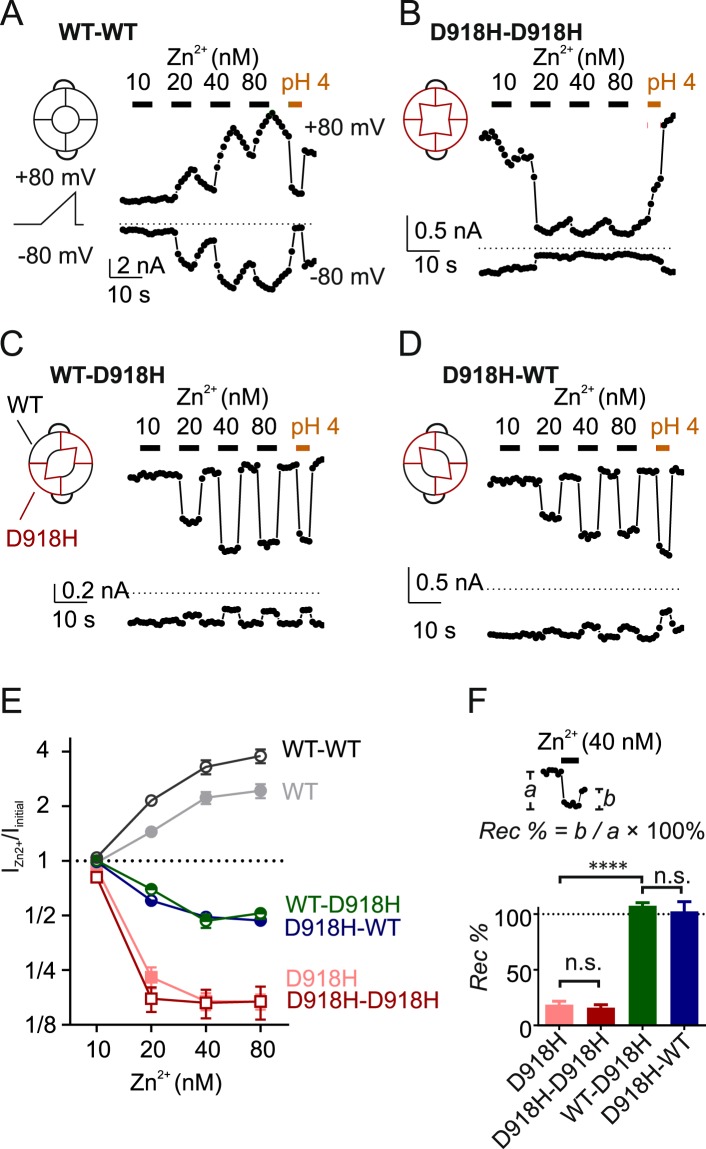
Concatemers consisting of WT and D918H subunits display an intermediate Zn2+-sensitivity. (AD) Effect of Zn2+, at the time and dose indicated, on currents from TRPA1 dimers composed of the four permutations of WT and D918H subunits. Currents were activated by pretreatment with cinnamaldehyde (100 µM) and were measured at +80 mV and −80 mV from ramp depolarizations applied once per second. (E) Average data from experiments as in A-D showing the magnitude of the currents in the presence of Zn2+, at the concentration indicated, relative to the starting current level IZn2+/Iinitial (measured at +80 mV). Data from WT and D918H monomers were replotted from Fig. 1F. (F) Recovery percentage (Rec %) of the currents from inhibition following removal of Zn2+ (40 nM) was quantitated as shown. n.s. P > 0.05, ****P < 0.0001 (Tukey’s multiple comparison following one-way ANOVA); N = 5.
Figure 3
Figure 3
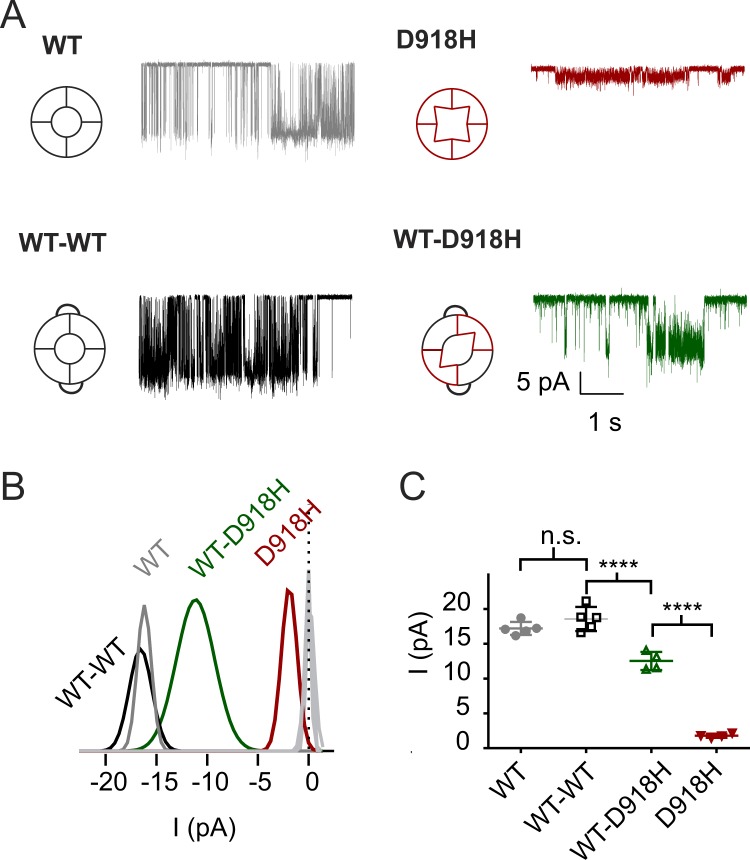
WT-D918H dimers display an intermediate single-channel conductance. (A) The unitary currents of WT, D918H, and WT-WT, WT-D918H channels recorded with cell-attached configuration. The bath solution was K+-based to zero cell membrane potential, and the current was recorded at −80 mV. (B) All points histograms fitted with Gaussians indicate that the WT-D918H displays an intermediate single channel conductance. (C) Scatter plot showing the single channel conductance of the indicated channels. n.s. P > 0.05, ****P < 0.0001 (Tukey’s multiple comparison following one-way ANOVA).
Figure 4
Figure 4
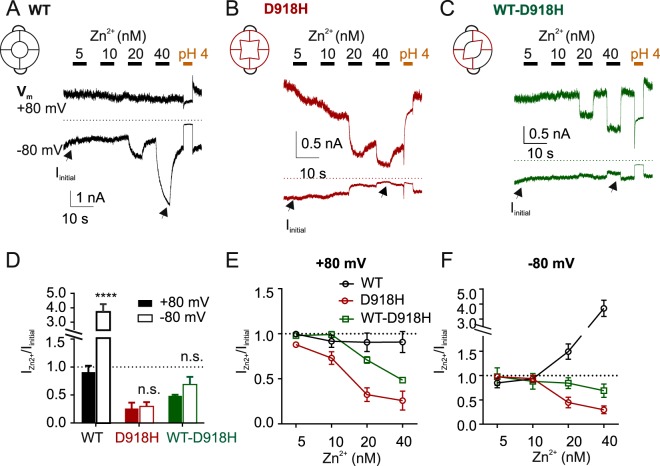
The block of D918H and WT-DH does not require the permeation of Zn2+. (AC): Effect of Zn2+ on currents from TRPA1 dimers measured with a stable holding potential of either +80 mV or −80 mV throughout the duration of the solution exchange. Traces were recorded sequentially but are shown on the same axes for illustrative purposes. Currents were activated by pretreatment with cinnamaldehyde (100 µM). (D) Summary of fraction change of TRPA1 WT, D918H and WT-D918H currents in response to Zn2+ (40 nM). IZn2+/Iinitial was calculated from the current magnitude measured 5 seconds after application of Zn2+, relative to that before Zn2+ application. n.s. P > 0.05, ****P < 0.0001 (Sidak’s multiple comparison following two-way ANOVA); N ≥ 4. (E,F): Average data from experiments as in A-C showing the magnitude of the currents in the presence of Zn2+, at the concentration indicated, relative to the starting current level IZn2+/Iinitial with a holding potential of +80 mV (E) or −80 mV (F). Note that while the potentiation of WT channels by Zn2+ is very sensitive to membrane potential, the inhibition of the D918H and WT-D918H channels is not very sensitive to membrane potential.
Figure 5
Figure 5
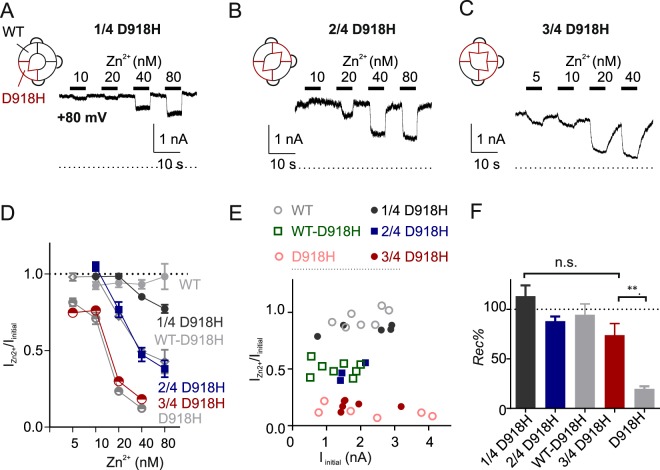
The Zn2+ sensitivity progressively increases with the number of D918H subunits in the TRPA1 tetramer. (A~C) Time courses of Zn2+ responses of TRPA1 concatemers composed of 4 TRPA1 subunits. The currents were activated by pretreatment with cinnamaldehyde (100 µM) and were all recorded with holding at +80 mV to prevent any Zn2+ entry. (D) Summary of current fraction changes of the tetramers under indicated Zn2+ conditions. (E) The scatter plot of current fraction changes in 40 nM Zn2+ against the current magnitudes. The data were replotted from Figs 4E and 5D, showing the inhibition rate does not correlate with current magnitude. (F) Summary of the recovery percentage (Rec %) at the wash-off of Zn2+ (40 nM). n.s. P > 0.05, **P < 0.01 (Tukey’s multiple comparison following one-way ANOVA); N ≥ 3.
Figure 6
Figure 6
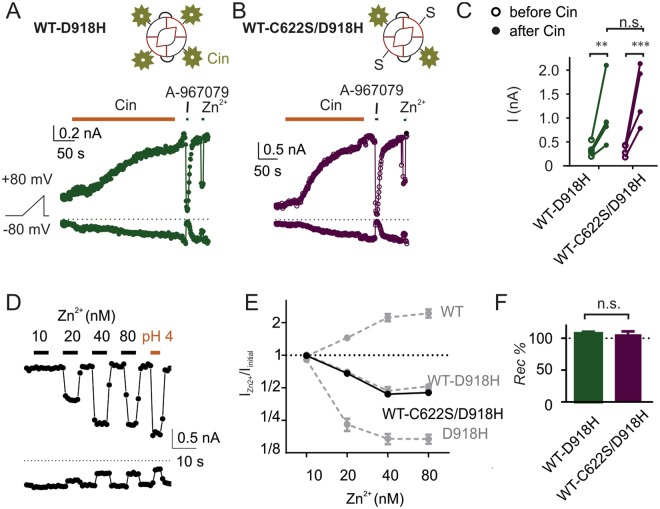
TRPA1 channels with 2 subunits harboring the C622S mutation can be activated by reactive electrophiles. (A,B) Activation by 100 µM cinnamaldehyde of currents in cells transfected with WT-D918H or WT-C622S/D918H. In both cases, cinnamaldehyde activated a current that could be inhibited by the TRPA1-specific blocker, A967079, and by Zn2+ (40 nM), reversibly. (C) Summary of current magnitudes measured before and after cinnamaldehyde treatment from experiments as in (A,B). **P < 0.01, ***P < 0.001 (Tukey’s multiple comparison following two-way ANOVA). (D) Inhibition of WT-C622S/D918H currents by the indicated concentrations of extracellular Zn2+. A pH 4 solution was used as a control; inhibiton of currents was qualitatively similar to that of WT-D918H currents. (E) Dose-dependence of inhibition by Zn2+ responses of WT-C622S/D918H currents (N = 5) is similar to that of WT-D918H. Data for WT, WT-D918H and D918H currents were replotted from Fig. 2. (F) Summary of recovery percentage (Rec %) at the wash-off of 40 nM Zn2+. n.s. P > 0.05 (unpaired t-test); N = 5.
Figure 7
Figure 7
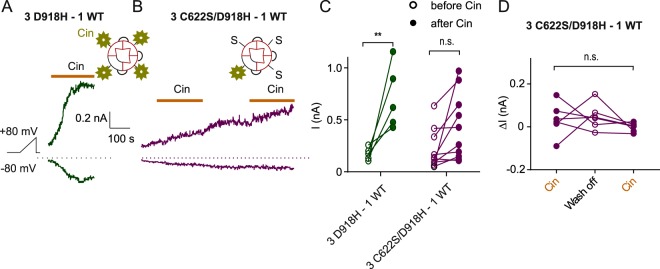
TRPA1 channels with 3 subunits harboring C622S mutation cannot be activated by cinnamaldehyde. (A) Response to 100 µM cinnamaldehyde of currents in cells transfected with 3 D918H - 1 WT and 3 C622S/D918H - 1 WT. Note that in (B), the current is spontaneously increasing and there is no correlation with the application of cinnamaldehyde. (C) Summary of current magnitudes measured before and after treatment of cinnamaldehyde. **P < 0.01 (Sidak’s multiple comparison following two-way ANOVA). (D) Summary of current magnitude changes during a 100 s window with or without cinnamaldehyde. n.s. P > 0.05 (repeated measures one-way ANOVA).
Figure 8
Figure 8
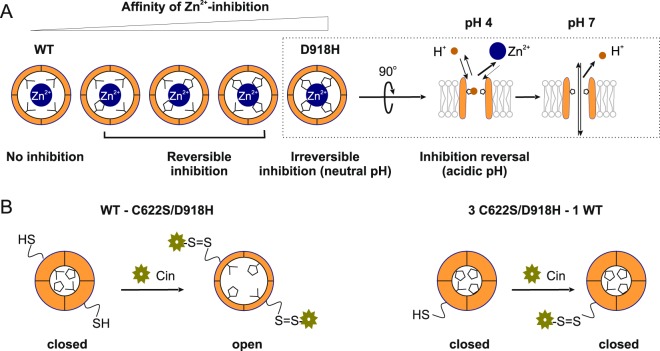
Summary. (A) Channel tetramers containing increasing numbers of histidine residues at position 918 (the narrowest point in the permeation pathway) display increasing sensitivities to Zn2+-inhibition. For channels containing 4 D918H subunits, Zn2+-inhibition is essentially irreversible at neutral pH. At low pH. protons displace Zn2+, and block the channel; subsequent wash-off of acid reverses the inhibition. See data in Figs 1~5. (B) The dimer WT-C622S/D918H is activated by cinnamaldehyde. The Zn2+-responses show the pore of WT-C622S/D918H is identical to that of WT-D918H, verifying the inclusion of subunits harboring the C622S mutation. In contrast, tetramers containing just one subunit that can be covalently modified by cinnamaldehyde are not activated. See data in Figs 6 and 7.
Figure 9
Figure 9
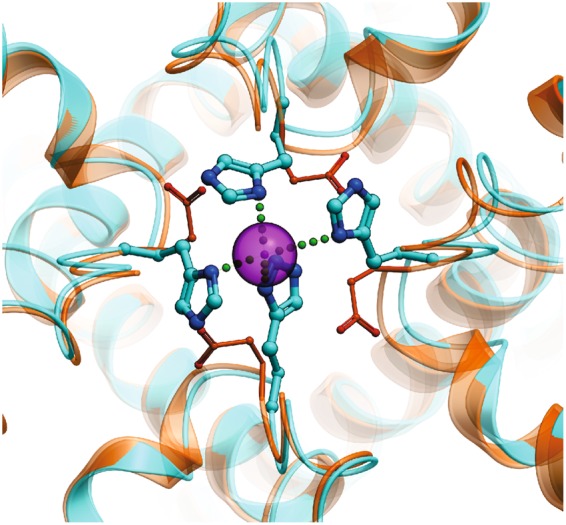
Model of the Asp915His mutant based on the human TRPA1 electron cyro-microscopy structure (PDB ID: 3J9P). Zn2+ ion shown in magenta, the original electron microscopy structure colored orange, the optimized model of the mutant colored cyan. Coordination of Zn2+ shown by green dotted lines.

References

    1. Zygmunt PM, Hogestatt ED. Trpa1. Handb Exp Pharmacol. 2014;222:583–630. doi: 10.1007/978-3-642-54215-2_23. - DOI - PubMed
    1. Julius D. TRP channels and pain. Annu Rev Cell Dev Biol. 2013;29:355–384. doi: 10.1146/annurev-cellbio-101011-155833. - DOI - PubMed
    1. Bautista DM, et al. TRPA1 mediates the inflammatory actions of environmental irritants and proalgesic agents. Cell. 2006;124:1269–1282. doi: 10.1016/j.cell.2006.02.023. - DOI - PubMed
    1. Jordt SE, et al. Mustard oils and cannabinoids excite sensory nerve fibres through the TRP channel ANKTM1. Nature. 2004;427:260–265. doi: 10.1038/nature02282. - DOI - PubMed
    1. Bandell M, et al. Noxious cold ion channel TRPA1 is activated by pungent compounds and bradykinin. Neuron. 2004;41:849–857. doi: 10.1016/S0896-6273(04)00150-3. - DOI - PubMed

Publication types