. 2018 Nov 20;8(1):17066.
doi: 10.1038/s41598-018-35151-7.

Cystic fibrosis transmembrane conductance regulator (CFTR) modulators have differential effects on cystic fibrosis macrophage function

Affiliations

Cystic fibrosis transmembrane conductance regulator (CFTR) modulators have differential effects on cystic fibrosis macrophage function

Shuzhong Zhang et al. Sci Rep. .

Abstract

Despite the addition of cystic fibrosis transmembrane conductance regulator (CFTR) modulators to the cystic fibrosis (CF) treatment regimen, patients with CF continue to suffer from chronic bacterial infections that lead to progressive respiratory morbidity. Host immunity, and macrophage dysfunction specifically, has an integral role in the inability of patients with CF to clear bacterial infections. We sought to characterize macrophage responses to CFTR modulator treatment as we hypothesized that there would be differential effects based on patient genotype. Human CF and non-CF peripheral blood monocyte-derived macrophages (MDMs) were analyzed for CFTR expression, apoptosis, polarization, phagocytosis, bacterial killing, and cytokine production via microscopy, flow cytometry, and ELISA-based assays. Compared to non-CF MDMs, CF MDMs display decreased CFTR expression, increased apoptosis, and decreased phagocytosis. CFTR expression increased and apoptosis decreased in response to ivacaftor or lumacaftor/ivacaftor therapy, and phagocytosis improved with ivacaftor alone. Ivacaftor restored CF macrophage polarization responses to non-CF levels and reduced Pseudomonas aeruginosa bacterial burden, but did not reduce other bacterial loads. Macrophage inflammatory cytokine production decreased in response to ivacaftor alone. In summary, ivacaftor and lumacaftor/ivacaftor have differential impacts on macrophage function with minimal changes observed in CF patients treated with lumacaftor/ivacaftor. Overall improvements in macrophage function in ivacaftor-treated CF patients result in modestly improved macrophage-mediated bacterial killing.


Conflict of interest statement

B.T.K. is a member of the US CF Advisory Board for Vertex Pharmaceuticals to provide advice on clinical trial development.

Figures

Figure 1
Figure 1
Macrophages from CF patients under CFTR modulation have altered CFTR expression and cell stability: (A) Mean CFTR expression was determined using ImageJ software of 5 independent fields of 10 MDMs for at least 4 patients per condition from fluorescent microscopy images, MOI 2. Fold change expression are presented in comparison to uninfected non-CF MDMs (non-CF NT). MDMs were grouped according to CF (F508del/F508del or F508del/G551D) and non-CF patients with or without infection with B. cenocepacia (Bc) and on clinical treatment with CFTR modulators (lumacaftor/ivacaftor or ivacaftor). CFTR modulator groups were infected with Bc. “NT” denotes no infection. “*” denotes a p value < 0.05, “**” denotes a p value < 0.01, and “***” denotes a p value < 0.001, unpaired t-test. (B) Representative image of fluorescent microscopy of MDMs from (A). CFTR is expressed in green, bacteria in red, and the macrophage nucleus is stained blue with DAPI. n = 4–6. CFTR modulator groups were infected with Bc. “NT” denotes no infection. (C) CFTR mean fluorescence detected via flow cytometry in human CF MDMs on or off CFTR modulators and normalized to non-CF MDMs, all groups with infection with B. cenocepacia (Bc). “**” denotes a p value < 0.01, and “***” denotes a p value < 0.001, one-way ANOVA with post-hoc Tukey. (D) Apoptosis was measured via an Annexin V detection assay via flow cytometry, and normalized to non-CF MDMs. Groups included non-CF MDMs (n = 13) and CF MDMs (n = 9) at baseline, in response to the apoptosis inducer thapsagargin (TG) (n = 3–4), and CF MDMs from patients on CFTR modulators (n = 5–6). “**” denotes a p value < 0.01, and “***” denotes a p value < 0.001, one-way ANOVA with post-hoc Tukey.
Figure 2
Figure 2
Macrophages from CF patients on Ivacaftor have altered polarization. (A) Baseline M1 and (B) M2 polarization of freshly isolated non-CF and CF monocytes. CF monocytes were grouped according to the presence or absence of clinical CFTR modulator treatment. “*” denotes a p value < 0.05 and “**” denotes a p value < 0.01, one-way ANOVA with post-hoc Tukey. (C) M1 and D) M2 polarization of non-CF and CF MDMs after 48 h exposure to polarizing stimulus. Data were normalized to non-CF MDMs. “*” denotes a p value < 0.05, one-way ANOVA with post-hoc Tukey. The flow cytometry gating strategy for Fig. 2 is found online (Supplementary Fig. S1), M1: CD68/CD80; M2: CD163/CD206.
Figure 3
Figure 3
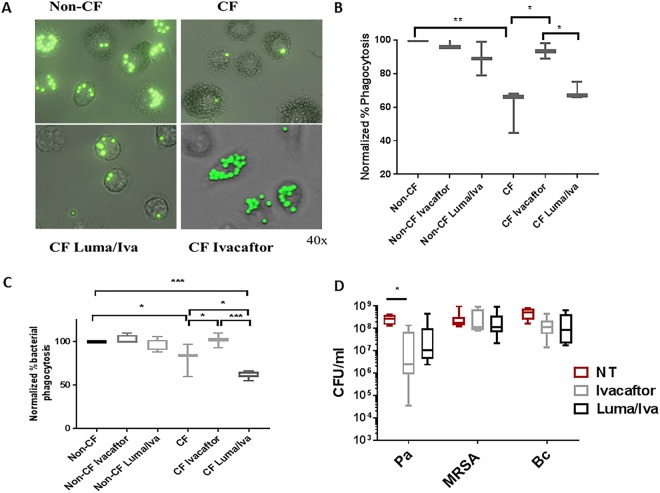
Macrophages from patients on Ivacaftor have improved phagocytosis and killing of Pseudomonas aeruginosa. (A) Representative microscopy image of non-CF and CF MDM phagocytosis of FITC-labeled beads, 40X magnification, MOI 50. CF MDMs were grouped according to the presence or absence of clinical CFTR modulator treatment. (B) Summed % phagocytosis normalized to non-CF MDMs for (A) “*” denotes a p value < 0.05 and “**” denotes a p value < 0.01, one-way ANOVA with post-hoc Tukey. (C) Summed %phagocytosis of RFP-expressing B. cenocepacia normalized to non-CF MDMs, n = 3–9/group, MOI 50. “*” denotes a p value < 0.05, “**” denotes a p value < 0.01, and “***” denotes a p value < 0.001, one-way ANOVA with post-hoc Tukey. (D) Colony-forming unit (CFU) assay for CF MDMs Infected with P. aeruginosa (Pa), MRSA, and B. cenocepacia (Bc). CF MDMs were grouped according to the presence or absence of clinical CFTR modulator treatment, n = 4–8/group, one-way ANOVA with post-hoc Tukey.
Figure 4
Figure 4
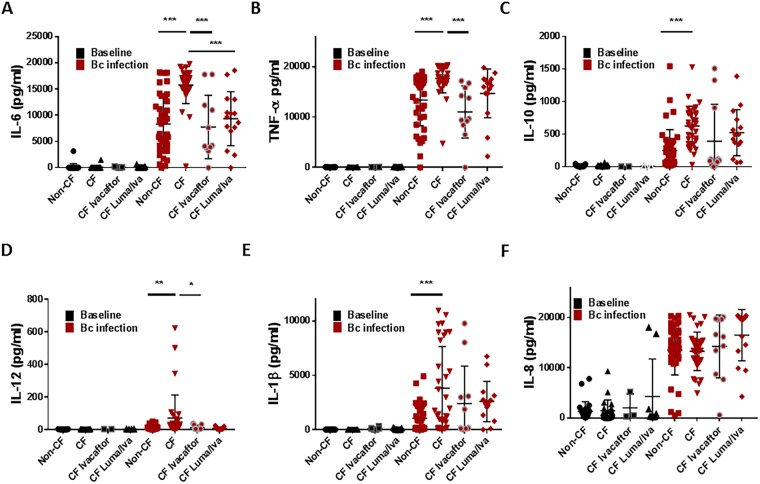
Macrophages from CF patients on CFTR modulators have differential cytokine production. Multiplex cytokine assay analysis of CF (n = 33) and non-CF (n = 41) MDM supernatants after 24 h with or without infection with B. cenocepacia (Bc, MOI 10) and/or treatment with ivacaftor or lumacaftor/ivacaftor (luma/iva) for (A) IL-6, (B) TNF-α, (C) IL-10, (D) IL-12, (E) IL-1β, and (F) IL-8. “*” denotes a p value < 0.05, “**” denotes a p value < 0.01, and “***” denotes a p value < 0.001, one-way ANOVA with post-hoc Tukey.
Figure 5
Figure 5
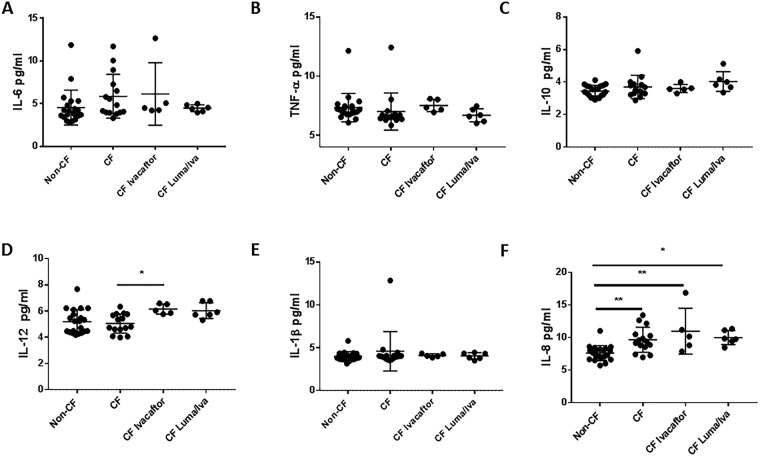
CFTR modulators do not change serum cytokine production. Multiplex cytokine assay analysis of CF (n = 15) and non-CF serum (n = 21) in the presence or absence of ivacaftor or lumacaftor/ivacaftor (luma/iva) for (A) IL-6, (B) TNF-α, (C) IL-10, (D) IL-12, (E) IL-1β, and (F) IL-8. “*” denotes a p value < 0.05, “**” denotes a p value < 0.01, and “***” denotes a p value < 0.001, one-way ANOVA with post-hoc Tukey.

References

    1. Hudock KM, Clancy JP. An update on new and emerging therapies for cystic fibrosis. Expert Opin Emerg Drugs. 2017;22:331–346. doi: 10.1080/14728214.2017.1418324. - DOI - PubMed
    1. Wainwright CE, Elborn JS, Ramsey BW. Lumacaftor-Ivacaftor in Patients with Cystic Fibrosis Homozygous for Phe508del CFTR. The New England journal of medicine. 2015;373:1783–1784. doi: 10.1056/NEJMc1510466. - DOI - PubMed
    1. Ramsey BW, et al. A CFTR potentiator in patients with cystic fibrosis and the G551D mutation. The New England journal of medicine. 2011;365:1663–1672. doi: 10.1056/NEJMoa1105185. - DOI - PMC - PubMed
    1. Hisert KB, et al. Restoring Cystic Fibrosis Transmembrane Conductance Regulator Function Reduces Airway Bacteria and Inflammation in People with Cystic Fibrosis and Chronic Lung Infections. Am J Respir Crit Care Med. 2017;195:1617–1628. doi: 10.1164/rccm.201609-1954OC. - DOI - PMC - PubMed
    1. Assani, K., Tazi, M. F., Amer, A. O. & Kopp, B. T. IFN-gamma stimulates autophagy-mediated clearance of Burkholderia cenocepacia in human cystic fibrosis macrophages. PLoS One9, e96681, doi:10.1371/journal.pone.0096681 (2014). - PMC - PubMed

Publication types

MeSH terms