Breastfeeding problems and interventions performed on problems: systematic review based on studies made in Turkey
- PMID: 30459512
- PMCID: PMC6239069
- DOI: 10.5152/TurkPediatriArs.2018.6350
Breastfeeding problems and interventions performed on problems: systematic review based on studies made in Turkey
Abstract
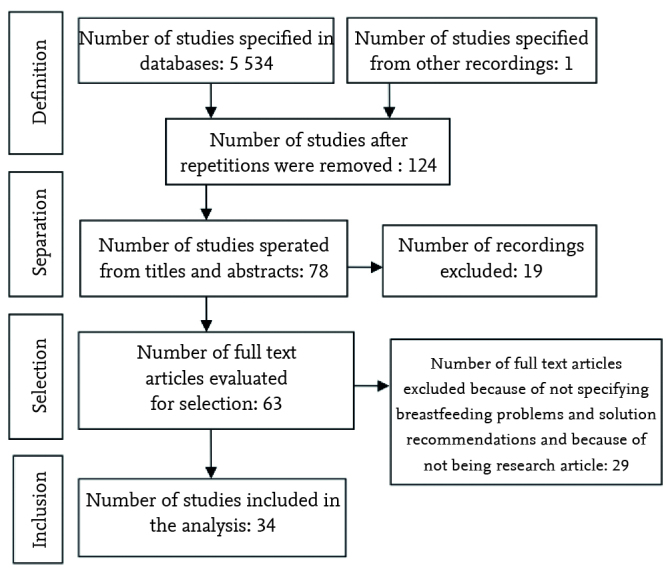
To determine the breastfeeding problems encountered in the postpartum period and effect of interventions done in relation to the problems based on breastfeeding studies in Turkey. This study is a systematic review and was conducted by performing a scan of the Turkish and English literature over the period October 2016-February 2017. The study included 27 articles and seven theses, which were published in 2000-2015 in Turkey and published in 2008-2017. Data are presented tabulating and the aggregate percentages were calculated for some data showing common characteristics. A total of 6736 parents and 592 babies were included in these studies. As a result of the combined percentage calculation based on the data of cross-sectional and case-control studies, the most frequently reported problems were having breastfeeding problem (24.5%), mother's milk deficiency/worry about milk deficiency/thinking her baby is not satisfied/baby's inadequate weight gain (15.7%), lack of knowledge and experience about breastfeeding/need for education and support (17.8%). Again, these studies showed that women stated the problems about have flat/depressed/small nipple (7.7%), pain/sensitivity (3.9%), swelling/fullness/engorgement (10.8%), redness (28.8%), crack/wound/bleeding (26.1%) and mastitis (5.6%). Methods of prenatal education/counselling/motivation/follow-up, strong motivation, proactive lactation management and social support, moist warm application, using of breast milk and olive oil and using of breast shield and feeding with container and pacifier using have been reported to be effective in the experimental/quasi-experimental and case report studies included in this systematic review. This study showed that women experienced a lot problem with breastfeeding and that more prenatal education/counselling/monitoring was used in reducing problems.
Keywords: Breastfeeding; care; midwifery; mother’s milk; nursing; postpartum period.
Conflict of interest statement
Conflict of Interest: The authors have no conflicts of interest to declare.
Figures
References
-
- World Health Organization. Postnatal care for mothers and newborns: Highlights from the World Health Organization 2013 Guidelines. [Accessed on: 01 Ekim 2016]. Avaible from: http://www.who.int/maternal_child_adolescent/publications/WHO-MCA-PNC-20....
-
- Benoit B, Goldberg L, Campbell-Yeo M. Infant feding and maternal guilt: The application of a feminist phenomenological framework to guide clinician practices in breast feeding promotion. Midwifery. 2016;34:58–65. https://doi.org/10.1016/j.midw.2015.10.011 - DOI - PubMed
-
- Kartal B, Kaplan B, Buldu A, Ateş CS, Ekinci E. Doğum sonu dönemdeki kadınların emzirme özellikleri ve bunu etkileyen meme sorunları. İzm Üniv Tıp Derg. 2015;1:1–10.
-
- Neifert M, Bunik M. Overcoming clinica barriers to exclusive breastfeeding. Pediatr Clin North Am. 2013;60:115–45. https://doi.org/10.1016/j.pcl.2012.10.001 - DOI - PubMed
-
- Türkyılmaz AS, Adalı T, Çağatay Seçkiner P. Beslenme durumu ve çocuk sağlığı: Hacettepe Üniversitesi Nüfus Etütleri Enstitüsü 2013 Türkiye Nüfus ve Sağlık Araştırması. Ankara: Hacettepe Üniversitesi Nüfus Etütleri Enstitüsü, T.C. Kalkınma Bakanlığı ve TÜBİTAK; 2014. pp. 156–69.
Publication types
LinkOut - more resources
Full Text Sources
Research Materials