


Do Thirty-Second Post-activation Potentiation Exercises Improve the 50-m Freestyle Sprint Performance in Adolescent Swimmers?
- PMID: 30459632
- PMCID: PMC6232934
- DOI: 10.3389/fphys.2018.01464
Do Thirty-Second Post-activation Potentiation Exercises Improve the 50-m Freestyle Sprint Performance in Adolescent Swimmers?
Abstract
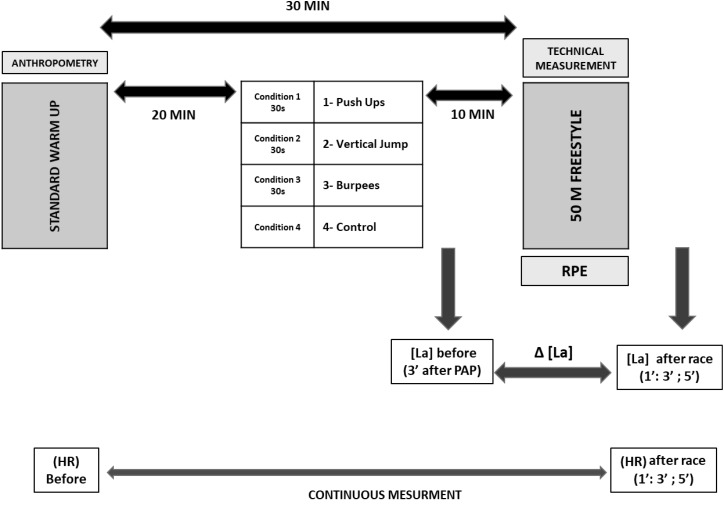
Objectives: The purpose of the study was to investigate performance, biomechanical, physiological, and psychophysiological effects of a simple and easily organized post-activation potentiation (PAP) re-warm-up performed before a 50-m freestyle swimming sprint. Methods: Regional level male adolescent swimmers [age: 13.0 ± 2.0 years; (min 11 years - max 15 years)] performed four trial conditions (three experimental, one control) on different days. The control trial involved a standardized 1200-m warm-up followed by 30 min of rest and a maximal 50-m freestyle swimming sprint. The experimental trials involved the same protocol but added a PAP component after a 20-min rest (10 min pre-50-m): The different PAP component involved the subjects in completing a 30-s maximal effort of: (1) push-ups (PU - upper body), (2) squats (SQ - lower body), and (3) burpees (BP - lower and upper body). Performance (time-trial), biomechanical (stroke length, stroke frequency), physiological (blood lactate concentrations, heart rate), and psychophysiological (ratings of perceived exertion) variables were collected. Results: The results demonstrated that the PAP protocols used in this investigation had no effect on swimming performance. Before the 50-m swimming sprint, the lactate values were significantly higher after the PU, BP, and SQ PAP loads compared to the control condition [P(CC-PU) = 0.02; P(CC-BP) = 0.01; P(CC-SQ) = 0.04]. For Lactate values, a significant and large effect of experimental condition compared to control condition was found (p < 0.05, η2 = 0.68). At 1 min after the 50-m time trial, significant differences were observed between the control condition and the different PAP loads [P(CC-PU) = 0.01; P(CC-BP) = 0.04; P(CC-SQ) = 0.01]. At 3 min after the 50-m sprint, significant differences were found between the control condition and the PU and SQ PAP loads [P(CC-PU) = 0.018; P(CC-SQ) = 0.008, respectively]. Additionally, a significant and large effect of experimental condition was found at 1 and 3 min after the 50-m swimming sprint (p < 0.05, η2 (1 min) = 0.73; η2 (3 min) = 0.59). There were medium sized but non-significant effects of interaction between the conditions, was illustrated for the mean HR values in response to the different conditions (p > 0.05; η2 = 0.083). Conclusion: None of the three PAP protocols showed any significant improvement in performance, biomechanical, physiological, and psychophysiological variables before, during and after the 50-m swimming time-trial. Further studies are warranted to investigate ways to improve swimming performance with simple body mass exercises performed in-between the end of pool warm-up and race start.
Keywords: competition; performance; post-activation potentiation; swimmers; swimming; warm-up.
Figures
Comment in
-
Commentary: Do Thirty-Second Post-activation Potentiation Exercises Improve the 50-m Freestyle Sprint Performance in Adolescent Swimmers?Front Physiol. 2019 Mar 18;10:215. doi: 10.3389/fphys.2019.00215. eCollection 2019. Front Physiol. 2019. PMID: 30936834 Free PMC article. No abstract available.
References
-
- Batista M., Roschel H., Barroso R. (2010). Potencialização pós-ativação: possíveis mecanismos fisiológicos e sua aplicação no aquecimento de atletas de modalidades de potência. Rev. Educ. Fís. 21 161–174.
-
- Bielec G., Makar P. (2010). Variability in swimmersŠ individual kinematics parameters versus training loads. Biol. Sport 27 143–147. 10.5604/20831862.913082 - DOI
LinkOut - more resources
Full Text Sources
Research Materials
