. 2018 Nov 6:9:561.
doi: 10.3389/fpsyt.2018.00561. eCollection 2018.

Elevated Glutamate and Glutamine Levels in the Cerebrospinal Fluid of Patients With Probable Alzheimer's Disease and Depression

Affiliations

Elevated Glutamate and Glutamine Levels in the Cerebrospinal Fluid of Patients With Probable Alzheimer's Disease and Depression

Caroline Madeira et al. Front Psychiatry. .

Abstract

Recent evidence suggests that Alzheimer's disease (AD) and depression share common mechanisms of pathogenesis. In particular, deregulation of glutamate-mediated excitatory signaling may play a role in brain dysfunction in both AD and depression. We have investigated levels of glutamate and its precursor glutamine in the cerebrospinal fluid (CSF) of patients with a diagnosis of probable AD or major depression compared to healthy controls and patients with hydrocephalus. Patients with probable AD or major depression showed significantly increased CSF levels of glutamate and glutamine compared to healthy controls or hydrocephalus patients. Furthermore, CSF glutamate and glutamine levels were inversely correlated to the amyloid tau index, a biomarker for AD. Results suggest that glutamate and glutamine should be further explored as potential CSF biomarkers for AD and depression.

Keywords: Alzheimer's disease; cerebrospinal fluid; depression; glutamate; glutamine; innotest amyloid tau index.


Figures
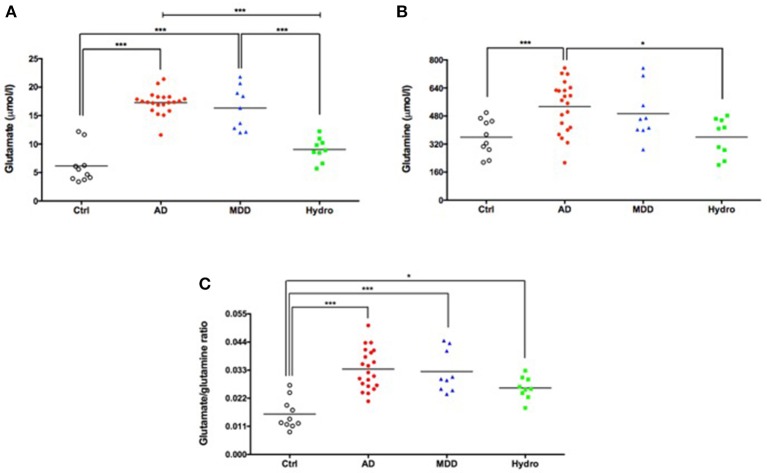
Figure 1
Figure 1
Increased CSF levels of glutamate (A), glutamine (B) and glutamate/glutamine ratio (C) in patients with probable AD and major depression. Symbols correspond to individual subjects. Horizontal lines represent mean values for each group. Statistical significances assessed by one-way ANOVA followed by Bonferroni adjustment for multiple comparisons. *P < 0.05; ***P < 0.001. AD, probable Alzheimer's disease; Ctrl, healthy controls; MDD, major depressive disorder; Hydro, hydrocephalus.
Figure 2
Figure 2
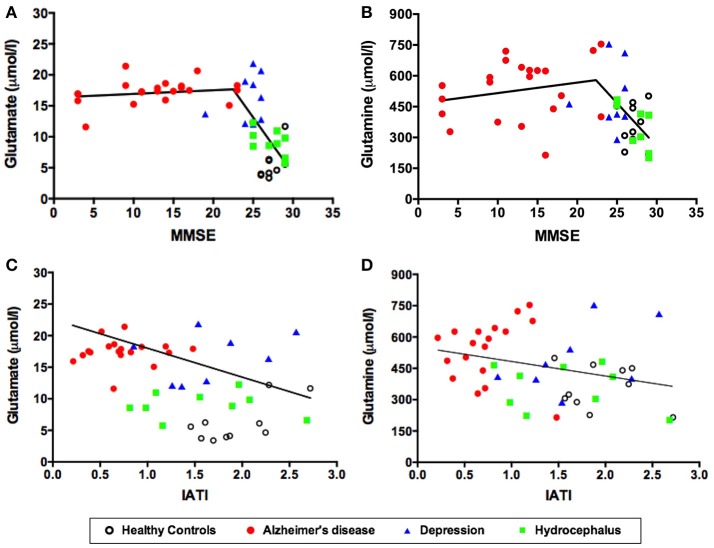
CSF levels of glutamate (A) and glutamine (B) as a function of MMSE scores. CSF levels of glutamate (C) and glutamine (D) as a function of the IATI index. Symbols correspond to individual subjects. Statistical significances assessed by Pearson correlation. MMSE, Mini Mental State Examination; IATI, INNOTEST amyloid/tau index.
Figure 3
Figure 3
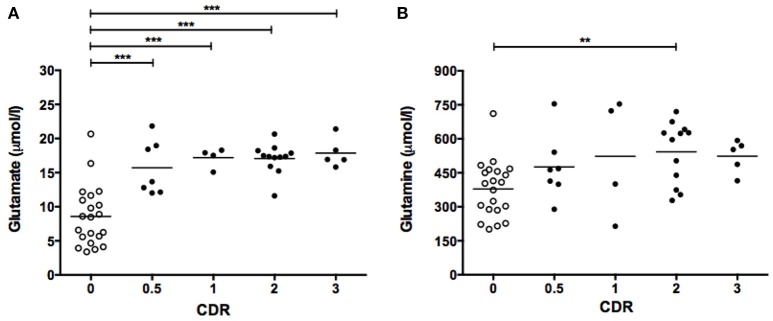
CSF levels of glutamate (A) and glutamine (B) as a function of CDR score. Symbols correspond to individual subjects. Horizontal lines represent mean values for each group. Statistical significances assessed by one-way ANOVA followed by Bonferroni adjustment for selected groups: CDR 0.5, 1, 2, and 3 vs. CDR 0. **P < 0.01; ***P < 0.001. CDR, Clinical Dementia Ratio.

References

    1. Zubenko GS, Zubenko WN, McPherson S, Spoor E, Marin DB, Farlow MR, et al. A collaborative study of the emergence and clinical features of the major depressive syndrome of Alzheimer's disease. Am J Psychiatry (2003) 160:857–66. 10.1176/appi.ajp.160.5.857 - DOI - PubMed
    1. Gualtieri CT, Johnson LG. Age-related cognitive decline in patients with mood disorders. Prog Neuropsychopharmacol Biol Psychiatry (2008) 32:962–7. 10.1016/j.pnpbp.2007.12.030 - DOI - PubMed
    1. Green RC, Cupples LA, Kurz A, Auerbach S, Go R, Sadovnick D, et al. Depression as a risk factor for Alzheimer disease: the MIRAGE Study. Arch Neurol. (2003) 60:753–759. 10.1001/archneur.60.5.753 - DOI - PubMed
    1. Saczynski JS, Beiser A, Seshadri S, Auerbach S, Wolf PA, Au R. Depressive symptoms and risk of dementia: the Framingham Heart Study. Neurology (2010) 75:35–41. 10.1212/WNL.0b013e3181e62138 - DOI - PMC - PubMed
    1. Diniz BS, Butters MA, Albert SM, Dew MA, Reynolds CF, 3rd. Late-life depression and risk of vascular dementia and Alzheimer's disease: systematic review and meta-analysis of community-based cohort studies. Br J Psychiatry (2013) 202:329–35. 10.1192/bjp.bp.112.118307 - DOI - PMC - PubMed

LinkOut - more resources