Review
. 2018 Oct 15:9:860.
doi: 10.3389/fneur.2018.00860. eCollection 2018.

Outside in: Unraveling the Role of Neuroinflammation in the Progression of Parkinson's Disease

Affiliations
Review

Outside in: Unraveling the Role of Neuroinflammation in the Progression of Parkinson's Disease

Paulina Troncoso-Escudero et al. Front Neurol. .

Abstract

Neuroinflammation is one of the most important processes involved in the pathogenesis of Parkinson's disease (PD). The current concept of neuroinflammation comprises an inflammation process, which occurs in the central nervous system due to molecules released from brain-resident and/or blood-derived immune cells. Furthermore, the evidence of the contribution of systemic delivered molecules to the disease pathogenesis, such as the gut microbiota composition, has been increasing during the last years. Under physiological conditions, microglia and astrocytes support the well-being and well-function of the brain through diverse functions, including neurotrophic factor secretion in both intact and injured brain. On the other hand, genes that cause PD are expressed in astrocytes and microglia, shifting their neuroprotective role to a pathogenic one, contributing to disease onset and progression. In addition, growth factors are a subset of molecules that promote cellular survival, differentiation and maturation, which are critical signaling factors promoting the communication between cells, including neurons and blood-derived immune cells. We summarize the potential targeting of astrocytes and microglia and the systemic contribution of the gut microbiota in neuroinflammation process archived in PD.

Keywords: Parkinson's disease; gut microbiota; neurodegenerative disease; neuroinflammation; neurotrophic factor.


Figures
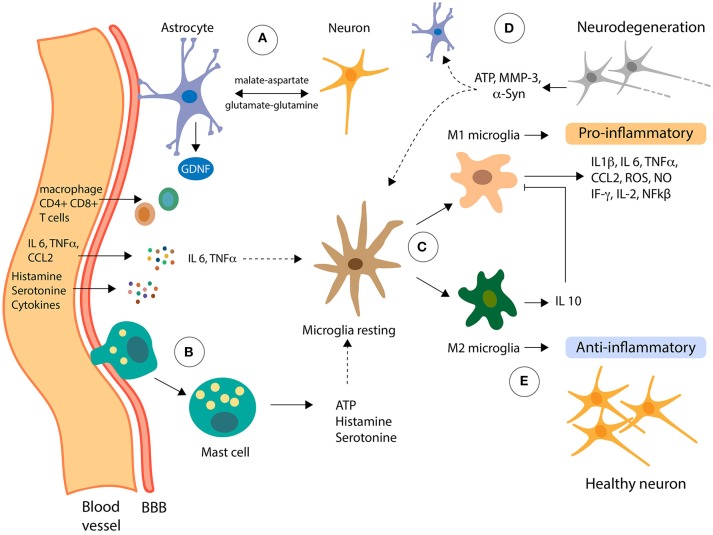
Figure 1
Figure 1
Role of non-neuronal cells in neuroinflammation. Pro-inflammatory molecules can reach the Central Nervous System (CNS) from the periphery going across the blood-brain barrier (BBB). (A) Astrocytes, the most abundant cells in the CNS, are functionally connected with the BBB, receiving signals from the periphery and from inside the CNS. Also, astrocytes metabolically support neurons via the shuttle systems malate-aspartate and glutamate-glutamine. (B) Mast cells can infiltrate the CNS, inducing changes in the microglia by the delivery of proinflammatory effectors, including ATP, which stimulates transcription of proinflammatory cytokines through PKC. (C) Resting microglia can be activated in two classical phenotypes, M1 and M2, depending on the effector signals from its microenvironment. (D) In presence of LPS and IFNγ, microglia cells polarize to M1 phenotype and secrete the proinflammatory cytokines which contribute to the dysfunction of dopaminergic neurons (neurodegeneration). Moreover, neuron failed can release α-Syn, ATP, MMP-3, among other molecules, in a cross-talk signaling with astrocytes and microglia, increasing the toxic-loop of neuroinflammation. (E) Contrary, IL 4 and IL 13 induce activation of microglia to M2 phenotype that downregulates M1 functions by release of IL 10 cytokines contributing to anti-inflammatory of CNS.
Figure 2
Figure 2
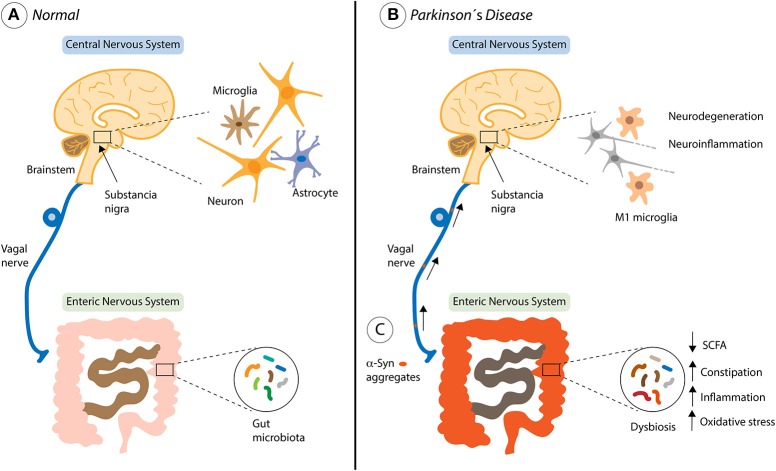
Contribution of the gut microbiota in Parkinson's disease progression. (A) The healthy bi-directional communication between the brain and the gut, highlighting the involvement of the vagus nerve. (B) The brain-gut axis and non-motor symptoms of Parkinson's disease (PD) including both central and gastrointestinal dysfunction. (C) Environmental factors such as the gut microbiota, might begin a pathological process within enteric nerve cell plexus, causing mucosal inflammation and oxidative stress, thereby initiating alpha-synuclein (α-syn) accumulation. The vagal nerve might provide a footpath for the spread of α-Syn from the Enteric Nervous System to the brain through the brainstem, Substancia nigra, basal forebrain and finally the cortical areas where is activated the neurodegeneration and neuroinflammation process described in PD.

References

    1. Jankovic J. Parkinson's disease: clinical features and diagnosis. J Neurol Neurosurg Psychiatry (2008) 79:368–76. 10.1136/jnnp.2007.131045 - DOI - PubMed
    1. Langston JW. The Parkinson's complex: parkinsonism is just the tip of the iceberg. Ann Neurol (2006) 59:591–6. 10.1002/ana.20834 - DOI - PubMed
    1. Muzerengi S, Contrafatto D, Chaudhuri KR. Non-motor symptoms: identification and management. Parkinsonism Relat Disord (2007) 13 (Suppl 3):S450–6. 10.1016/S1353-8020(08)70048-8 - DOI - PubMed
    1. Salat-Foix D, Suchowersky O. The management of gastrointestinal symptoms in Parkinson's disease. Expert Rev Neurother (2012) 12:239–48. 10.1586/ern.11.192 - DOI - PubMed
    1. Peall KJ, Kuiper A, de Koning TJ, Tijssen MA. Non-motor symptoms in genetically defined dystonia: Homogenous groups require systematic assessment. Parkinsonism Relat Disord (2015) 21:1031–40. 10.1016/j.parkreldis.2015.07.003 - DOI - PubMed