. 2018 Nov 6:9:1624.
doi: 10.3389/fpls.2018.01624. eCollection 2018.

Comprehensively Characterizing the Cytological Features of Saccharum spontaneum by the Development of a Complete Set of Chromosome-Specific Oligo Probes

Affiliations

Comprehensively Characterizing the Cytological Features of Saccharum spontaneum by the Development of a Complete Set of Chromosome-Specific Oligo Probes

Zhuang Meng et al. Front Plant Sci. .

Abstract

Chromosome-specific identification is a powerful technique in the study of genome structure and evolution. However, there is no reliable cytogenetic marker to unambiguously identify each of the chromosomes in sugarcane (Saccharum spp., Poaceae), which has a complex genome with a high level of ploidy and heterozygosity. In this study, we developed a set of oligonucleotide (oligo)-based probes through bioinformatic design and massive synthetization. These probes produced a clear and bright single signal in each of the chromosomes and their eight homologous chromosomes in the ancient species Saccharum spontaneum (2n = 8x = 64). Thus, they can be used as reliable markers to robustly label each of the chromosomes in S. spontaneum. We then obtained the karyotype data and established a nomenclature based on chromosomal sizes for the eight chromosomes of the octoploid S. spontaneum. In addition, we also found that the 45S and 5S rDNAs demonstrated high copy number variations among different homologous chromosomes, indicating a rapid evolution of the highly repeated sequence after polyploidization. Our fluorescence in situ hybridization (FISH) assay also demonstrated that these probes could be used as cross-species markers between or within the genera of Sorghum and Saccharum. By comparing FISH analyses, we discovered that several chromosome rearrangement events occurred in S. spontaneum, which might have contributed to the basic chromosome number reduction from 10 in sorghum to 8 in sugarcane. Consistent identification of individual chromosomes makes molecular cytogenetic study possible in sugarcane and will facilitate fine chromosomal structure and karyotype evolution of the genus Saccharum.

Keywords: Saccharum spontaneum; chromosomal rearrangement; chromosome identification; fluorescence in situ hybridization; karyotype; oligo probe.


Figures
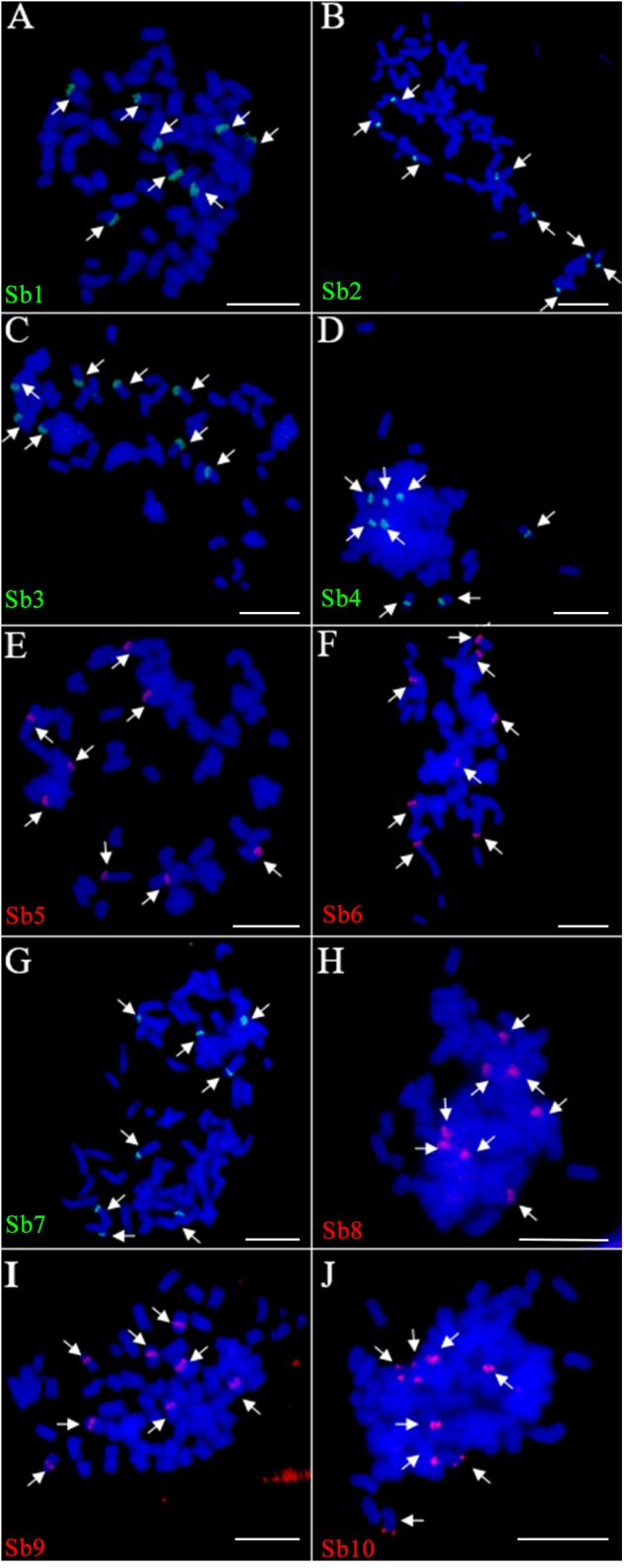
FIGURE 1
FIGURE 1
Fluorescence in situ hybridization (FISH) assay of the sorghum-derived oligo probes in Saccharum spontaneum SES208. (A–J) The 10 oligo probes derived from sorghum chromosome 1–10 (Table 1) were hybridized to the mitotic metaphase chromosomes of S. spontaneum SES208, respectively. Bright and clear signals were detected from each of the probes in SES208. The arrows in each cell indicate the FISH signals in the eight homologous chromosomes in octoploid S. spontaneum SES208. Scale bars, 10 μm.
FIGURE 2
FIGURE 2
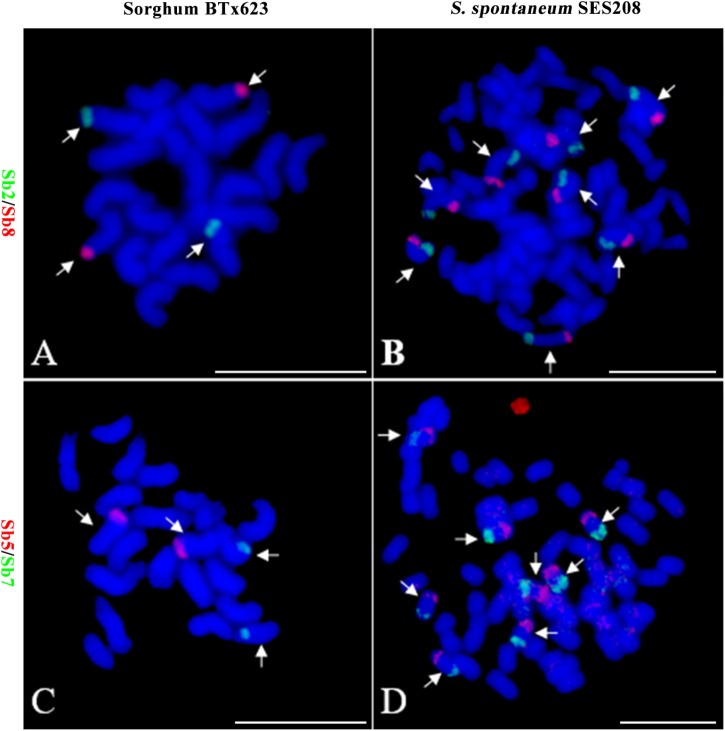
Validation of chromosomal rearrangement between sorghum and S. spontaneum by oligo-FISH. (A,B) A FISH assay of oligo probes Sb2 (green) and Sb8 (red) in sorghum BTx623 and S. spontaneum SES208. The FISH result confirmed that probes Sb2 and Sb8 are located on different chromosomes in sorghum (A) but are located at the opposite ends of the same chromosome in S. spontaneum SES208 (B). (C,D) A FISH assay of oligo probes Sb5 (red) and Sb7 (green) in sorghum BTx623 and S. spontaneum SES208. The FISH result revealed that probes Sb5 and Sb7 are located on different chromosomes in sorghum (C) but are located at the opposite ends of the same chromosome in S. spontaneum SES208 (D). The arrows indicate the chromosomes bearing FISH signals. Scale bars, 10 μm.
FIGURE 3
FIGURE 3
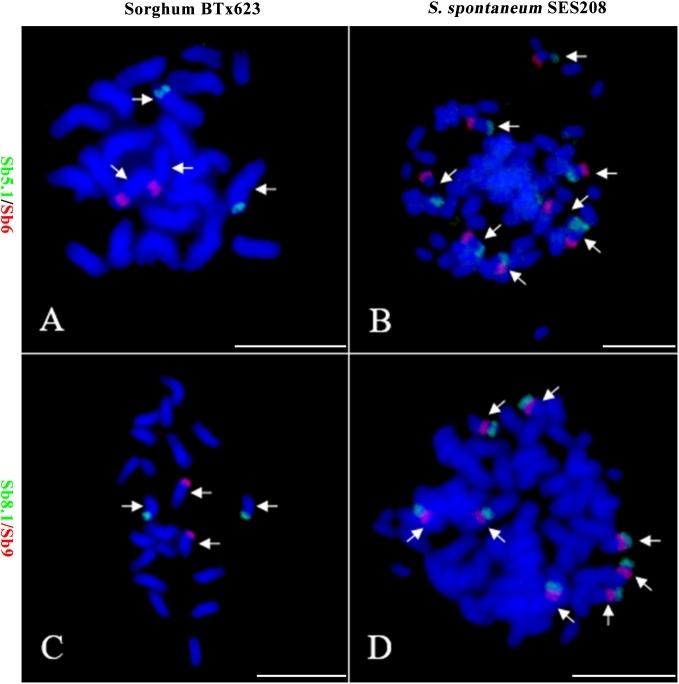
Further validation of chromosomal rearrangements between sorghum and S. spontaneum by oligo-FISH. (A,B) A FISH assay of oligo probes Sb5.1 (green) and Sb6 (red) in sorghum BTx623 (A) and S. spontaneum SES208 (B). The FISH result confirmed that the probes Sb5.1 and Sb6 are located on different chromosomes in sorghum (A) but in the opposite ends of the same chromosome in S. spontaneum SES208 (B). (C,D) A FISH assay of oligo probes Sb8.1 (green) and Sb9 (red) in sorghum BTx623 (C) and S. spontaneum SES208 (D). The FISH result confirmed that probes Sb8.1 and Sb9 are located on different chromosomes in sorghum (C) but on the same chromosome in S. spontaneum SES208 (D). Arrows indicate the chromosomes bearing FISH signals. Scale bars, 10 μm.
FIGURE 4
FIGURE 4
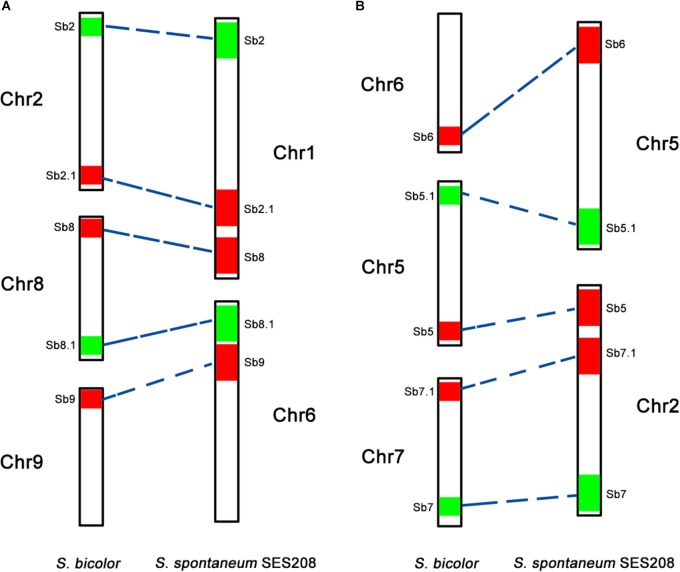
A schematic illustration of chromosomal rearrangements between sorghum and S. spontaneum. (A,B) Represent two chromosome rearrangement events involving sorghum chromosomes 2, 8, and 9, and sorghum chromosomes 6, 5, and 7, respectively. The chromosomes are depicted according to the oligo FISH results as shown in Figures 2, 3. The color bars represent the signals produced by the oligo probe. The relative length of each chromosome were drawn based on the data of the sorghum genome and Table 2.
FIGURE 5
FIGURE 5
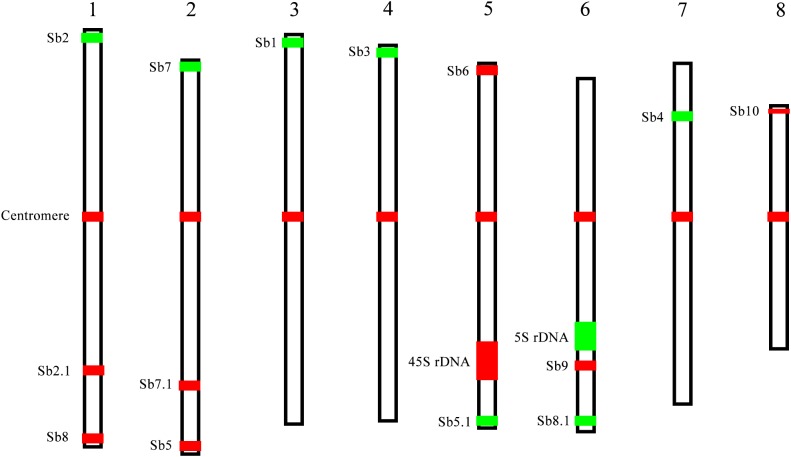
A representative chromosome schematic of S. spontaneum SES208. The color bars represent the signals produced by the probes used in this study. The relative length of each chromosome and signal positions were drawn based on the data in Table 2.
FIGURE 6
FIGURE 6
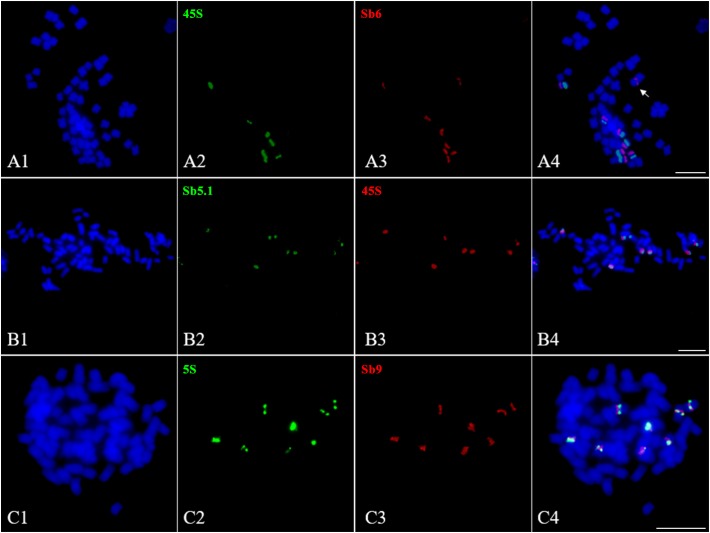
Fluorescence in situ hybridization mapping of 45S and 5S rDNAs in S. spontaneum SES208. (A1–A4), (B1–B4), and (C1–C4) Dual-probes FISH assay using probe pairs of 45S rDNA (green) and Sb6 (red), 45S rDNA (red) and Sb5.1 (green), and 5S rDNA (green) and Sb9 (red) in S. spontaneum SES208, respectively. (A1–A4) Show that the FISH signals of 45S rDNA and Sb6 are located at the opposite arms in chromosome 5 in S. spontaneum SES208. (B1–B4) Show that the FISH signals of 45S rDNA and Sb5.1 are located on the same arm in chromosome 5 in S. spontaneum SES208. (C1–C4) display that the FISH signals of 5S rDNA and Sb9 are located closely each other in the same arm in the same chromosome in S. spontaneum SES208. The arrow in (A4) indicates that one of the chromosome 5 homologous has no 45S rDNA signal. Scale bars, 10 μm.

References

    1. Boyle S., Rodesch M. J., Halvensleben H. A., Jeddeloh J. A., Bickmore W. A. (2011). Fluorescence in situ hybridization with high-complexity repeat-free oligonucleotide probes generated by massively parallel synthesis. Chromosome Res. 19 901–909. 10.1007/s10577-011-9245-0 - DOI - PMC - PubMed
    1. Braz G. T., He L., Zhao H., Zhang T., Semrau K., Rouillard J. M., et al. (2018). Comparative oligo-FISH mapping: an efficient and powerful methodology to reveal karyotypic and chromosomal evolution. Genetics 208 513–523. 10.1534/genetics.117.300344 - DOI - PMC - PubMed
    1. Cuadrado A., Acevedo R., Moreno Díaz de la Espina S., Jouve N., de la Torre C. (2004). Genome remodelling in three modern S. officinarum × S. spontaneum sugarcane cultivars. J. Exp. Bot. 55 847–854. 10.1093/jxb/erh093 - DOI - PubMed
    1. Daniels J., Roach B. T. (1987). “Taxonomy and evolution,” in Sugarcane Improvement Through Breeding, ed. Heinz D. J. (Amsterdam: Elsevier; ), 7–84. 10.1016/B978-0-444-42769-4.50007-2 - DOI
    1. Deng C. L., Qin R. Y., Wang N. N., Cao Y., Gao J., Gao W. J., et al. (2012). Karyotype of asparagus by physical mapping of 45S and 5S rDNA by FISH. J. Genet. 91 209–212. 10.1007/s12041-012-0159-1 - DOI - PubMed