


The Evolution of Selective Dorsal Rhizotomy for the Management of Spasticity
- PMID: 30460456
- PMCID: PMC6361072
- DOI: 10.1007/s13311-018-00690-4
The Evolution of Selective Dorsal Rhizotomy for the Management of Spasticity
Abstract
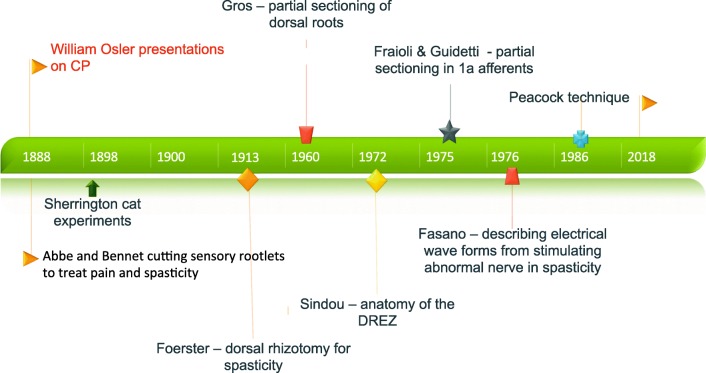
Selective dorsal rhizotomy is a key technique in the surgical management of spasticity in patients with cerebral palsy. The technique evolved from the late 1800s when pioneers like Dana and Abbe performed dorsal rhizotomy in their treatment of refractory pain. These surgeons noted a reduction in muscle tone associated with the operation. When Sherrington then published his Nobel prize-winning work on the corticospinal tract and its role in the neuromuscular system in the 1890s, the course was set for modifying spasticity by aiming surgery at the dorsal roots. This procedure underwent multiple modifications through the next century and today it is, arguably, the most commonly performed operation to treat cerebral palsy children with spasticity. Selective dorsal rhizotomy is a technique that still teaches us a great deal about neurophysiology on a daily basis and it is thanks to the pioneers, described in this article, that we have this tool in our armamentarium.
Keywords: Evolution; History; Selective dorsal rhizotomy; Spasticity.; Techniques.
Figures
References
-
- Sherrington CS. On reciprocal innervation of antagonistic muscles. Third note, Proceedings of the Royal Society of London. 1897;60:414–417. doi: 10.1098/rspl.1896.0062. - DOI
-
- Sherrington CS. On the reciprocal innervation of antagonistic muscles. Fifth note. Proceedings of the Royal Society of London. 1899;64:179–181. doi: 10.1098/rspl.1898.0090. - DOI
-
- Sherrington CS. On reciprocal innervation of antagonistic muscles.─ Tenth note. Proc. R. Soc. Lond. B. 1907;79:337–349. doi: 10.1098/rspb.1907.0026. - DOI
-
- Sherrington CS. Reciprocal innervation of antagonistic muscles. Thirteenth note.―On the antagonism between reflex inhibition and reflex excitation. Proc. R. Soc. Lond. B. 1908;80:565–578. doi: 10.1098/rspb.1908.0053. - DOI
-
- Sherrington CS. Reciprocal innervation of antagonistic muscles. Fourteenth note.-On double reciprocal innervation. Proc. R. Soc. Lond. B. 1909;81:249–268. doi: 10.1098/rspb.1909.0022. - DOI
Publication types
MeSH terms
LinkOut - more resources
Full Text Sources
Medical
Miscellaneous
