


The role of mitochondria in angiogenesis
- PMID: 30460535
- PMCID: PMC6426673
- DOI: 10.1007/s11033-018-4488-x
The role of mitochondria in angiogenesis
Abstract
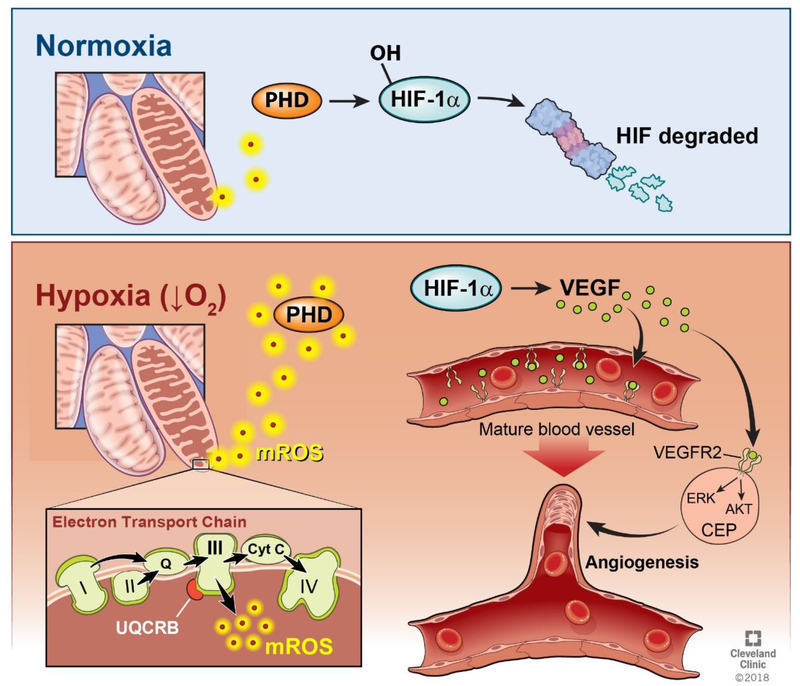
Angiogenesis extends pre-existing blood vessels to improve oxygen and nutrient delivery to inflamed or otherwise hypoxic tissues. Mitochondria are integral in this process, controlling cellular metabolism to regulate the proliferation, migration, and survival of endothelial cells which comprise the inner lining of blood vessels. Mitochondrial Complex III senses hypoxic conditions and generates mitochondrial reactive oxygen species which stabilize hypoxia-inducible factor (HIF-1α) protein. HIF-1α induces the transcription of the vegfa gene, allowing the translation of vascular endothelial growth factor protein, which interacts with mature and precursor endothelial cells, mobilizing them to form new blood vessels. This cascade can be inhibited at specific points by means of gene knockdown, enzyme treatment, and introduction of naturally occurring small molecules, providing insight into the relationship between mitochondria and angiogenesis. This review focuses on current knowledge of the overall role of mitochondria in controlling angiogenesis and outlines known inhibitors that have been used to elucidate this pathway which may be useful in future research to control angiogenesis in vivo.
Keywords: Angiogenesis; Endothelial; HIF-1α; Mitochondria; VEGF; mROS.
Conflict of interest statement
Declaration of Interest
The authors declare that they have no conflict of interest.
Figures
References
-
- Arany Z, Foo SY, Ma Y, Ruas JL, Bommi-Reddy A, Girnun G, Cooper M, Laznik D, Chinsomboon J, Rangwala SM, Baek KH, Rosenzweig A, Spiegelman BM (2008) HIF-independent regulation of VEGF and angiogenesis by the transcriptional coactivator PGC-1alpha. Nature 451(7181):1008–1012. doi:10.1038/nature06613 - DOI - PubMed
-
- Biniecka M, Canavan M, McGarry T, Gao W, McCormick J, Cregan S, Gallagher L, Smith T, Phelan JJ, Ryan J, O’Sullivan J, Ng CT, Veale DJ, Fearon U (2016) Dysregulated bioenergetics: a key regulator of joint inflammation. Ann Rheum Dis 75 (12):2192–2200. doi:10.1136/annrheumdis-2015-208476 - DOI - PMC - PubMed
Publication types
MeSH terms
Substances
Grants and funding
- HL103453/Foundation for the National Institutes of Health
- R37 HL060917/HL/NHLBI NIH HHS/United States
- R01 HL060917/HL/NHLBI NIH HHS/United States
- HL115008/Foundation for the National Institutes of Health
- P01 HL081064/HL/NHLBI NIH HHS/United States
- HL60917/Foundation for the National Institutes of Health
- U10 HL109250/HL/NHLBI NIH HHS/United States
- P01 HL103453/HL/NHLBI NIH HHS/United States
- R01 HL115008/HL/NHLBI NIH HHS/United States
- HL109250/Foundation for the National Institutes of Health
- HL081064/Foundation for the National Institutes of Health
LinkOut - more resources
Full Text Sources
