


Blunted stress reactivity reveals vulnerability to early life adversity in young adults with a family history of alcoholism
- PMID: 30461123
- PMCID: PMC6529292
- DOI: 10.1111/add.14501
Blunted stress reactivity reveals vulnerability to early life adversity in young adults with a family history of alcoholism
Abstract
Background and aims: People with blunted stress reactivity have poor impulse control and also show increased risk for alcoholism. Exposure to early life adversity (ELA) contributes to blunted reactivity, but individual differences in susceptibility to ELA are not well understood. This study aimed to determine whether exposure to ELA has a greater impact on stress reactivity in young adults with a family history of alcoholism (FH+) compared with young adults with no family history of alcoholism (FH-).
Design: Observational study using linear modeling.
Setting: Oklahoma, USA.
Participants: Seven hundred and nine young adults (398 females) recruited through community advertisement.
Measurements: We obtained heart rates and cortisol levels in subjects while undergoing public speaking and mental arithmetic stress compared with a resting control day (1418 test sessions). ELA was quantified as 0, 1 or > 1 adverse events experienced by age 15 years. FH+ people had one or two parents with an alcohol use disorder, and FH- controls had no such history for two generations.
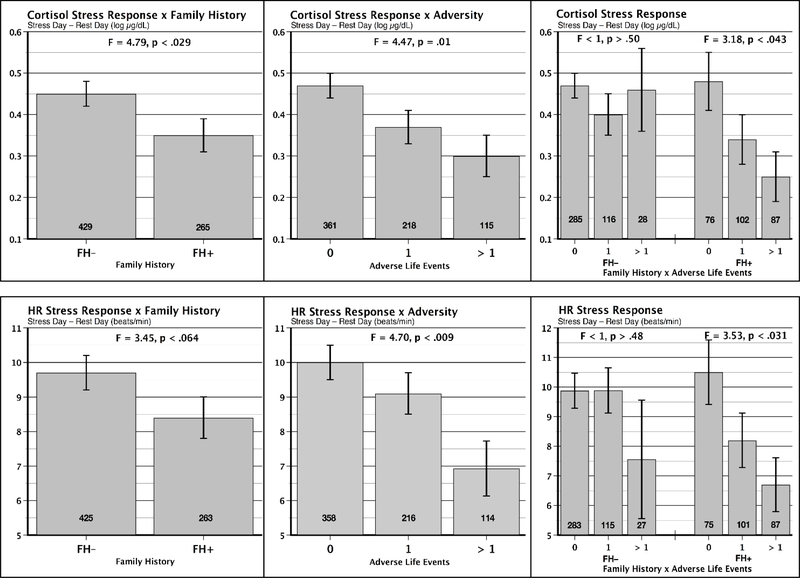
Findings: Increasing levels of ELA predicted progressive blunting of cortisol and heart rate reactivity for the whole sample (Fs = 4.57 and 4.70, Ps ≤ 0.011), but examination by FH status showed that the effect of ELA was significant only among FH+ (Fs ≥ 3.5, Ps < 0.05) and absent in FH- (Ps > 0.40). This difference in ELA impact was not explained by the cortisol diurnal cycle or subjective evaluation of the stressors.
Conclusions: People with a family history of alcoholism appear to be vulnerable, in terms of changes to physiological stress response, to the impact of exposure to early life adversity while people with no family history of alcoholism appear to be resilient. Blunted stress reactivity may reflect differential vulnerability to early life adversity in young adults with a family history of alcoholism.
Keywords: Cortisol; family history of alcoholism; heart rate; life-time adversity; public speaking; stress reactivity.
© 2018 Society for the Study of Addiction. This article has been contributed to by US Government employees whose work is in the public domain in the USA.
Conflict of interest statement
Declarations of interest
None
Figures
References
-
- Errico AL , Parsons OA , King AC , Lovallo WR Attenuated cortisol response to biobehavioral stressors in sober alcoholics, J Stud Alcohol 1993: 54: 393–398. - PubMed
-
- Bernardy NC , King AC , Parsons OA , Lovallo WR Altered cortisol response in sober alcoholics: an examination of contributing factors, Alcohol 1996: 13: 493–498. - PubMed
-
- Lovallo WR , Dickensheets SL , Myers DA , Thomas TL , Nixon SJ Blunted stress cortisol response in abstinent alcoholic and polysubstance-abusing men, Alcohol Clin Exp Res 2000: 24: 651–658. - PubMed
-
- King RJ , Jones J , Scheuer JW , Curtis D , Zarcone VP Plasma cortisol correlates of impulsivity and substance abuse, Personality and Individual Differences 1990: 11: 287–291.
Publication types
MeSH terms
Grants and funding
LinkOut - more resources
Full Text Sources
Medical
Miscellaneous
