Lactobacillus rhamnosus GG versus Placebo for Acute Gastroenteritis in Children
- PMID: 30462938
- PMCID: PMC6358014
- DOI: 10.1056/NEJMoa1802598
Lactobacillus rhamnosus GG versus Placebo for Acute Gastroenteritis in Children
Abstract
Background: Acute gastroenteritis develops in millions of children in the United States every year, and treatment with probiotics is common. However, data to support the use of probiotics in this population are limited.
Methods: We conducted a prospective, randomized, double-blind trial involving children 3 months to 4 years of age with acute gastroenteritis who presented to one of 10 U.S. pediatric emergency departments. Participants received a 5-day course of Lactobacillus rhamnosus GG at a dose of 1×10¹⁰ colony-forming units twice daily or matching placebo. Follow-up surveys were conducted daily for 5 days and again 14 days after enrollment and 1 month after enrollment. The primary outcome was moderate-to-severe gastroenteritis, which was defined as an illness episode with a total score on the modified Vesikari scale of 9 or higher (scores range from 0 to 20, with higher scores indicating more severe disease), within 14 days after enrollment. Secondary outcomes included the duration and frequency of diarrhea and vomiting, the duration of day-care absenteeism, and the rate of household transmission (defined as the development of symptoms of gastroenteritis in previously asymptomatic household contacts).
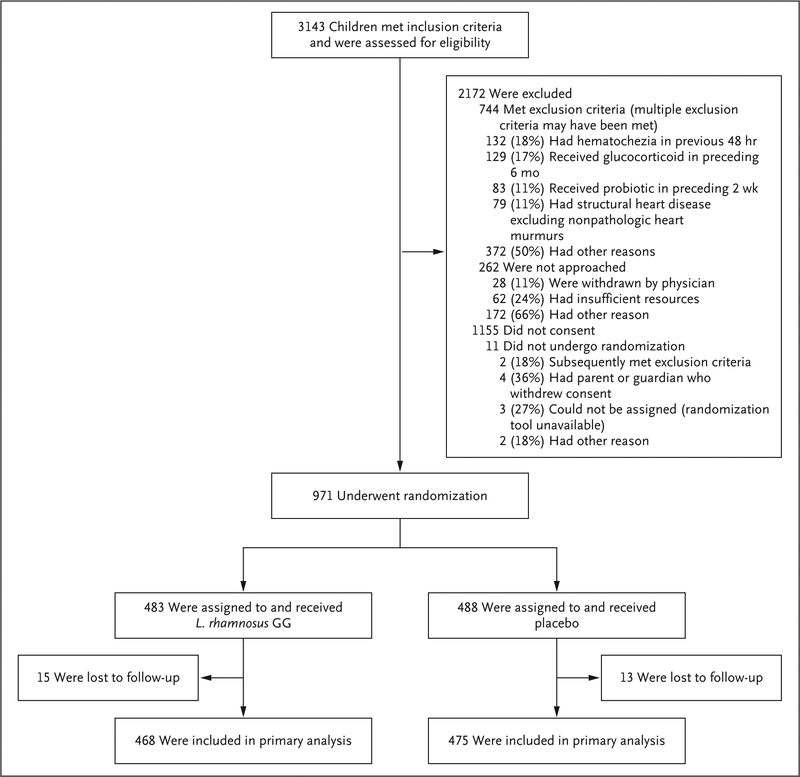
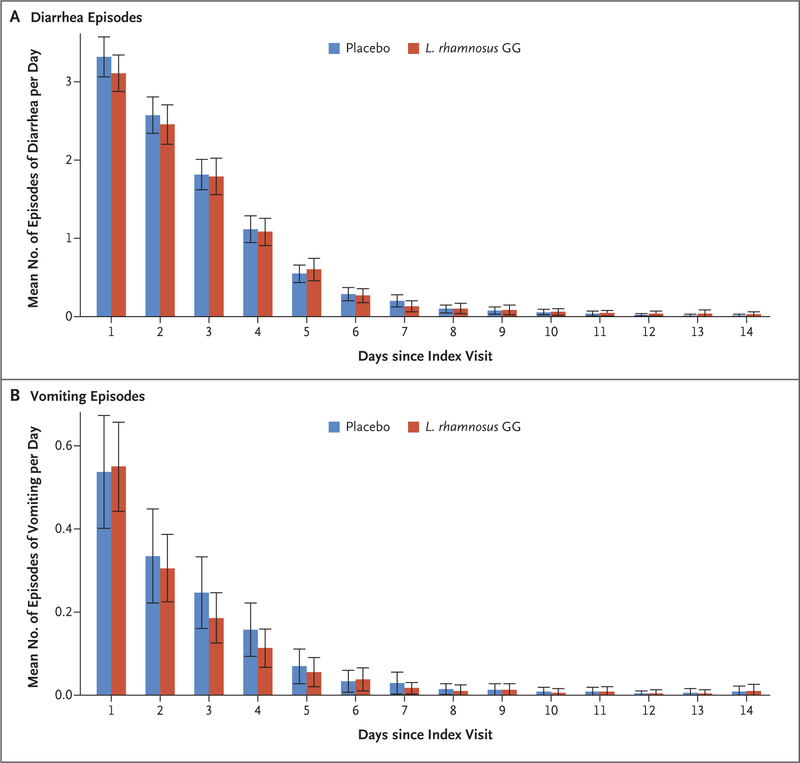
Results: Among the 971 participants, 943 (97.1%) completed the trial. The median age was 1.4 years (interquartile range, 0.9 to 2.3), and 513 participants (52.9%) were male. The modified Vesikari scale score for the 14-day period after enrollment was 9 or higher in 55 of 468 participants (11.8%) in the L. rhamnosus GG group and in 60 of 475 participants (12.6%) in the placebo group (relative risk, 0.96; 95% confidence interval, 0.68 to 1.35; P=0.83). There were no significant differences between the L. rhamnosus GG group and the placebo group in the duration of diarrhea (median, 49.7 hours in the L. rhamnosus GG group and 50.9 hours in the placebo group; P=0.26), duration of vomiting (median, 0 hours in both groups; P=0.17), or day-care absenteeism (median, 2 days in both groups; P=0.67) or in the rate of household transmission (10.6% and 14.1% in the two groups, respectively; P=0.16).
Conclusions: Among preschool children with acute gastroenteritis, those who received a 5-day course of L. rhamnosus GG did not have better outcomes than those who received placebo. (Funded by the Eunice Kennedy Shriver National Institute of Child Health and Human Development and others; ClinicalTrials.gov number, NCT01773967 .).
Figures
Comment in
-
Probiotics fail to improve preschool gastroenteritis.Nat Rev Gastroenterol Hepatol. 2019 Feb;16(2):76. doi: 10.1038/s41575-019-0104-3. Nat Rev Gastroenterol Hepatol. 2019. PMID: 30626899 No abstract available.
-
Lactobacillus administration does not affect acute gastroenteritis.J Pediatr. 2019 May;208:294-297. doi: 10.1016/j.jpeds.2019.02.053. J Pediatr. 2019. PMID: 31027623 No abstract available.
-
Lactobacillus for Gastroenteritis in Children.N Engl J Med. 2019 May 9;380(19):e36. doi: 10.1056/NEJMc1900909. N Engl J Med. 2019. PMID: 31067396 No abstract available.
-
Lactobacillus for Gastroenteritis in Children.N Engl J Med. 2019 May 9;380(19):e36. doi: 10.1056/NEJMc1900909. N Engl J Med. 2019. PMID: 31067397 No abstract available.
-
Lactobacillus for Gastroenteritis in Children.N Engl J Med. 2019 May 9;380(19):e36. doi: 10.1056/NEJMc1900909. N Engl J Med. 2019. PMID: 31067398 No abstract available.
References
-
- World Health Organization. Diarrhoeal disease fact sheet. May 2017. (http://www.who.int/mediacentre/factsheets/fs330/en/).
-
- Feizizadeh S, Salehi-Abargouei A, Akbari V. Efficacy and safety of Saccharomyces boulardii for acute diarrhea. Pediatrics 2014; 134(1): e176–e191. - PubMed
-
- Szajewska H, Skórka A, Ruszczyński M, Gieruszczak-Białek D. Meta-analysis: Lactobacillus GG for treating acute gastroenteritis in children — updated analysis of randomised controlled trials. Aliment Pharmacol Ther 2013; 38: 467–76. - PubMed
Publication types
MeSH terms
Associated data
Grants and funding
LinkOut - more resources
Full Text Sources
Other Literature Sources
Medical