


Defining the role of neutrophil-to-lymphocyte ratio in COPD: a systematic literature review
- PMID: 30464448
- PMCID: PMC6225854
- DOI: 10.2147/COPD.S178068
Defining the role of neutrophil-to-lymphocyte ratio in COPD: a systematic literature review
Abstract
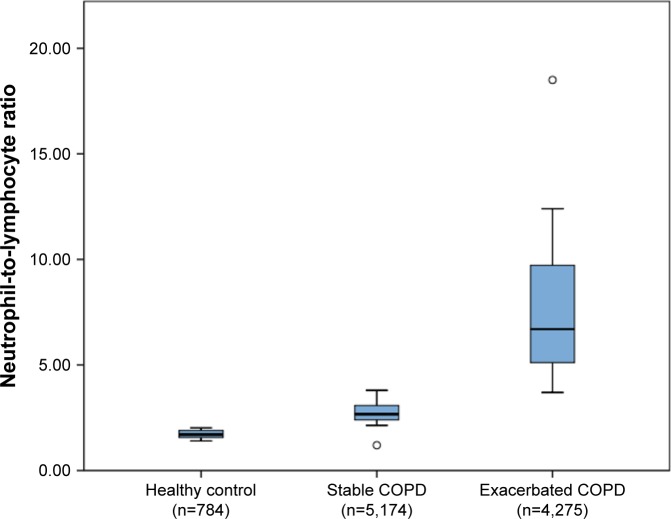
COPD is characterized by a pulmonary and systemic inflammatory process. Several authors have reported the elevation of multiple inflammatory markers in patients with COPD; however, their use in routine clinical practice has limitations. The neutrophil-to-lymphocyte ratio (NLR) is a useful and cost-effective inflammatory marker derived from routine complete blood count. We performed a systematic literature review using the PRISMA statement. Twenty-two articles were included, recruiting 7,601 COPD patients and 784 healthy controls. Compared with controls, COPD patients had significantly higher NLR values. We found a significant correlation between the NLR and clinical/functional parameters (FEV1, mMRC, and BODE index) in COPD patients. Elevation of the NLR is associated with the diagnosis of acute exacerbation of COPD (pooled data propose a cut-off value of 3.34 with a median sensitivity, specificity, and area under the curve of 80%, 86%, and 0.86, respectively). Additionally, increased NLR is also associated with the diagnosis of a bacterial infection in exacerbated patients, with a cut-off value of 7.30, although with a low sensitivity and specificity. The NLR is an independent predictor of in-hospital and late mortality after exacerbation. In conclusion, the NLR could be a useful marker in COPD patients; however, further studies are needed to better identify the clinical value of the NLR.
Keywords: GOLD stage; acute exacerbations of COPD; bacterial infection; eosinophilia; inflammatory biomarkers; mortality in COPD.
Conflict of interest statement
Disclosure The authors report no conflicts of interest in this work.
Figures

References
-
- Vogelmeier CF, Criner GJ, Martinez FJ, et al. Global strategy for the diagnosis, management, and prevention of chronic obstructive lung disease 2017 report. GOLD executive summary. Am J Respir Crit Care Med. 2017;195(5):557–582. - PubMed
-
- Walter RE, Wilk JB, Larson MG, et al. Systemic inflammation and COPD: the Framingham Heart Study. Chest. 2008;133(1):19–25. - PubMed
