


Magnetic resonance imaging analysis of work-related chronic low back pain: comparisons of different lumbar disc patterns
- PMID: 30464586
- PMCID: PMC6216966
- DOI: 10.2147/JPR.S162988
Magnetic resonance imaging analysis of work-related chronic low back pain: comparisons of different lumbar disc patterns
Abstract
Background: Currently, there is a lack of comparative research about different lumbar disc patterns in patients with work-related chronic low back pain (CLBP) based on magnetic resonance imaging (MRI) analysis. Therefore, this study, on different patterns of lumbar disc degeneration or herniation in patients with CLBP, is valuable. In this study, we retrospectively investigated lumbar degenerative changes in patients with CLBP by using MRI analysis.
Materials and methods: Two hundred and eighty-three patients (110 women and 173 men) with work-related CLBP were enrolled and divided into four groups based on intervertebral disc morphology from MRI analysis, including normal discs (ND) group, degenerative discs (DD) group, bulging discs (BD) group, and herniated discs (HD) group. Demographic characteristics, occupational information, Visual Analog Scale (VAS) scores, and Oswestry Disability Index (ODI) scores were analyzed. Moreover, multiple parameters were investigated in the MRI analysis.
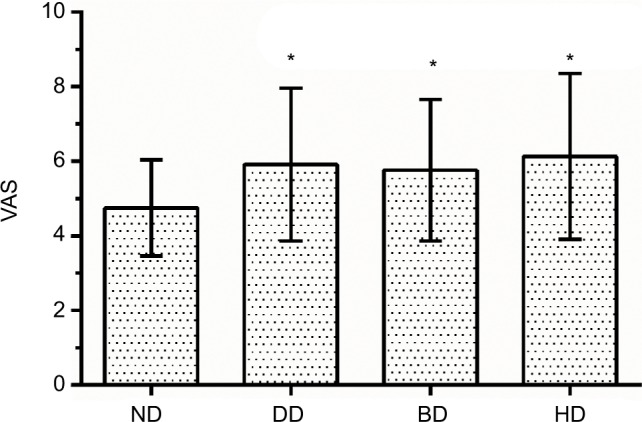
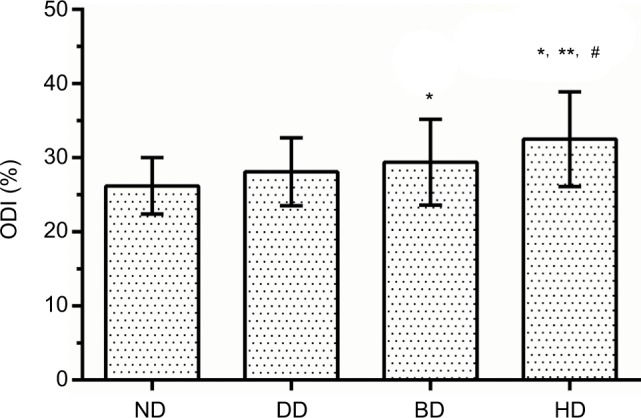
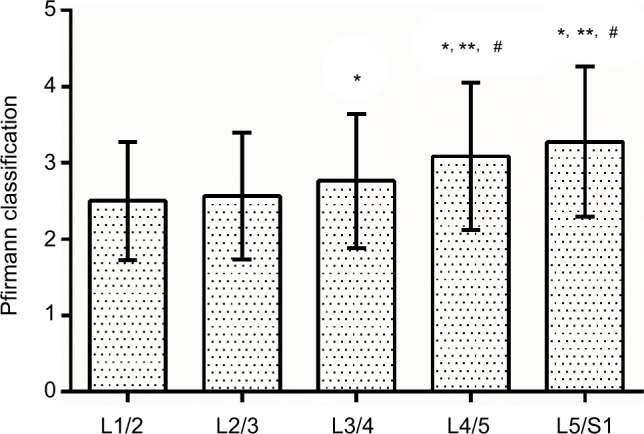
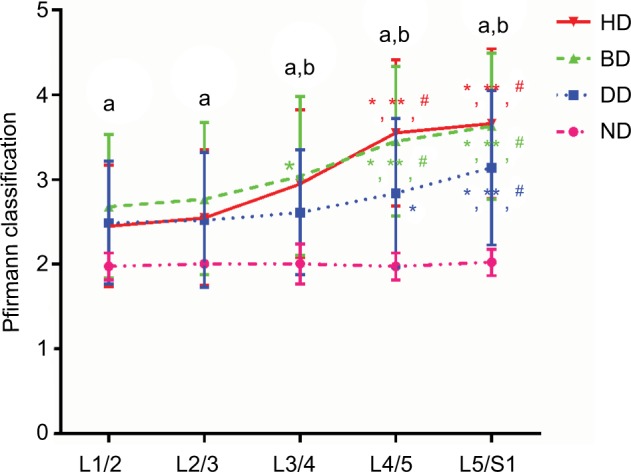
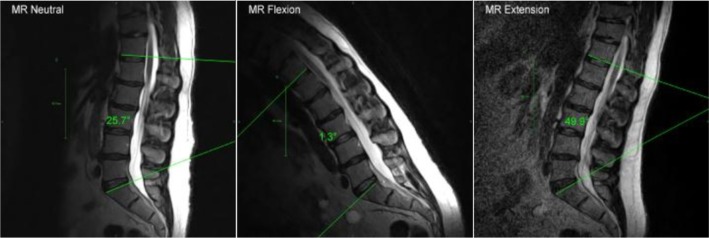
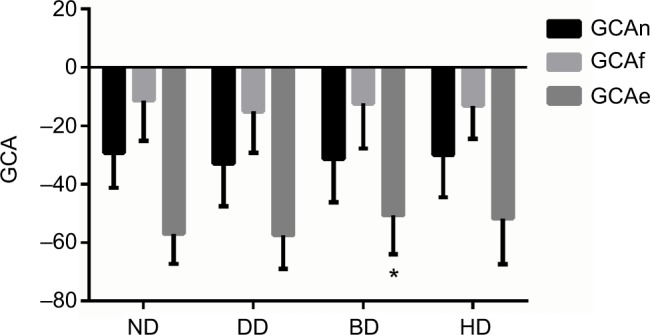
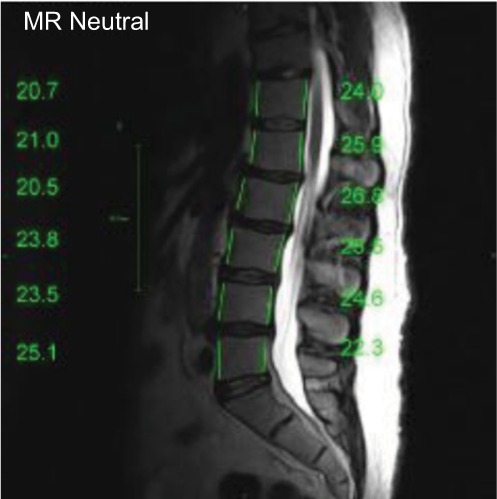
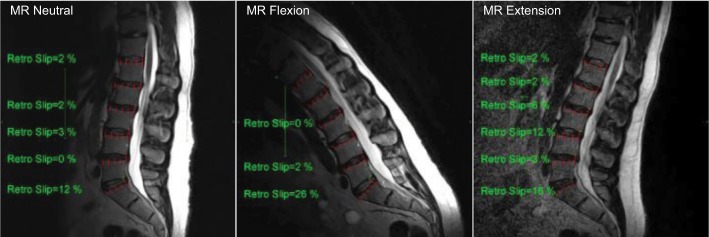
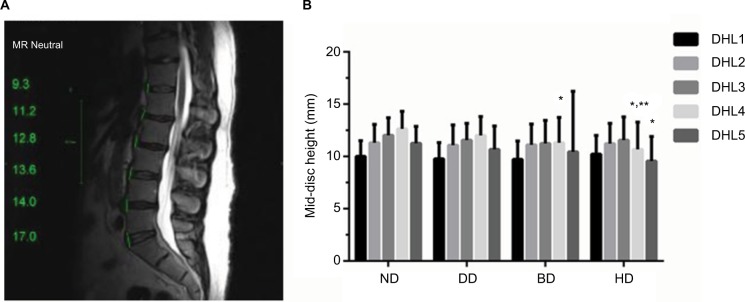
Results: The mean age of all 283 patients was 41.8±12.0 years (range, 18-80) and the mean duration of CLBP for all patients was 24.5±24.9 months. There were no significant differences in the patients' BMI, history of smoking, and education level (P>0.05). The three most common occupational types were manual worker, desk worker, and technician. The VAS and ODI scores of patients with CLBP in the DD, BD, and HD groups were significantly higher than those of patients in the ND group (P<0.05). The degrees of degeneration of L4/5 and L5/S1 were significantly higher than those of other intervertebral discs (P<0.05). The disc heights of L4/5 in the BD and HD groups were significantly lower than those of the ND group (P<0.05) and the disc height of L5/S1 in the HD group was significantly lower than that of the ND group (P<0.05). At the neutral position, the distances of L3/4, L4/5, and L5/S1 discs' bulge/herniation in the BD and HD groups were significantly higher than those in the ND and DD groups (P<0.05).
Conclusion: In summary, more severe degenerative changes of lower lumbar discs (L4/5 and L5/S1) such as higher degree of degeneration of disc, lower disc height, and significant displacement of disc were found in patients with work-related CLBP based on MRI analysis.
Keywords: bulging discs; chronic low back pain; degenerative discs; herniated discs; magnetic resonance imaging analysis.
Conflict of interest statement
Disclosure The authors report no conflicts of interest in this work.
Figures
References
-
- Morlion B. Chronic low back pain: pharmacological, interventional and surgical strategies. Nat Rev Neurol. 2013;9(8):462–473. - PubMed
-
- Balagué F, Mannion AF, Pellisé F, Cedraschi C. Non-specific low back pain. Lancet. 2012;379(9814):482–491. - PubMed
-
- GBD 2016 Disease and Injury Incidence and Prevalence Collaborators Global, regional, and national incidence, prevalence, and years lived with disability for 328 diseases and injuries for 195 countries, 1990–2016: a systematic analysis for the Global Burden of Disease Study 2016. Lancet. 2017;390(10100):1211–1259. - PMC - PubMed
-
- Gore M, Sadosky A, Stacey BR, Tai KS, Leslie D. The burden of chronic low back pain: clinical comorbidities, treatment patterns, and health care costs in usual care settings. Spine. 2012;37(11):E668–E677. - PubMed
-
- Ract I, Meadeb JM, Mercy G, et al. A review of the value of MRI signs in low back pain. Diagn Interv Imaging. 2015;96(3):239–249. - PubMed
LinkOut - more resources
Full Text Sources
