


Behavior change techniques for increasing physical activity in cancer survivors: a systematic review and meta-analysis of randomized controlled trials
- PMID: 30464612
- PMCID: PMC6215922
- DOI: 10.2147/CMAR.S170064
Behavior change techniques for increasing physical activity in cancer survivors: a systematic review and meta-analysis of randomized controlled trials
Abstract
Purpose: The purpose of this systematic review and meta-analysis is to investigate how physical activity (PA) can be effectively promoted in cancer survivors. The effect of PA-promoting interventions in general, behavior change techniques (BCTs), and further variables as moderators in particular are evaluated.
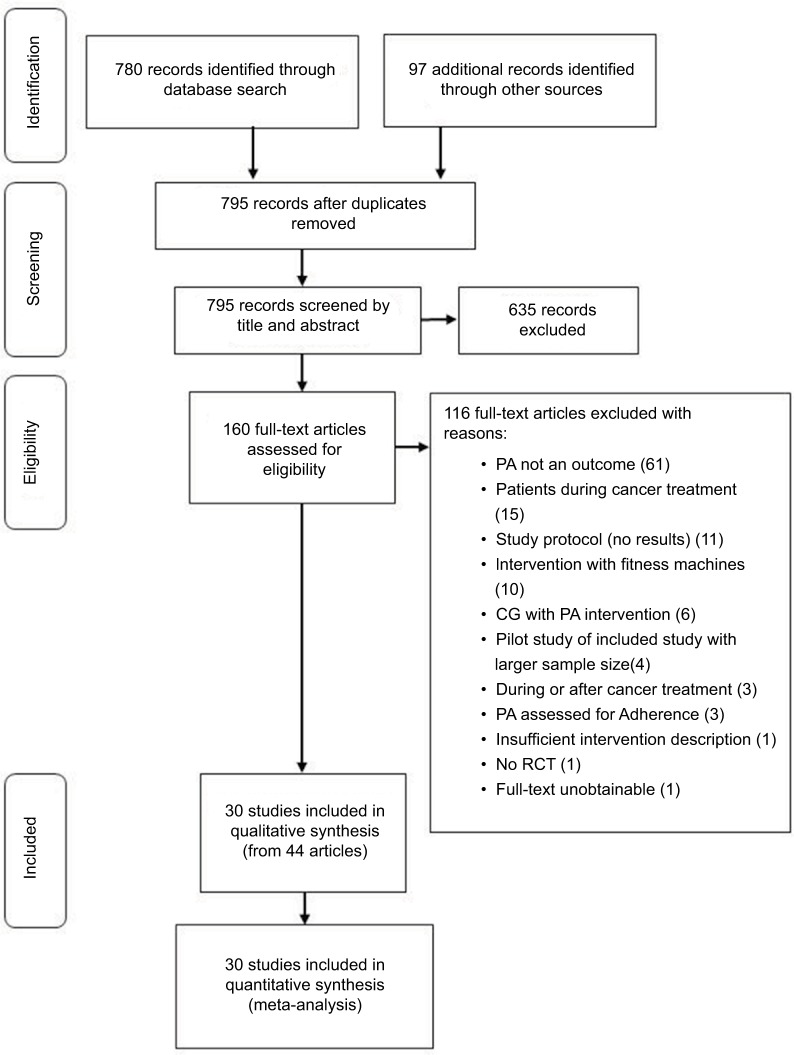
Methods: This study included randomized controlled trials of lifestyle interventions aiming at an increase in PA that can be carried out independently at home, published by December 2016, for adults diagnosed with cancer after completion of the main treatment. Primary outcomes were subjective and objective measures of PA prior to and immediately after the intervention. Meta-analysis and meta-regression were used to estimate effect sizes (ES) in terms of standardized mean differences, variation between ES in terms of heterogeneity indices (I2), and moderator effects in terms of regression coefficients.
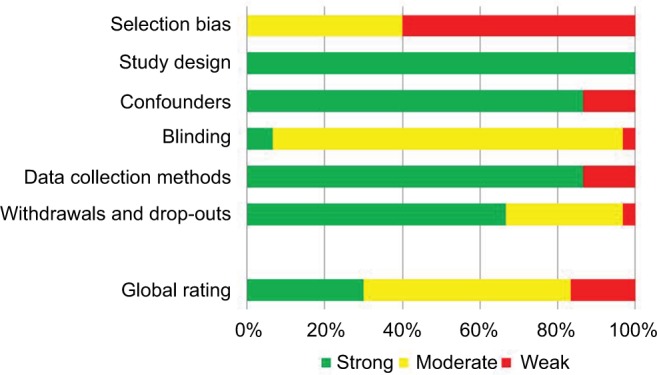
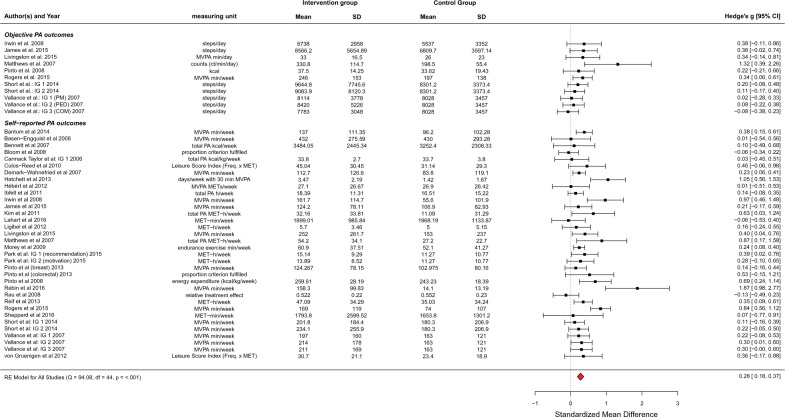
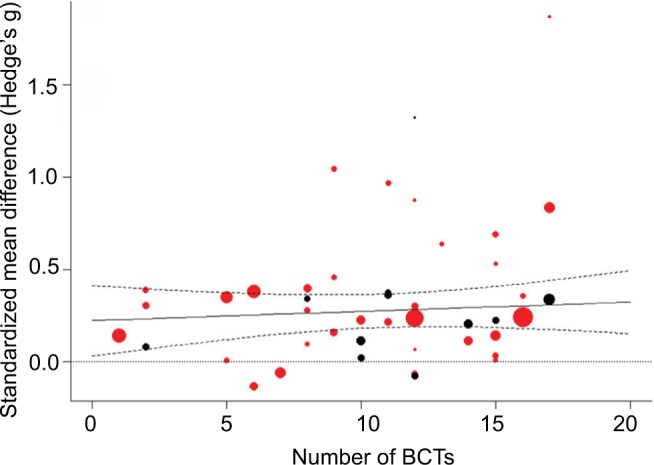
Results: This study included 30 studies containing 45 ES with an overall significant small positive effect size of 0.28 (95% confidence interval=0.18-0.37) on PA, and I2=54.29%. The BCTs Prompts, Reduce prompts, Graded tasks, Non-specific reward, and Social reward were significantly related to larger effects, while Information about health consequences and Information about emotional consequences, as well as Social comparison were related to smaller ES. The number of BCTs per intervention did not predict PA effects. Interventions based on the Theory of Planned Behavior were associated with smaller ES, and interventions with a home-based setting component were associated with larger ES. Neither the duration of the intervention nor the methodological quality explained differences in ES.
Conclusion: Certain BCTs were associated with an increase of PA in cancer survivors. Interventions relying on BCTs congruent with (social) learning theory such as using prompts and rewards could be especially successful in this target group. However, large parts of between-study heterogeneity in ES remained unexplained. Further primary studies should directly compare specific BCTs and their combinations.
Keywords: behavior change; exercise; intervention methods; lifestyle; moderator effects; tumor.
Conflict of interest statement
Disclosure The authors report no conflicts of interest in this work.
Figures
References
-
- Stewart BW, Wild CP. World Cancer Report 2014. Lyon: International Agency for Research on Cancer/World Health Organization; 2014. online ed.
-
- Centers for Disease Control and Prevention Cancer survivors—United States, 2007. MMWR Morb Mortal Wkly Rep. 2011;60(9):269–272. - PubMed
-
- Siegel RL, Miller KD, Jemal A. Cancer statistics, 2017. CA: A Cancer Journal for Clinicians. 2017;67(1):7–30. - PubMed
-
- Cancer Research UK Cancer survival statistics. [Accessed September 15, 2017]. Available from: http://www.cancerresearchuk.org/health-professional/cancer-statistics/su....
-
- Hewitt M, Greenfield S, Stovall E, editors. From Cancer Patient to Cancer Survivor: Lost in Transition. Washington, DC: National Academy Press; 2006.
LinkOut - more resources
Full Text Sources
Medical
