


Mediators of the Effect of Childhood Socioeconomic Status on Late Midlife Cognitive Abilities: A Four Decade Longitudinal Study
- PMID: 30465026
- PMCID: PMC6176967
- DOI: 10.1093/geroni/igy003
Mediators of the Effect of Childhood Socioeconomic Status on Late Midlife Cognitive Abilities: A Four Decade Longitudinal Study
Abstract
Background and objectives: Childhood socioeconomic status (cSES) is found to predict later-life cognitive abilities, yet the mechanisms underlying these associations remain unclear. The objective of this longitudinal study was to examine the direct and indirect paths through which cSES influences late midlife cognitive outcomes.
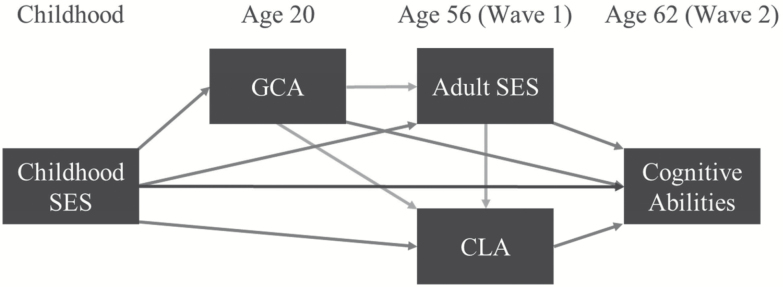
Research design and methods: Participants were 1,009 male twins in the Vietnam Era Twin Study of Aging (VETSA). At mean ages 20 and 62, participants completed a standardized test for general cognitive ability (GCA). The age 62 cognitive assessment also included in-person tests of processing speed, episodic memory, abstract reasoning, working memory, verbal fluency, visual-spatial ability, and executive functions. At mean age 56, participants were interviewed regarding their own and their parents' education and occupation, and completed questionnaires about cognitive leisure activities and sociodemographic information. Multiple mediation analyses were conducted to examine the direct path effects and indirect path effects of cSES through age 20 GCA, adult SES, and cognitive leisure activities on seven cognitive outcomes at age 62, adjusting for age, ethnicity, and non-independence of observations.
Results: Total (direct plus indirect) effects were significant for all measures with the exception of executive functions. Men from lower cSES backgrounds had poorer cognitive functioning in late midlife. The direct effect of cSES was partially mediated for abstract reasoning, and was fully mediated for the remaining six cognitive outcomes. Total indirect effects accounted for at least half of the total effects in each model, with paths through age 20 GCA explaining most of the total indirect effects.
Discussion and implications: cSES predicted cognitive functioning in late middle age Using multiple mediation models, we show that lower cSES predicts poorer cognition in late midlife primarily through young adult cognitive ability and to a lesser extent through SES in adulthood and engagement in cognitively stimulating activities.
Keywords: Adult development; Cognition; Cognitive leisure activities; Socioeconomic status; Veterans.
Conflict of interest statement
Conflict of Interest None.
Figures
References
-
- Baron R. M. & Kenny D. A (1986). The moderator-mediator variable distinction in social psychological research: Conceptual, strategic, and statistical considerations. Journal of Personality and Social Psychology, 51, 1173–1182. doi:10.1037/0022-3514.51.6.1173 - PubMed
-
- Bradley R. H. & Corwyn R. F (2002). Socioeconomic status and child development. Annual Review of Psychology, 53, 371–399. doi:10.1146/annurev.psych.53.100901.135233 - PubMed
-
- Boehmer T. K., Flanders W. D., McGeehin M. A., Boyle C. A., & Barrett D. H (2004). Postservice mortality among Vietnam veterans: 30-year follow-up. Archives of Internal Medicine, 164, 1908–1916. doi:10.1001/archinte.164.17.1908 - PubMed
Grants and funding
LinkOut - more resources
Full Text Sources
