


Placental Macrophages: A Window Into Fetal Microglial Function in Maternal Obesity
- PMID: 30465871
- PMCID: PMC6527487
- DOI: 10.1016/j.ijdevneu.2018.11.004
Placental Macrophages: A Window Into Fetal Microglial Function in Maternal Obesity
Abstract
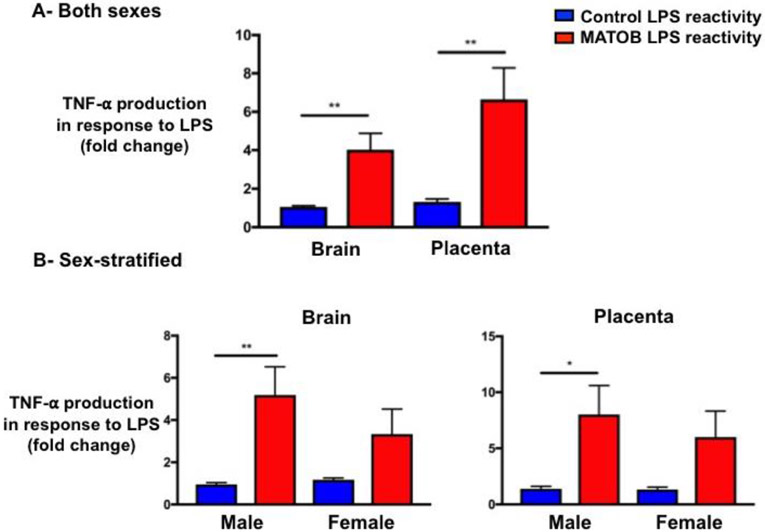
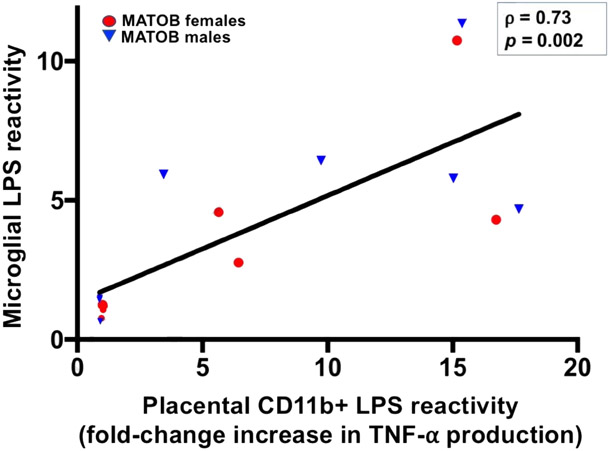
Fetal placental macrophages and microglia (resident brain macrophages) have a common origin in the fetal yolk sac. Yolk-sac-derived macrophages comprise the permanent pool of brain microglia throughout an individual's lifetime. Inappropriate fetal microglial priming may therefore have lifelong neurodevelopmental consequences, but direct evaluation of microglial function in a living fetus or neonate is impossible. We sought to test the hypothesis that maternal obesity would prime both placental macrophages and fetal brain microglia to overrespond to an immune challenge, thus providing a window into microglial function using placental cells. Obesity was induced in C57BL/6 J mice using a 60% high-fat diet. On embryonic day 17.5, fetal brain microglia and corresponding CD11b + placental cells were isolated from fresh tissue. Cells were treated with media or lipopolysaccharide (LPS). Tumor necrosis factor-alpha (TNF-α) production by stimulated and unstimulated cells was quantified via ELISA. We demonstrate for the first time that the proinflammatory cytokine production of CD11b + placental cells is strongly correlated with that of brain microglia (Spearman's ρ = 0.73, p = 0.002) in the setting of maternal obesity. Maternal obesity-exposed CD11b + cells had an exaggerated response to LPS compared to controls, with a 5.1-fold increase in TNF-α production in placentas (p = 0.003) and 3.8-fold increase in TNF-α production in brains (p = 0.002). In sex-stratified analyses, only male obesity-exposed brains and placentas had significant increase in TNF-α production in response to LPS. Taken together, these data suggest that maternal obesity primes both placental macrophages and fetal brain microglia to overproduce a proinflammatory cytokine in response to immune challenge. Male brain and placental immune response is more marked than female in this setting. Given that fetal microglial priming may impact neuroimmune function throughout the lifespan, these data could provide insight into the male predominance of certain neurodevelopmental morbidities linked to maternal obesity, including cognitive dysfunction, autism spectrum disorder, and ADHD. Placental CD11b+ macrophages may have the potential to serve as an accessible biomarker of aberrant fetal brain immune activation in maternal obesity. This finding may have broader implications for assaying the impact of other maternal exposures on fetal brain development.
Keywords: Hofbauer cells; fetal brain; inflammation; maternal obesity; microglia; placenta.
Copyright © 2018 ISDN. Published by Elsevier Ltd. All rights reserved.
Figures
References
-
- Ajami B, Bennett JL, Krieger C, Tetzlaff W, and Rossi FM. 2007. 'Local self-renewal can sustain CNS microglia maintenance and function throughout adult life', Nat Neurosci, 10: 1538–43. - PubMed
-
- Bar J, Schreiber L, Saruhanov E, Ben-Haroush A, Golan A, and Kovo M. 2012. 'Placental histopathological findings in obese and nonobese women with complicated and uncomplicated pregnancies', Arch Gynecol Obstet, 286: 1343–7. - PubMed
MeSH terms
Substances
Grants and funding
LinkOut - more resources
Full Text Sources
Other Literature Sources
Research Materials
