


Dieting is associated with reduced bone mineral accrual in a longitudinal cohort of girls
- PMID: 30466435
- PMCID: PMC6251190
- DOI: 10.1186/s12889-018-6206-y
Dieting is associated with reduced bone mineral accrual in a longitudinal cohort of girls
Abstract
Background: Peak bone mass accrual occurs during adolescence, a time when dieting and related eating behaviors are common. Impaired bone mineral accrual is a known consequence of eating disorders in adolescents, but the effects of subclinical dieting behaviors on bone mineral content (BMC) have not been described in this age group. The goal of this analysis was to determine whether dieting behavior in preadolescence and adolescence is associated with bone mineral accrual in adolescent girls.
Methods: Non-Hispanic white girls (n = 139) were followed in a longitudinal cohort study. BMC was assessed at ages 9 and 15y. Dieting to lose weight was reported every 2 years, and dietary restraint and disinhibition, eating attitudes, weight concerns, and body esteem were assessed at age 11y. Girls were classified as "early dieters" if they first dieted by age 11y (31.7%), "adolescent dieters" if they first dieted after 11y (46.8%), or non-dieters if they did not report dieting by 15 y (21.6%). The effect of dieting related variables on BMC at 15y and change in BMC from 9 to 15y was assessed using linear regression, controlling for height, weight, BMI, physical activity, and pubertal status.
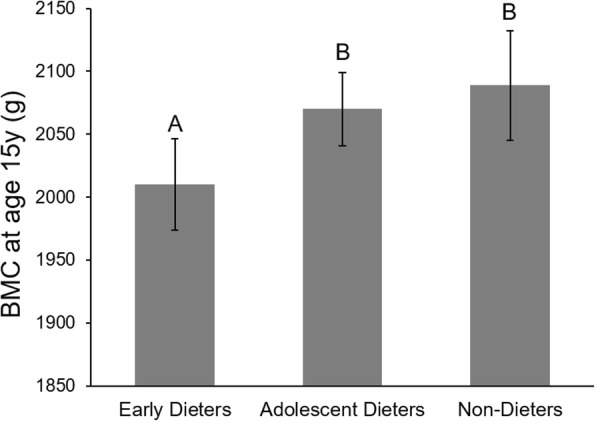
Results: Girls who first reported dieting to lose weight by age 11y had a 4.2% lower bone mineral accrual across adolescence (p = 0.02) and 3.1% lower BMC at age 15y (p = 0.005) than girls who first reported dieting after 11y or not at all. Number of weight control behaviors used, dietary restraint, and weight concerns were also negatively associated with BMC (p < 0.05).
Conclusions: Dieting behavior in preadolescence is associated with reduced bone mineral accrual. Strategies to promote optimal bone development should include prevention of dieting.
Trial registration: Clinicaltrials.gov NCT03342430, November 17, 2017. Retrospectively registered.
Keywords: Adolescence; Bone; Children; Dieting; Eating behavior.
Conflict of interest statement
Ethics approval and consent to participate
This study was approved by the Institutional Review Board of the Pennsylvania State University (#18342). Parents provided written consent for their child’s participation.
Consent for publication
Not applicable.
Competing interests
The authors declare that they have no competing interests.
Publisher’s Note
Springer Nature remains neutral with regard to jurisdictional claims in published maps and institutional affiliations.
Figures
References
-
- Weaver CM, Gordon CM, Janz KF, Kalkwarf HJ, Lappe JM, Lewis R, O'Karma M, Wallace TC, Zemel BS. The National Osteoporosis Foundation's position statement on peak bone mass development and lifestyle factors: a systematic review and implementation recommendations. Osteoporos Int. 2016;27(4):1281–1386. doi: 10.1007/s00198-015-3440-3. - DOI - PMC - PubMed
Publication types
MeSH terms
Associated data
Grants and funding
LinkOut - more resources
Full Text Sources
Medical
