


doi: 10.1186/s13073-018-0598-2.
Acquired mechanisms of immune escape in cancer following immunotherapy
Affiliations
- PMID: 30466478
- PMCID: PMC6249768
- DOI: 10.1186/s13073-018-0598-2
Item in Clipboard
Acquired mechanisms of immune escape in cancer following immunotherapy
Genome Med.
.
Abstract
Immunotherapy has revolutionized the management of numerous cancers; however, a substantial proportion that initially respond subsequently acquire means of immune escape and relapse. Analysis of recent clinical trials permits us to preliminarily understand how immunotherapies exert evolutionary pressures: selecting cancer subclones deficient in antigenicity and/or immunogenicity, thereby facilitating immune escape.
Conflict of interest statement
Competing interests
CJW reports being a co-founder of Neon Therapeutics and a member of its scientific advisory board. The remaining authors declare that they have no competing interests.
Publisher’s Note
Springer Nature remains neutral with regard to jurisdictional claims in published maps and institutional affiliations.
Figures
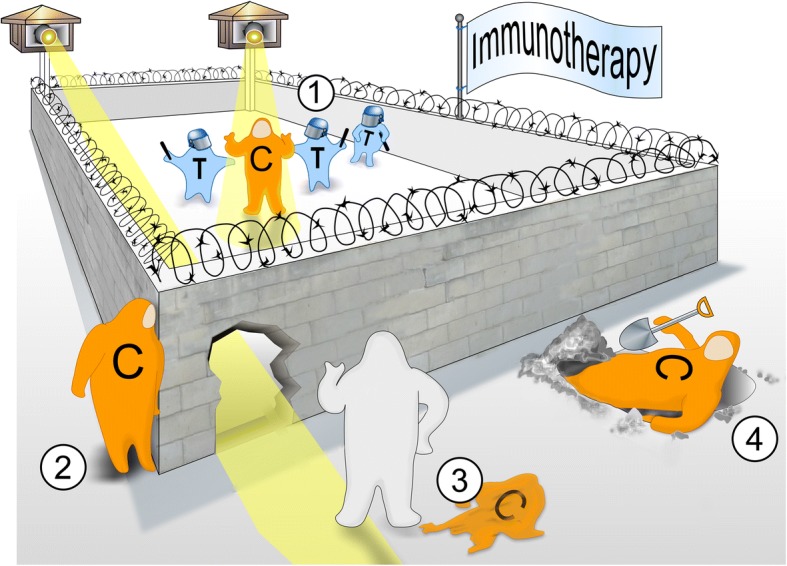
The great escape: acquired mechanisms of immune evasion in cancer. Multiple immunotherapeutic approaches have potently targeted T-cell responses (T) against cancer cells (C) in the clinical setting (1); however, a substantial subset of initial responders acquire novel immunogenomic means of immune escape and relapse. From clinical investigations, the most common acquired mechanisms of immune escape appear to be (2) deficits in antigen presentation machinery, (3) loss of antigenicity, and/or (4) loss of immunogenicity—including by exploiting bypass immune checkpoint pathways
References
-
- Schreiber RD. Tumor immunology. Adv Immunol. 2016;130:2–318.
-
- Sotillo E, Barrett DM, Black KL, Bagashev A, Oldridge D, Wu G, et al. Convergence of acquired mutations and alternative splicing of CD19 enables resistance to CART-19 immunotherapy. Cancer Discov. 2015;5:1282–1295. doi: 10.1158/2159-8290.CD-15-1020. - DOI - PMC - PubMed
-
- Mehta A, Kim YJ, Robert L, Tsoi J, Comin-Anduix B, Berent-Maoz B, et al. Immunotherapy resistance by inflammation-induced dedifferentiation. Cancer Discov. 2018;8:935–943. doi: 10.1158/2159-8290.CD-17-1178. - DOI - PMC - PubMed
Publication types
MeSH terms
Grants and funding
LinkOut - more resources
Full Text Sources
Other Literature Sources
