


Structural network disruption markers explain disability in multiple sclerosis
- PMID: 30467210
- PMCID: PMC6518973
- DOI: 10.1136/jnnp-2018-318440
Structural network disruption markers explain disability in multiple sclerosis
Abstract
Objective: To evaluate whether structural brain network metrics correlate better with clinical impairment and information processing speed in multiple sclerosis (MS) beyond atrophy measures and white matter lesions.
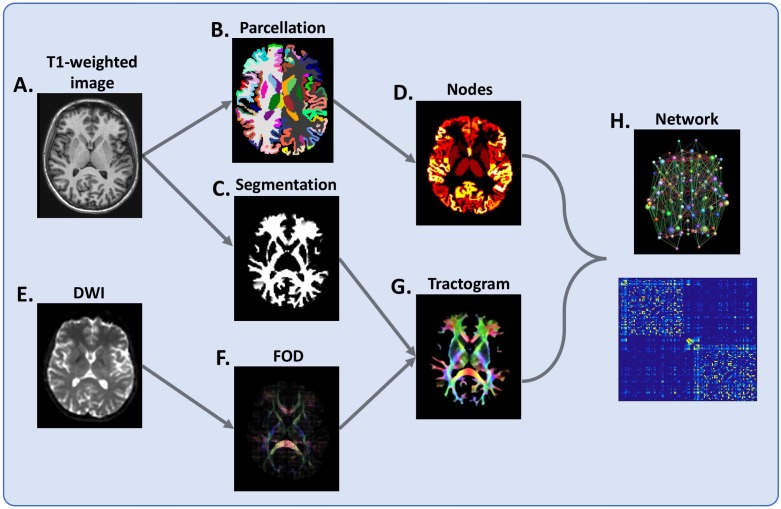
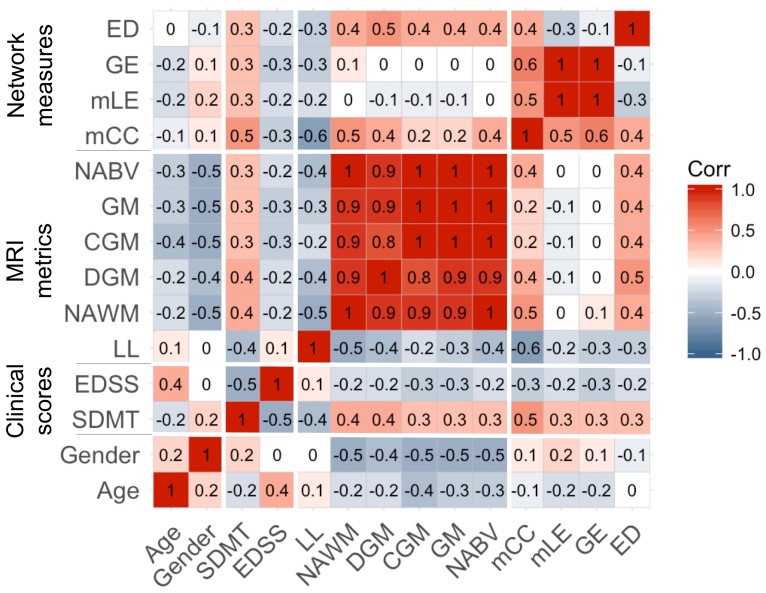
Methods: This cross-sectional study included 51 healthy controls and 122 patients comprising 58 relapsing-remitting, 28 primary progressive and 36 secondary progressive. Structural brain networks were reconstructed from diffusion-weighted MRIs and standard metrics reflecting network density, efficiency and clustering coefficient were derived and compared between subjects' groups. Stepwise linear regression analyses were used to investigate the contribution of network measures that explain clinical disability (Expanded Disability Status Scale (EDSS)) and information processing speed (Symbol Digit Modalities Test (SDMT)) compared with conventional MRI metrics alone and to determine the best statistical model that explains better EDSS and SDMT.
Results: Compared with controls, network efficiency and clustering coefficient were reduced in MS while these measures were also reduced in secondary progressive relative to relapsing-remitting patients. Structural network metrics increase the variance explained by the statistical models for clinical and information processing dysfunction. The best model for EDSS showed that reduced network density and global efficiency and increased age were associated with increased clinical disability. The best model for SDMT showed that lower deep grey matter volume, reduced efficiency and male gender were associated with worse information processing speed.
Conclusions: Structural topological changes exist between subjects' groups. Network density and global efficiency explained disability above non-network measures, highlighting that network metrics can provide clinically relevant information about MS pathology.
Keywords: EDSS; SDMT; mri; multiple sclerosis; network analysis.
© Author(s) (or their employer(s)) 2019. Re-use permitted under CC BY. Published by BMJ.
Conflict of interest statement
Competing interests: AJT has received honoraria/support for travel for consultancy from Eisai, Biogen (Optum Insight), Hoffman La Roche, MedDay, TEVA, Almirall, and Excemed. He received support for travel for consultancy as chair of the International Progressive MS Alliance Scientific Steering Committee, and member of the National MS Society (USA) Research Programs Advisory Committee. He receives an honorarium from SAGE Publishers as Editor-in-Chief of Multiple Sclerosis Journal and a free subscription from Elsevier as a board member for the Lancet Neurology. Support from the NIHR UCLH Biomedical Research Centre is acknowledged.CT has received an ECTRIMS post-doctoral research fellowship in 2015. She has also received honoraria and support for travelling from Bayer-Schering, Teva, Merck-Serono and Serono Foundation, Biogen, Sanofi-Aventis, Novartis, and Ismar Healthcare. FP is non-clinical Guarantors of the Brain fellow. He has also received honoraria from Bioclinica Inc. DC has received honoraria (paid to his employer) from Ismar Healthcare NV, Swiss MS Society, Excemed (previously Serono Symposia International Foundation), Merck, Bayer and Teva for faculty-led education work; Teva for advisory board work; meeting expenses from Merck, MS Trust, National MS Society, Novartis, Société des Neurosciences and Teva; and has previously held stock in GlaxoSmithKline. ATT has received speaker honoraria from Biomedia, Sereno Symposia International Foundation, Bayer and meeting expenses from Biogen Idec and is the UK PI for two clinical trials sponsored by MEDDAY pharmaceutical company (MD1003 in optic neuropathy [MS-ON] and progressive MS [MS-SPI2]).
Figures
References
Publication types
MeSH terms
Grants and funding
LinkOut - more resources
Full Text Sources
Medical
