. 2018 Nov 30:9:399-411.
doi: 10.1016/j.isci.2018.11.007. Epub 2018 Nov 7.

FMRP Interacts with C/D Box snoRNA in the Nucleus and Regulates Ribosomal RNA Methylation

Affiliations

FMRP Interacts with C/D Box snoRNA in the Nucleus and Regulates Ribosomal RNA Methylation

Michelle Ninochka D'Souza et al. iScience. .

Erratum in

Abstract

FMRP is an RNA-binding protein that is known to localize in the cytoplasm and in the nucleus. Here, we have identified an interaction of FMRP with a specific set of C/D box snoRNAs in the nucleus. C/D box snoRNAs guide 2'O methylations of ribosomal RNA (rRNA) on defined sites, and this modification regulates rRNA folding and assembly of ribosomes. 2'O methylation of rRNA is partial on several sites in human embryonic stem cells, which results in ribosomes with differential methylation patterns. FMRP-snoRNA interaction affects rRNA methylation on several of these sites, and in the absence of FMRP, differential methylation pattern of rRNA is significantly altered. We found that FMRP recognizes ribosomes carrying specific methylation patterns on rRNA and the recognition of methylation pattern by FMRP may potentially determine the translation status of its target mRNAs. Thus, FMRP integrates its function in the nucleus and in the cytoplasm.

Keywords: Molecular Interaction; Omics; Stem Cells Research.


Figures

None
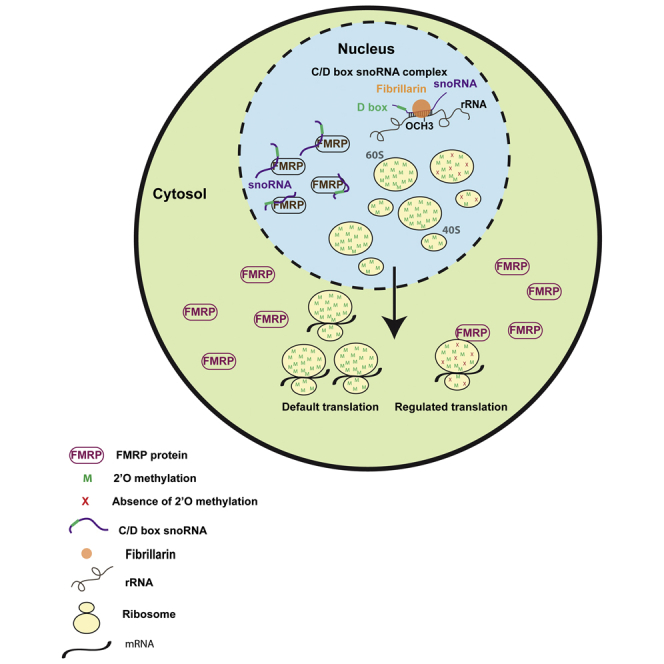
Graphical abstract
Figure 1
Figure 1
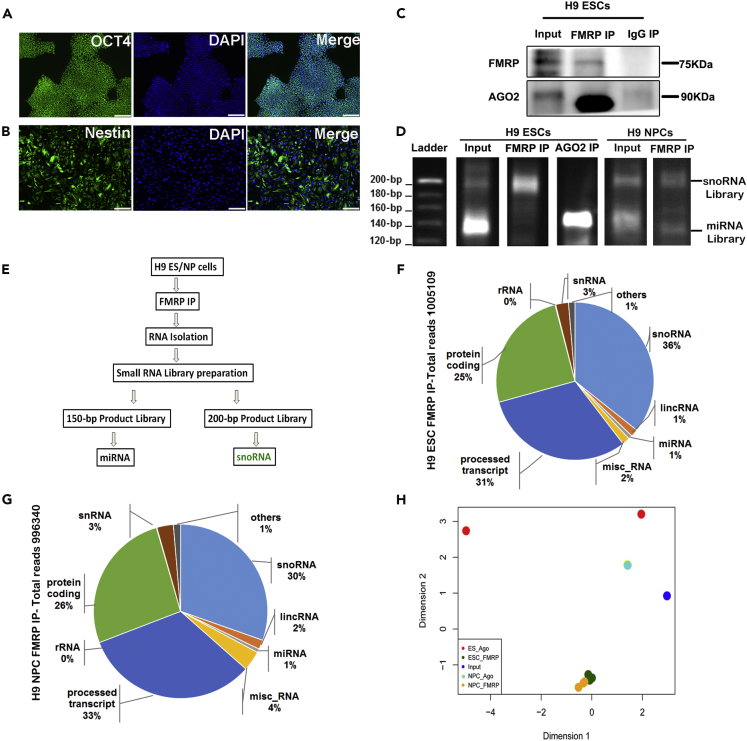
FMRP Interacts with Selected Set of C/D Box snoRNAs in Human ESCs and NPCs (A) Characterization of H9 hESCs with pluripotency marker OCT4 and nuclear marker DAPI (scale bar, 50 μm). (B) Characterization of H9 hNPCs with differentiation marker Nestin and nuclear marker DAPI (scale bar, 50 μm). (C) Immunoblot for FMRP and AGO2 from H9 hESC lysate after FMRP and IgG immunoprecipitation. (D) Polyacrylamide gels showing mobility of cDNA libraries prepared from RNA extracted after immunoprecipitation with FMRP and AGO2 from H9 hESC and hNPC lysate. (E) Schematic showing the experimental workflow to identify FMRP-associated small RNAs. (F) Pie chart showing the distribution of different classes of small RNAs from the sequence obtained from the 200-bp band of the library from H9 hESCs, n = 3. (G) Pie chart showing the distribution of different classes of small RNAs from the sequence obtained from the 200-bp band of the library from H9 hNPCs, n = 3. (H) Principal component analysis (PCA) chart indicating clustering of snoRNA libraries in H9 hESCs and H9 hNPCs, hESC FMRP IP n = 3, hNPC FMRP IP n = 3, hESC Input n = 1, and hESC AGO2 IP n = 2.
Figure 2
Figure 2
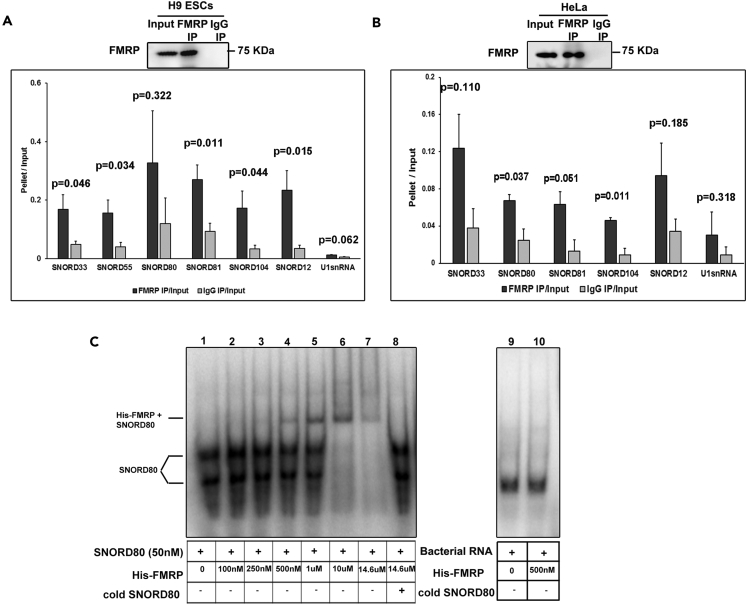
Validation of FMRP Interaction with C/D Box snoRNA (A) Validation of FMRP-interacting snoRNA in human H9 hESCs by qPCR with representative immunoblot for FMRP IP (n = 6, unpaired Student's t test, mean ± SEM). (B) Validation of FMRP-interacting snoRNA in HeLa cells by qPCR with representative immunoblot for FMRP IP (n = 4, unpaired Student's t test, mean ± SEM). Also refer Tables S1 and S2. (C) Electrophoretic mobility shift assay showing shift in mobility of radiolabeled SNORD80 by increasing concentration of His-FMRP. Lane 8 shows a complete abolishment of shift with molar excess of unlabeled (cold) SNORD80 RNA. Lanes 9 and 10 indicated no change in the mobility of His-FMRP with radiolabeled non-specific bacterial RNA. Samples in lanes 9 and 10 were run on a separate gel.
Figure 3
Figure 3
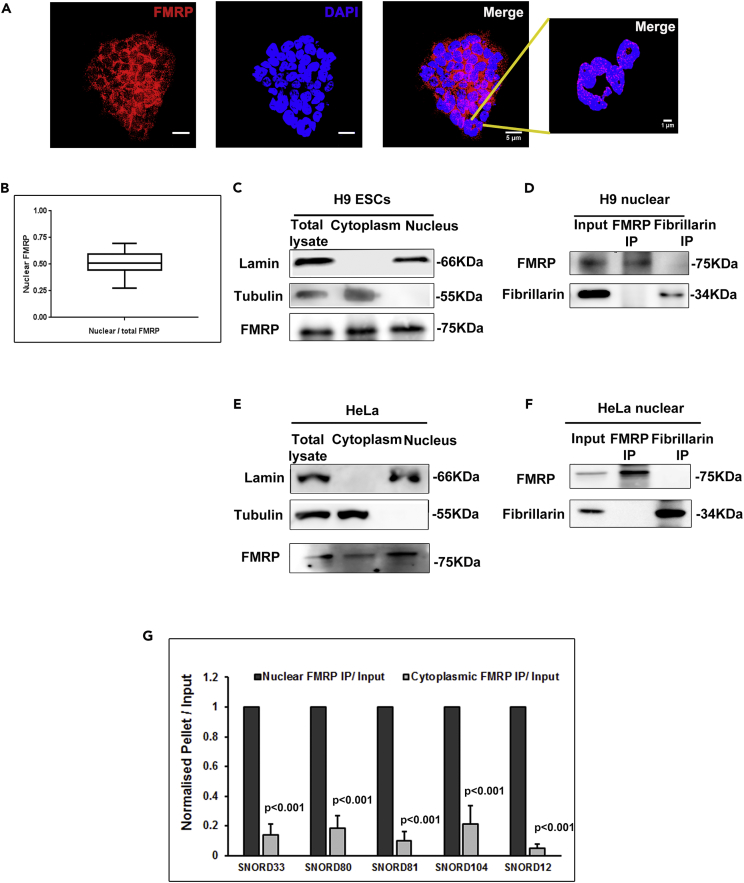
Interaction of Nuclear FMRP with C/D Box snoRNA (A) Immunostaining of H9 hESCs (blue-DAPI, red-FMRP, and scale bar, 5 μm) followed by segmented images showing nuclear distribution of FMRP (scale bar, 1 μm). (B) Quantification of nuclear FMRP in H9 hESCs, n = 29 cells. (C) Immunoblots showing the distribution of FMRP in H9 hESC nuclear and cytoplasmic fractions, Lamin as nuclear marker and Tubulin as cytoplasmic marker. (D) Immunoblots for FMRP and Fibrillarin followed by FMRP or Fibrillarin immunoprecipitation from nuclear fractions of H9 hESCs. (E) Immunoblots showing the distribution of FMRP in HeLa nuclear and cytoplasmic fractions with Lamin as nuclear marker and Tubulin as cytoplasmic marker. (F) Immunoblots for FMRP and Fibrillarin followed by FMRP or Fibrillarin immunoprecipitation from nuclear fractions of HeLa cells. (G) qPCR for selected snoRNAs after immunoprecipitation with FMRP from nuclear and cytoplasmic lysates of H9 hESCs. Values are the ratio of pellet/input of the cytoplasmic fraction normalized to the pellet/input ratio of the nuclear fraction (n = 3, unpaired Student's t test, mean ± SEM).
Figure 4
Figure 4
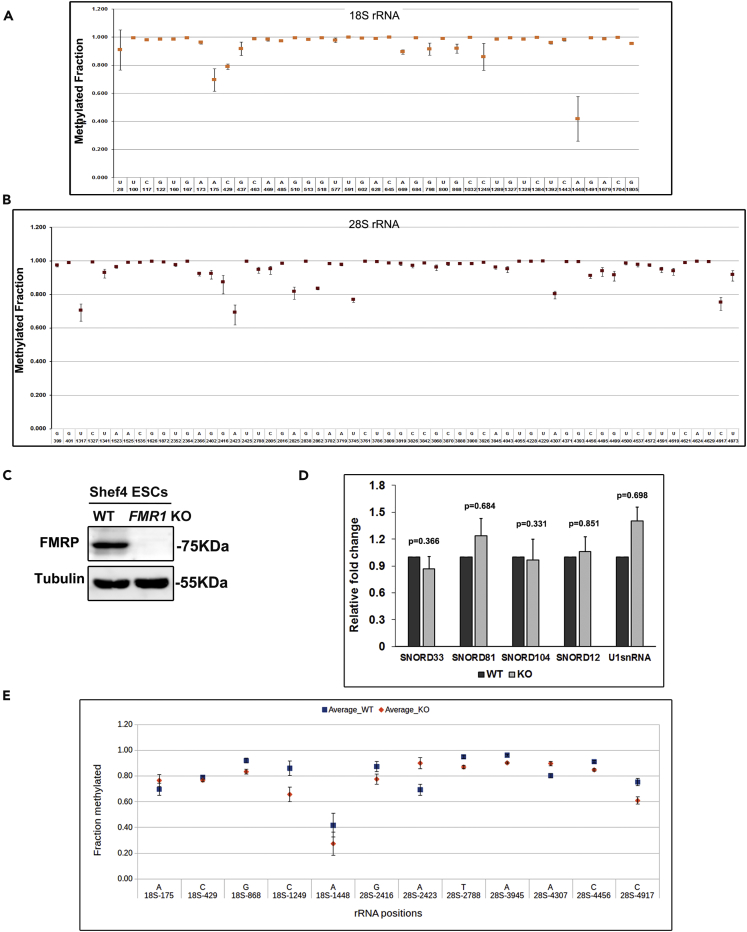
Ribosomal RNA 2'O-Methylation Pattern in Shef4 and Shef4 FMR1 KO hESCs (A) Methylation index of the sites on 18S rRNA in Shef4 hESCs. The x axis represents the respective methylation position on 18S rRNA, and y axis represents the fraction methylated, n = 3. (B) Methylation index of the sites on 28S rRNA in Shef4 hESCs. The x axis represents the respective methylation position on 28S rRNA, and y axis represents the fraction methylated, n = 3. (C) Immunoblots showing absence of FMRP in Shef4 FMR1 KO hESCs with Tubulin as the control. (D) Change in levels of top snoRNA candidates in Shef4 WT and Shef4 FMR1 KO hESCs by qPCR (n = 5, unpaired Student's t test, mean ± SEM). (E) Sites in 18S and 28S rRNA that show 5% or more difference in the methylation index between Shef4 hESCs and Shef4 FMR1 KO hESCs (n = 3, mean ± SEM).
Figure 5
Figure 5
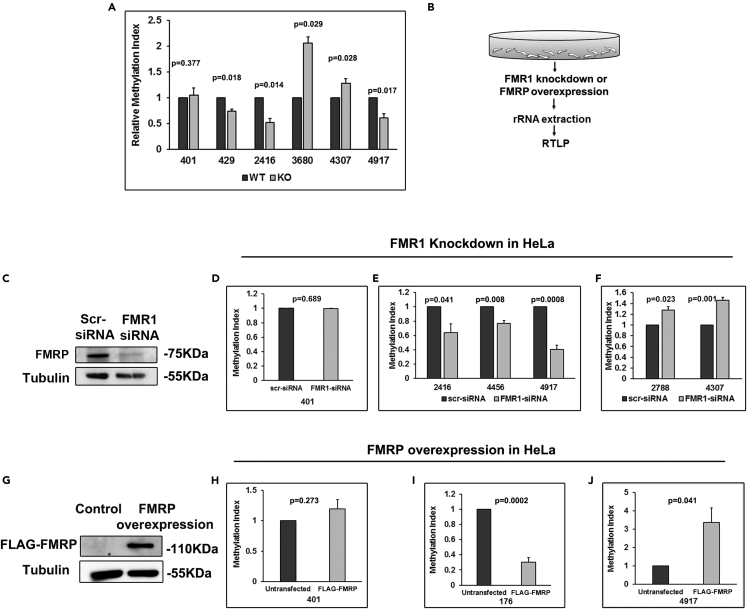
Validation of Change in rRNA 2'O-Methylation Pattern by FMRP (A) RTL-P for selected sites on 18S and 28S rRNA to show differences in methylation in Shef4 WT and Shef4 FMR1 KO hESC lysate (n = 3, unpaired Student's t test, mean ± SEM). (B) Schematic for reverse transcription followed by PCR (RTL-P) on FMR1 knockdown or FMRP overexpression in HeLa cells. (C) Representative immunoblots for FMRP showing its knockdown in HeLa cells with Tubulin as a control. (D–F) RTL-P for selected sites showing the change in 2’O-methylation on FMR1 knockdown in HeLa cells (n = 3, unpaired Student's t test, mean ± SEM). (G) Representative immunoblots for FMRP showing overexpression of FLAG-FMRP in HeLa cells with Tubulin as a control. (H–J) RTL-P for selected sites showing the change in 2’O-methylation on overexpression of FLAG-FMRP in HeLa cells (n = 3, unpaired Student's t test, mean ± SEM).
Figure 6
Figure 6
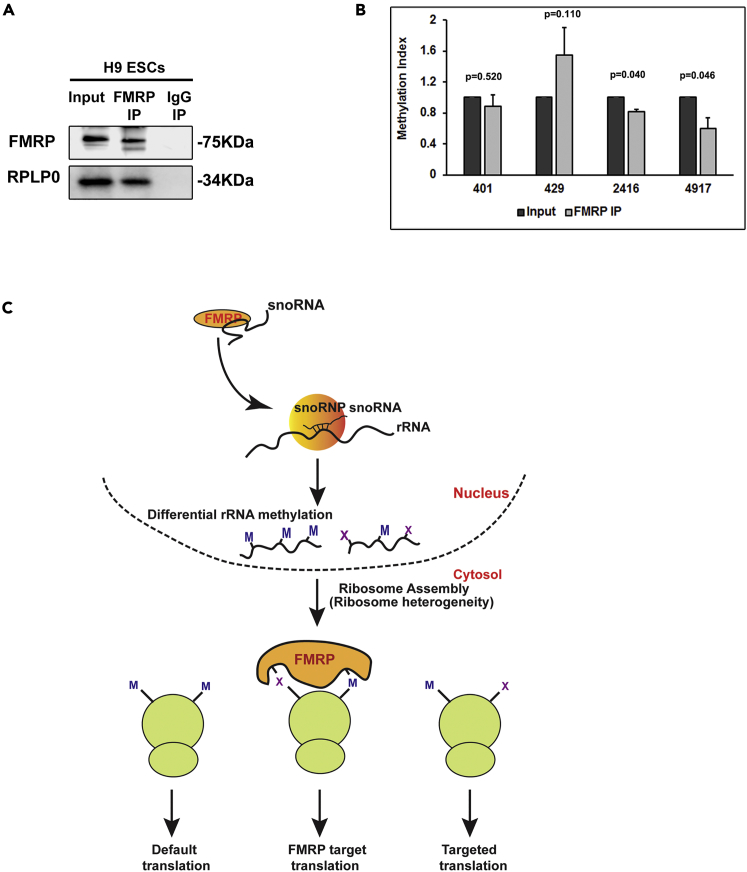
Recognition of rRNA 2'O-Methylation by FMRP (A) Immunoblots showing the presence of ribosomal protein RPLP0 in FMRP immunoprecipitate from H9 hESC nuclear fractions. (B) Relative methylation index of H9 hESC rRNA from FMRP IP normalized to input by RTL-P (n = 3–4, unpaired Student’s t test, mean ± SEM). (C) Model illustrating the role of FMRP in regulating translation through differential rRNA methylation.

References

    1. Bardoni B., Willemsen R., Weiler I.J., Schenck A., Severijnen L.A., Hindelang C., Lalli E., Mandel J.L. NUFIP1 (nuclear FMRP interacting protein 1) is a nucleocytoplasmic shuttling protein associated with active synaptoneurosomes. Exp. Cell Res. 2003;289:95–107. - PubMed
    1. Bassell G.J., Warren S.T. Fragile X syndrome: loss of local mRNA regulation alters synaptic development and function. Neuron. 2008;60:201–214. - PMC - PubMed
    1. Bensaddek D., Nicolas A., Lamond A.I. Quantitative proteomic analysis of the human nucleolus. Methods Mol. Biol. 2016;1455:249–262. - PubMed
    1. Brameier M., Herwig A., Reinhardt R., Walter L., Gruber J. Human box C/D snoRNAs with miRNA like functions: expanding the range of regulatory RNAs. Nucleic Acids Res. 2011;39:675–686. - PMC - PubMed
    1. Cavaille J., Nicoloso M., Bachellerie J.P. Targeted ribose methylation of RNA in vivo directed by tailored antisense RNA guides. Nature. 1996;383:732–735. - PubMed

LinkOut - more resources