


Scaffold Structural Microenvironmental Cues to Guide Tissue Regeneration in Bone Tissue Applications
- PMID: 30469378
- PMCID: PMC6266401
- DOI: 10.3390/nano8110960
Scaffold Structural Microenvironmental Cues to Guide Tissue Regeneration in Bone Tissue Applications
Abstract
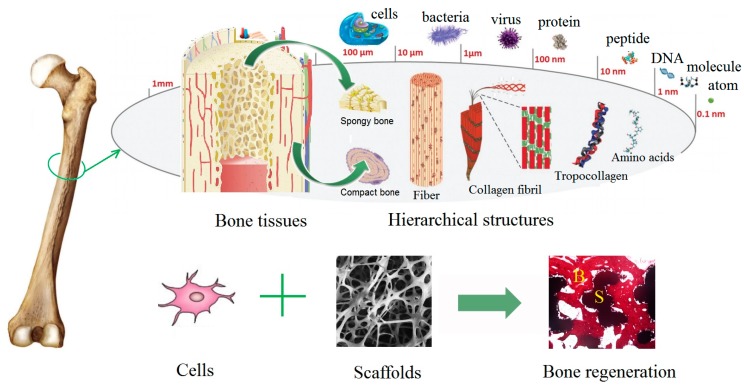
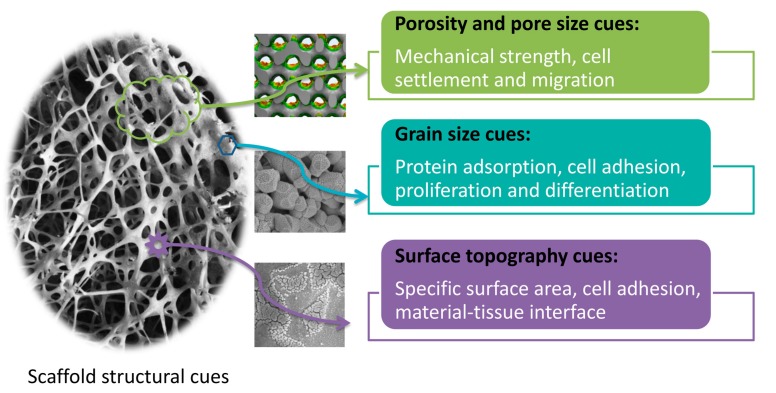
In the process of bone regeneration, new bone formation is largely affected by physico-chemical cues in the surrounding microenvironment. Tissue cells reside in a complex scaffold physiological microenvironment. The scaffold should provide certain circumstance full of structural cues to enhance multipotent mesenchymal stem cell (MSC) differentiation, osteoblast growth, extracellular matrix (ECM) deposition, and subsequent new bone formation. This article reviewed advances in fabrication technology that enable the creation of biomaterials with well-defined pore structure and surface topography, which can be sensed by host tissue cells (esp., stem cells) and subsequently determine cell fates during differentiation. Three important cues, including scaffold pore structure (i.e., porosity and pore size), grain size, and surface topography were studied. These findings improve our understanding of how the mechanism scaffold microenvironmental cues guide bone tissue regeneration.
Keywords: bone tissue regeneration; grain size; porosity; structural microenvironmental cues; surface topography.
Conflict of interest statement
The authors declare no conflicts of interest.
Figures
References
Publication types
Grants and funding
- 31670985/National Natural Science Foundation of China
- 18YFB1105600, 2018YFC1106800/National Key Research and Development Program of China
- 2018GZ0142/Key R & D project of Sichuan Province
- 2016CZYD0004/Sichuan Province Major Scientific & Technological Achievements Transformation Demonstration Project
- 2017SZ0001/Sichuan Province Science & Technology Department Key Projects
LinkOut - more resources
Full Text Sources
Other Literature Sources
