


Indoor Air Quality and Potential Health Risk Impacts of Exposure to Antibiotic Resistant Bacteria in an Office Rooms in Southern Poland
- PMID: 30469413
- PMCID: PMC6267043
- DOI: 10.3390/ijerph15112604
Indoor Air Quality and Potential Health Risk Impacts of Exposure to Antibiotic Resistant Bacteria in an Office Rooms in Southern Poland
Abstract
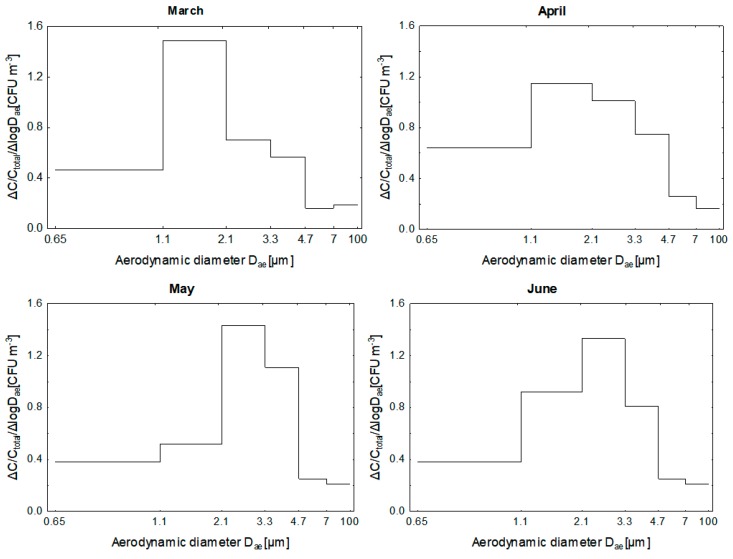
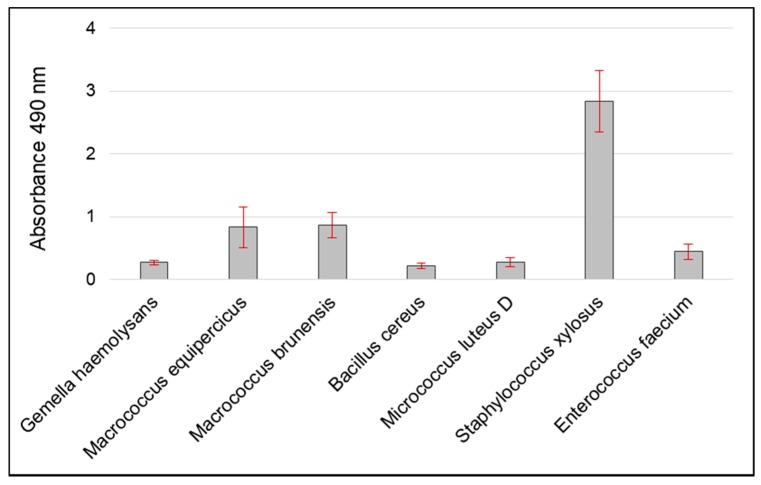
The aims of this article are to characterize: the quantity of culturable bacterial aerosol (QCBA) and the quality of culturable bacterial aerosol (QlCBA) in an office building in Southern Poland during the spring. The average concentration of culturable bacterial aerosol (CCBA) in this building ranged from 424 CFU m-3 to 821 CFU m-3, below Polish proposals for threshold limit values. Size distributions were unimodal, with a peak of particle bacterial aerodynamic diameters less than 3.3 μm, increasing potentially adverse health effects due to their inhalation. The spring office exposure dose (SPED) of bacterial aerosol was estimated. The highest value of SPED was in April (218 CFU kg-1), whereas the lowest was in June (113 CFU kg-1). Analysis was undertaken to determine the antibiotic resistance of isolated strains and their ability to form biofilms, which may facilitate the spread of antibiotic resistance genes. In the course of the study, it was found that Staphylococcus xylosus had the greatest ability to form biofilms, while the strains with the highest antibiotic resistance were Micrococcus luteus D and Macrococcus equipercicus. Given that mainly antibiotic-sensitive bacteria from bioaerosol were isolated, which transfers resistance genes to their plasmids, this shows the need for increased monitoring of indoor air quality in workplaces.
Keywords: antibiotic resistance; bioaerosol; health risk assessment; indoor air quality; size distribution.
Conflict of interest statement
The authors declare no conflict of interest.
Figures
References
-
- Reynolds S.J., Black D.W., Borin S.S., Breuer G., Burmeister L.F., Fuortes L.J., Smith T.F., Stein M.A., Subramanian P., Thorne P.S., et al. Indoor environmental quality in six commercial office buildings in the midwest United States. Appl. Occup. Environ. Hyg. 2001;16:1065–1077. doi: 10.1080/104732201753214170. - DOI - PubMed
-
- Ashmore M.R., Dimitroulopoulou C. Personal exposure of children to air pollution. Atmos. Environ. 2009;43:128–141. doi: 10.1016/j.atmosenv.2008.09.024. - DOI
-
- Wichmann J., Lind T., Nilsson M.A.M., Bellander T. PM2.5, soot and NO2 indoor-outdoor relationships at homes, pre-schools and schools in Stockholm, Sweden. Atmos. Environ. 2010;44:4536–4544. doi: 10.1016/j.atmosenv.2010.08.023. - DOI
-
- Wang Y.F., Wang C.H., Hsu K.L. Size and seasonal distributions of airborne bioaerosols in commuting trains. Atmos. Environ. 2010;44:4331–4338. doi: 10.1016/j.atmosenv.2010.08.029. - DOI
Publication types
MeSH terms
Substances
LinkOut - more resources
Full Text Sources
Medical
Molecular Biology Databases
Miscellaneous
