Review
. 2018 Nov 22;7(12):466.
doi: 10.3390/jcm7120466.

Applications of Functional Near-Infrared Spectroscopy (fNIRS) Neuroimaging in Exercise⁻Cognition Science: A Systematic, Methodology-Focused Review

Affiliations
Review

Applications of Functional Near-Infrared Spectroscopy (fNIRS) Neuroimaging in Exercise⁻Cognition Science: A Systematic, Methodology-Focused Review

Fabian Herold et al. J Clin Med. .

Abstract

For cognitive processes to function well, it is essential that the brain is optimally supplied with oxygen and blood. In recent years, evidence has emerged suggesting that cerebral oxygenation and hemodynamics can be modified with physical activity. To better understand the relationship between cerebral oxygenation/hemodynamics, physical activity, and cognition, the application of state-of-the art neuroimaging tools is essential. Functional near-infrared spectroscopy (fNIRS) is such a neuroimaging tool especially suitable to investigate the effects of physical activity/exercises on cerebral oxygenation and hemodynamics due to its capability to quantify changes in the concentration of oxygenated hemoglobin (oxyHb) and deoxygenated hemoglobin (deoxyHb) non-invasively in the human brain. However, currently there is no clear standardized procedure regarding the application, data processing, and data analysis of fNIRS, and there is a large heterogeneity regarding how fNIRS is applied in the field of exercise⁻cognition science. Therefore, this review aims to summarize the current methodological knowledge about fNIRS application in studies measuring the cortical hemodynamic responses during cognitive testing (i) prior and after different physical activities interventions, and (ii) in cross-sectional studies accounting for the physical fitness level of their participants. Based on the review of the methodology of 35 as relevant considered publications, we outline recommendations for future fNIRS studies in the field of exercise⁻cognition science.

Keywords: cognition; executive functions; fNIRS; optical imaging; physical activity; working memory.


Conflict of interest statement

The authors declare no conflict of interest.

Figures
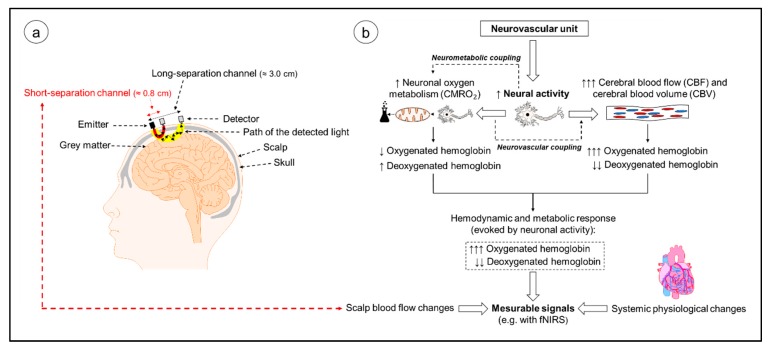
Figure 1
Figure 1
(a) Schematic illustration of the neurovascular unit and the changes in cerebral hemodynamics and oxygenation induced by neural activity. (b) Exemplary illustration of a possible NIRS montage on the human head and the assumed banana-shaped course of detected light of “short-separation channels” and of “long-separation channels”. fNIRS, functional near-infrared spectroscopy; CMRO2, cerebral metabolic rate of oxygen; , increase; , decrease.
Figure 2
Figure 2
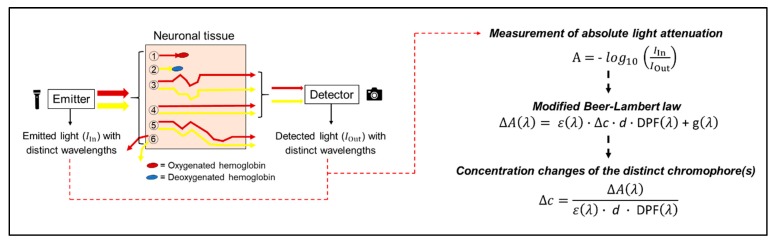
Schematic illustration of light propagation through the neuronal tissue. On the left side of the illustration, possible photon paths for different wavelengths are depicted (red colors represent wavelengths of λ > 800 nm (mainly absorbed by oxyHb—see Photon 1), whereas yellow colors represent wavelengths of λ < 800 nm (mainly absorbed by deoxyHb—see Photon 2). Path 3 represents a photon that undergoes some scattering events before being recorded by a detector. Path 4 represents a ballistic photon. Path 5 represents a photon that, after some scattering events, is not recorded by a detector (lost due to forward scattering). Path 6 represents a photon that is lost due to backward scattering. In the right part of the illustration, the formulas to calculate concentration changes in chromophores are shown (based on continuous-wave NIRS). The symbols have the following meanings: A: light attenuation, or ΔΑ(λ): changes in light attenuation at a certain wavelength (λ); ΙΙn: intensity of emitted light; ΙOut: intensity of recorded light; ε(λ): the extinction coefficient of the chromophore at a certain wavelength (λ); Δc: changes in chromophore concentration; d: separation (distance) between source and detector; DPF(λ): differential path length factor (DPF) for a certain wavelength (λ); g(λ): scattering at a certain wavelength (λ), where g is cancelled out since it is assumed to be negligible when only light attenuation (as in continuous-wave NIRS) is considered [45,54,58].
Figure 3
Figure 3
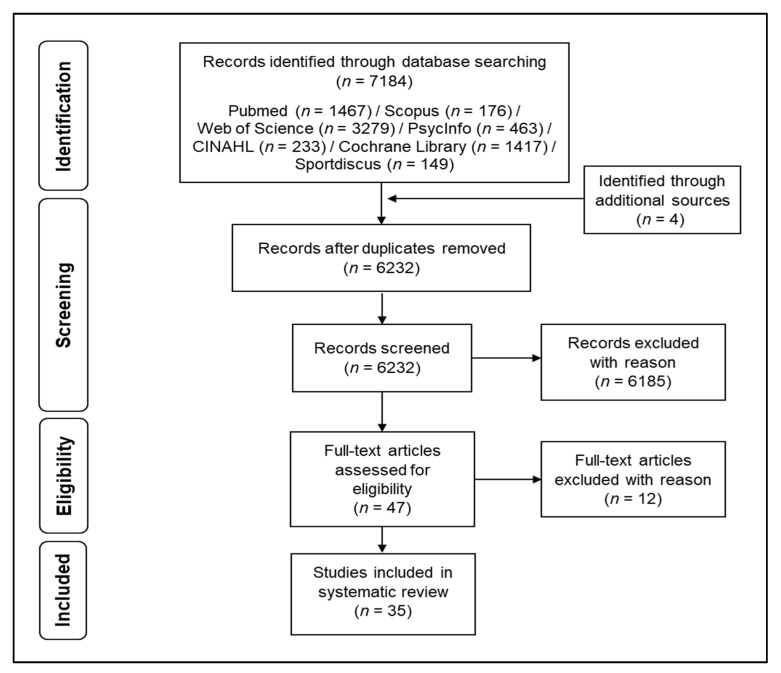
Flow chart with information about the search, screening, and selection processes, which led to the identification of relevant articles included in this review.
Figure 4
Figure 4
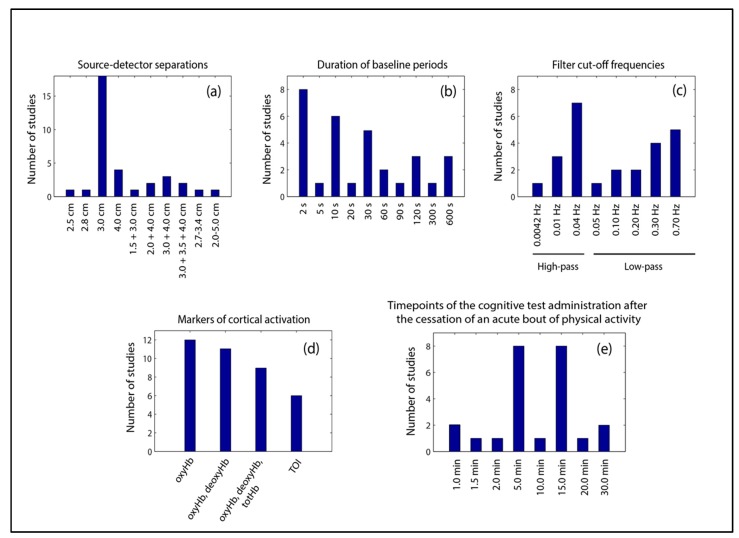
Overview on (a) source-detector separations, (b) durations of baseline periods, (c) filter cut-off frequencies, (d) markers of cortical activation, and (e) timepoints of the cognitive test administration after the cessation of an acute bout of physical activity. cm: centimeters; deoxyHb: deoxygenated hemoglobin; Hz: Hertz; min: minutes; oxyHb: oxygenated hemoglobin; s: seconds; TOI: tissue oxygenation index; totHb: total hemoglobin.

References

    1. Turner C.E., Barker-Collo S.L., Connell C.J.W., Gant N. Acute hypoxic gas breathing severely impairs cognition and task learning in humans. Physiol. Behav. 2015;142:104–110. doi: 10.1016/j.physbeh.2015.02.006. - DOI - PubMed
    1. Moss M.C., Scholey A.B. Oxygen administration enhances memory formation in healthy young adults. Psychopharmacology. 1996;124:255–260. doi: 10.1007/BF02246665. - DOI - PubMed
    1. Chung S.-C., Kwon J.-H., Lee H.-W., Tack G.-R., Lee B., Yi J.-H., Lee S.-Y. Effects of high concentration oxygen administration on n-back task performance and physiological signals. Physiol. Meas. 2007;28:389–396. doi: 10.1088/0967-3334/28/4/005. - DOI - PubMed
    1. Chung S.-C., Lee B., Tack G.-R., Yi J.-H., Lee H.-W., Kwon J.-H., Choi M.-H., Eom J.-S., Sohn J.-H. Physiological mechanism underlying the improvement in visuospatial performance due to 30% oxygen inhalation. Appl. Ergon. 2008;39:166–170. doi: 10.1016/j.apergo.2007.05.008. - DOI - PubMed
    1. Alosco M.L., Gunstad J., Jerskey B.A., Xu X., Clark U.S., Hassenstab J., Cote D.M., Walsh E.G., Labbe D.R., Hoge R., et al. The adverse effects of reduced cerebral perfusion on cognition and brain structure in older adults with cardiovascular disease. Brain Behav. 2013;3:626–636. doi: 10.1002/brb3.171. - DOI - PMC - PubMed