


Early disease progression and treatment discontinuation in patients with advanced ovarian cancer receiving immune checkpoint blockade
- PMID: 30470581
- PMCID: PMC6613945
- DOI: 10.1016/j.ygyno.2018.11.025
Early disease progression and treatment discontinuation in patients with advanced ovarian cancer receiving immune checkpoint blockade
Abstract
Objective: Delayed responses observed with immune checkpoint blockade (ICB) present a challenge for patients with peritoneal malignancies, who risk early symptomatic disease progression requiring treatment discontinuation. While efforts are ongoing to define the biomarkers of response, it is equally important to identify patients at risk for early discontinuation. We sought to investigate the timing of disease progression in epithelial ovarian cancer (EOC) patients treated with ICB and to identify pre-treatment clinical parameters associated with early discontinuation.
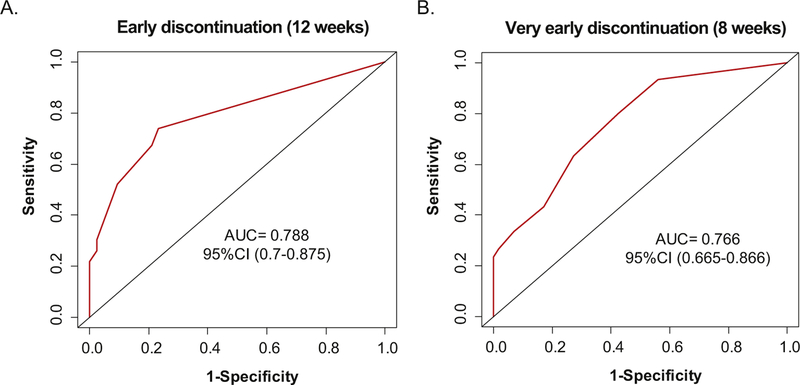
Methods: Retrospective analysis was performed on EOC patients treated with ICB at MSKCC from January 2013 to May 2017. Cutoffs for early and very early discontinuation due to disease progression were defined at 12 and 8 weeks, respectively. Univariate and multivariate logistic regression models were built based on pre-treatment clinical variables.
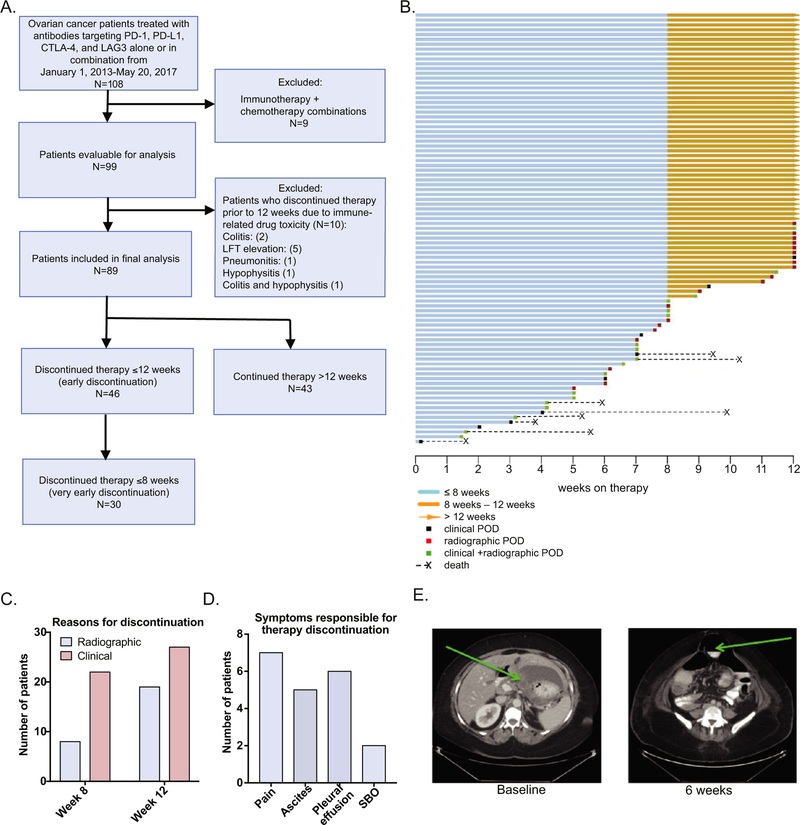
Results: Of 108 identified patients, 89 were included in the analysis. Forty-six (51.7%) patients discontinued therapy early, 30 of which (33.7%) discontinued therapy very early. Eight patients (9.0%) died within 12 weeks of ICB initiation from disease progression. In multivariate analyses, bulky peritoneal disease (p = 0.009, OR: 4.94) and liver parenchymal metastases (p = 0.001, OR: 8.08) were associated with early discontinuation. Liver parenchymal metastases (p = 0.001, OR 6.64), and high neutrophil-to-lymphocyte ratio (p = 0.021, OR: 3.54), were associated with very early discontinuation.
Conclusions: Over 50% of EOC patients suffer disease progression requiring early discontinuation of ICB. Pre-treatment prognostic clinical characteristics may identify patients at highest risk for early discontinuation due to disease progression and warrant caution in using these agents in late line patients with advanced disease.
Keywords: CTLA-4; Immunotherapy; Ovarian cancer; PD-1.
Copyright © 2018 The Authors. Published by Elsevier Inc. All rights reserved.
Conflict of interest statement
Conflicts of interest
The authors report the following potential conflicts of interest. No authors had conflicts of interest related to this work, with the exception of government/foundation funding sources indicated in the Acknowledgements section. Several authors on the study indicated financial activities outside of submitted work, which include personal fees, grants, and intellectual property. All disclosures are indicated in detail in the submitted ICJME Forms for Disclosure of Potential Conflicts of Interest. A.S. is currently an employee of Merck & Co. Inc.
Figures
References
-
- Sharma P, Allison JP, The future of immune checkpoint therapy, Science 348 (6230) (2015) 56–61. - PubMed
-
- Hamanishi J, Mandai M, Konishi I, Immune checkpoint inhibition in ovarian cancer, Int. Immunol 28 (7) (2016) 339–348. - PubMed
-
- Matulonis UA, et al. , Antitumor activity and safety of pembrolizumab in patients with advanced recurrent ovarian cancer: interim results from the phase 2 KEYNOTE-100 study, J. Clin. Oncol 36 (2018) (suppl; abstr 5511). - PubMed
Publication types
MeSH terms
Substances
Grants and funding
LinkOut - more resources
Full Text Sources
Other Literature Sources
Research Materials
