. 2019 Mar:188:794-806.
doi: 10.1016/j.neuroimage.2018.11.036. Epub 2018 Nov 22.

Age-related differences in default-mode network connectivity in response to intermittent theta-burst stimulation and its relationships with maintained cognition and brain integrity in healthy aging

Affiliations

Age-related differences in default-mode network connectivity in response to intermittent theta-burst stimulation and its relationships with maintained cognition and brain integrity in healthy aging

Kilian Abellaneda-Pérez et al. Neuroimage. 2019 Mar.

Abstract

The default-mode network (DMN) is affected by advancing age, where particularly long-range connectivity has been consistently reported to be reduced as compared to young individuals. We examined whether there were any differences in the effects of intermittent theta-burst stimulation (iTBS) in DMN connectivity between younger and older adults, its associations with cognition and brain integrity, as well as with long-term cognitive status. Twenty-four younger and 27 cognitively normal older adults were randomly assigned to receive real or sham iTBS over the left inferior parietal lobule between two resting-state functional magnetic resonance imaging (rs-fMRI) acquisitions. Three years later, those older adults who had received real iTBS underwent a cognitive follow-up assessment. Among the younger adults, functional connectivity increased following iTBS in distal DMN areas from the stimulation site. In contrast, older adults exhibited increases in connectivity following iTBS in proximal DMN regions. Moreover, older adults with functional responses to iTBS resembling those of the younger participants exhibited greater brain integrity and higher cognitive performance at baseline and at the 3-year follow-up, along with less cognitive decline. Finally, we observed that 'young-like' functional responses to iTBS were also related to the educational background attained amongst older adults. The present study reveals that functional responses of the DMN to iTBS are modulated by age. Furthermore, combining iTBS and rs-fMRI in older adults may allow characterizing distinctive cognitive profiles in aging and its progression, probably reflecting network plasticity systems that may entail a neurobiological substrate of cognitive reserve.

Keywords: Aging; Cognitive reserve; Default-mode network; Intermittent theta-burst stimulation; Resting-state functional magnetic resonance imaging.


Conflict of interest statement

Conflict of Interest

A.P.-L. serves on the scientific advisory boards for Starlab Neuroscience, Neuroelectrics, Axilum Robotics, Constant Therapy, NovaVision, Cognito and Neosync, and is listed as an inventor on several issued and pending patents on the real-time integration of transcranial magnetic stimulation with electroencephalography and magnetic resonance imaging. E.S. serves on the scientific advisory boards for EBNeuro Ltd and Neuroelectrics, and is listed as an inventor on issued and pending patents on the integration of non-invasive brain stimulation with neuroimaging data for therapeutic applications in neurodegenerative disorders. The remaining authors declare no competing interests.

Figures
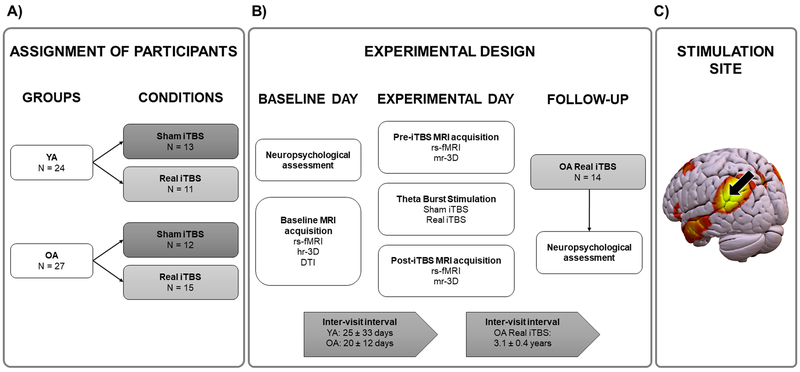
Figure 1.
Figure 1.
Study protocol. A) Assignment of participants. Distribution of the participants between groups (younger vs. older adults) and conditions (sham vs. real iTBS). B) Experimental design. Timeline of the procedures and scans acquired on the baseline day, the experimental day and the follow-up. C) The DMN, with an arrow pointing to the stimulation site over the lIPL. Abbreviations: YA, younger adults; OA, older adults; iTBS, intermittent theta-burst stimulation; rs-fMRI, resting-state functional magnetic resonance imaging; hr-3D, high-resolution three-dimensional; DTI, diffusion tensor imaging; mr-3D, medium-resolution three-dimensional.
Figure 2.
Figure 2.
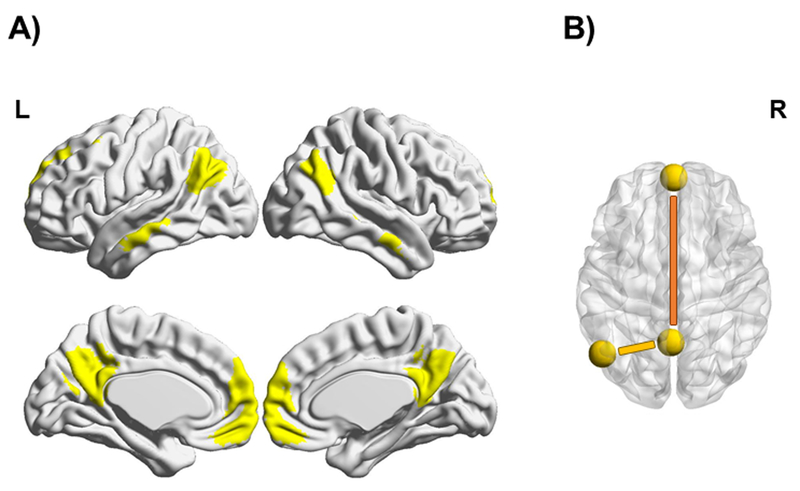
A) The DMN mask covering the most important regions of this network is shown in yellow on the standard MNI map. B) The two functional couplings used for analyzing long-range and local connectivity within the DMN. The long-range DMN connectivity measure (mPFC-to-PCC) is shown in orange, while the local DMN connectivity measure (Stim-to-PCC) is shown in yellow. The yellow spheres represent the selected DMN seeds.
Figure 3.
Figure 3.
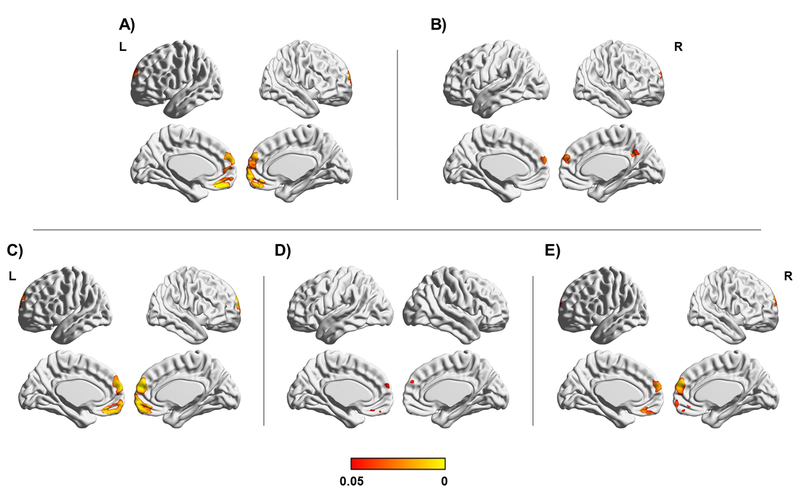
Seed-to-DMN analyses after iTBS. Significant results at p < 0.05 (FWE-corrected) are shown on the standard MNI map. A) Interaction between group and condition. B) Main effect of condition. C) Younger adults: sham < real iTBS. D) Real iTBS condition: younger > older adults. E) Younger adults in real iTBS condition: post- > pre-iTBS. Color bar indicates FWE-corrected p values.
Figure 4.
Figure 4.
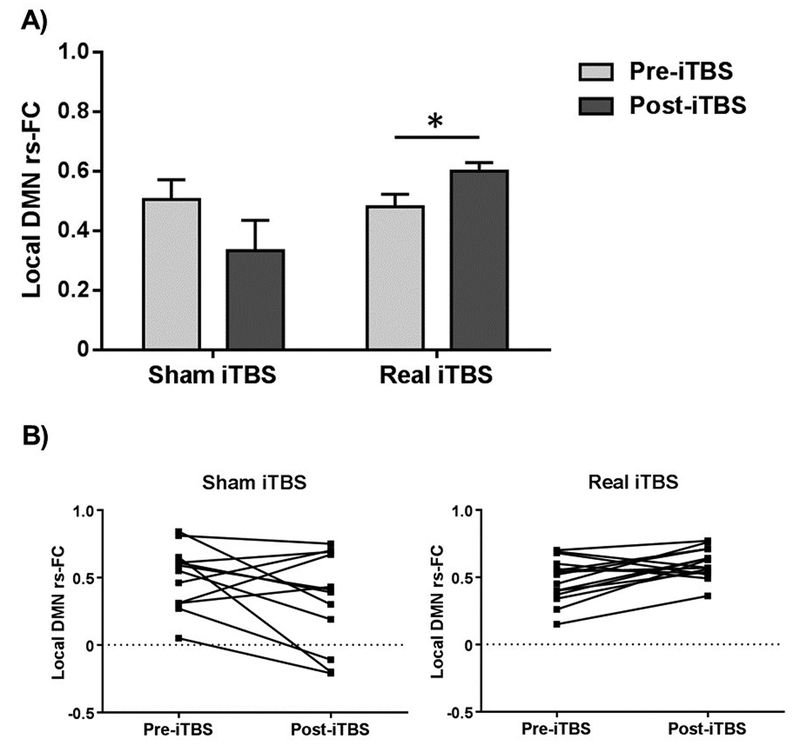
Local DMN connectivity in older adults. A) A significant interaction between condition and time was found for the local DMN rs-FC among the older adults. Post-hoc pairwise analyses revealed that real iTBS increased local DMN rs-FC amongst the older adults, while no significant changes were found in the older adults who had received sham iTBS. B) Inter-individual variability in local DMN rs-FC before and after stimulation among the older adults is shown separately for sham and real iTBS conditions. Data in A) are represented as mean with standard error of the mean (SEM). * Significant differences (p < 0.05). Abbreviations: iTBS, intermittent theta-burst stimulation; DMN, default-mode network; rs-FC, resting-state functional connectivity.
Figure 5.
Figure 5.
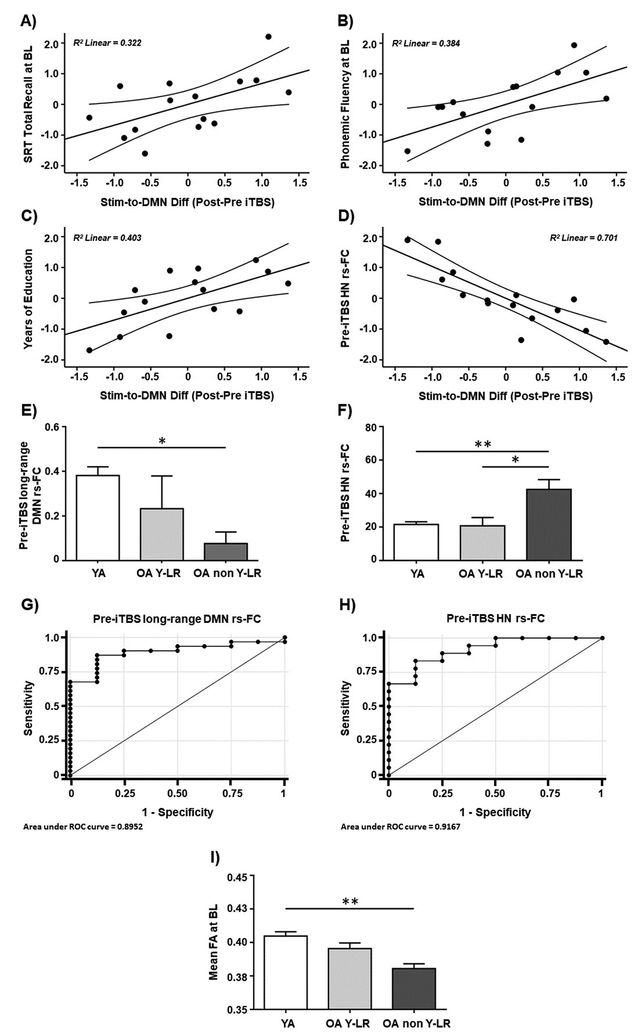
Scatter plots showing the relationships between iTBS-induced changes in the DMN rs-FC observed in the main experimental day and baseline A) SRT total recall, B) phonemic fluency, C) years of education, and D) pre-iTBS HN rs-FC. Bar charts showing significant interactions and Bonferroni-corrected post-hoc analyses between the three characterized subgroups with regards to E) pre-iTBS long-range DMN rs-FC, F) pre-iTBS HN rs-FC, and I) mean FA at baseline. The ROC curves for predicting a younger / ‘young-like’ response to iTBS based on G) pre-iTBS long-range DMN rs-FC, and H) pre-iTBS HN rs-FC. Data in A), B), C), and D) are presented with adjusted z scores. Data in E), F), and I) are represented as mean with SEM. Data in (I) are presented adjusted to two decimals. * Significant differences (p < 0.05), ** Significant differences (p < 0.001). Abbreviations: Stim, stimulation site; DMN, default-mode network; Diff; difference; iTBS, intermittent theta-burst stimulation; SRT, Selective Reminding Test; BL, baseline; HN, hippocampal network; rs-FC, resting-state functional connectivity; YA, younger adults; OA YL-R, older adults with ‘young-like’ responses; OA non YL-R, older adults with ‘non-young-like’ responses; ROC, receiver operating characteristic; FA, fractional anisotropy.
Figure 6.
Figure 6.
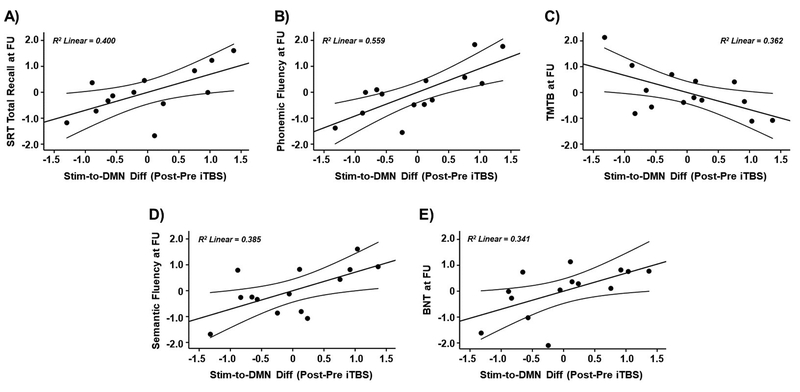
Scatter plots showing the relationships between iTBS-induced changes in the DMN rs-FC observed in the main experimental day and follow-up cognitive scores in A) SRT total recall, B) phonemic fluency, C) TMTB, D) semantic fluency, and E) BNT. Data in A), B), C), D), and E) are presented with adjusted z scores. Abbreviations: Stim, stimulation site; DMN, default-mode network; Diff; difference; iTBS, intermittent theta-burst stimulation; SRT, Selective Reminding Test; FU, follow-up; TMTB, Trail Making Test B; BNT, Boston Naming Test.
Figure 7.
Figure 7.
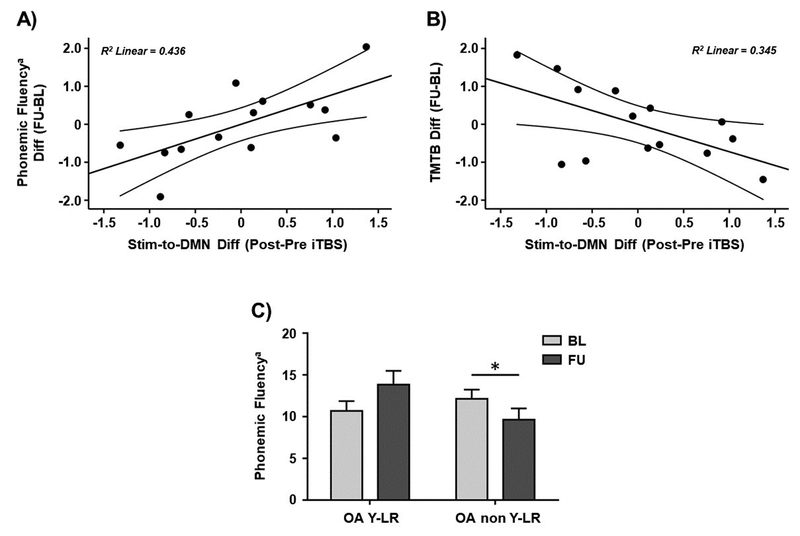
Scatter plots showing the relationships between iTBS-induced changes in the DMN rs-FC observed in the main experimental day and the difference in A) phonemic fluency and B) TMTB scores between the follow-up and baseline. C) Bar chart showing significant interactions and pairwise post-hoc comparisons between the older adults with ‘young-like’ and ‘non-young-like’ responses with regards to phonemic fluency at both timepoints. Data in A) and B) are presented with adjusted z scores. Data in C) are represented as mean with SEM. a Phonemic fluency for letter M. * Significant differences (p < 0.05). Abbreviations: Stim, stimulation site; DMN, default-mode network; Diff; difference; iTBS, intermittent theta-burst stimulation; FU, follow-up; BL, baseline; TMTB, Trail Making Test B; OA YL-R, older adults with ‘young-like’ responses; OA non YL-R, older adults with ‘non-young-like’ responses.

References

    1. Altman DG, & Bland JM (1999). How to randomise. BMJ (Clinical Research Ed.), 319(7211), 703–704. 10.1136/bmj.319.7211.703 - DOI - PMC - PubMed
    1. Andrews-Hanna JR, Snyder AZ, Vincent JL, Lustig C, Head D, Raichle ME, & Buckner RL (2007). Disruption of Large-Scale Brain Systems in Advanced Aging. Neuron, 56(5), 924–935. 10.1016/j.neuron.2007.10.038 - DOI - PMC - PubMed
    1. Antal A, Chaieb L, Moliadze V, Monte-silva K, Poreisz C, Thirugnanasambandam N, … Paulus W (2010). Brain-derived neurotrophic factor ( BDNF ) gene polymorphisms shape cortical plasticity in humans. Brain Stimulation, 3(4), 230–237. 10.1016/j.brs.2009.12.003 - DOI - PubMed
    1. Barker A (1991). An Introduction to the Basic Principles of Magnetic Nerve Stimulation. Journal of Clinical Neurophysiology, 8(1), 26–37. - PubMed
    1. Bartrés-Faz D, & Arenaza-Urquijo EM (2011). Structural and functional imaging correlates of cognitive and brain reserve hypotheses in healthy and pathological aging. Brain Topography, 24(3–4), 340–357. 10.1007/s10548-011-0195-9 - DOI - PubMed

Publication types