. 2018 Nov 30:9:475-486.
doi: 10.1016/j.isci.2018.11.012. Epub 2018 Nov 10.

Ultradian Rhythms in the Transcriptome of Neurospora crassa

Affiliations

Ultradian Rhythms in the Transcriptome of Neurospora crassa

Bharath Ananthasubramaniam et al. iScience. .

Abstract

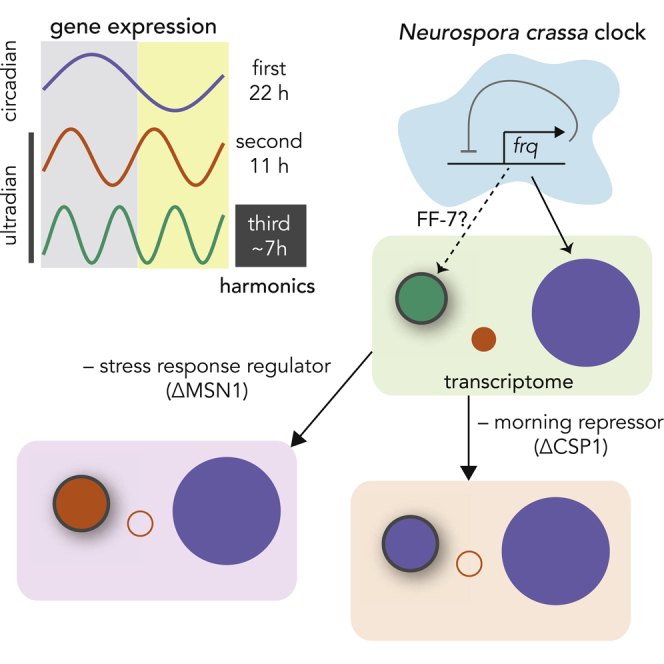
In many organisms, the circadian clock drives rhythms in the transcription of clock-controlled genes that can be either circadian (∼24-hr period) or ultradian (<24-hr period). Ultradian rhythms with periods that are a fraction of 24 hr are termed harmonics. Several harmonic transcripts were discovered in the mouse liver, but their functional significance remains unclear. Using a model-based analysis, we report for the first time ∼7-hr third harmonic transcripts in Neurospora crassa, a well-established fungal circadian model organism. Several third harmonic genes are regulated by female fertility 7 (FF-7), whose transcript itself is third harmonic. The knockout of circadian output regulator CSP1 superimposes circadian rhythms on the third harmonic genes, whereas the knockout of stress response regulator MSN1 converts third harmonic rhythms to second harmonic rhythms. The 460 ∼7-hr genes are co-regulated in two anti-phasic groups in multiple genotypes and include kinases, chromatin remodelers, and homologs of harmonic genes in the mouse liver.

Keywords: Biological Sciences; Chronobiology; Transcriptomics.


Figures

None
Graphical abstract
Figure 1
Figure 1
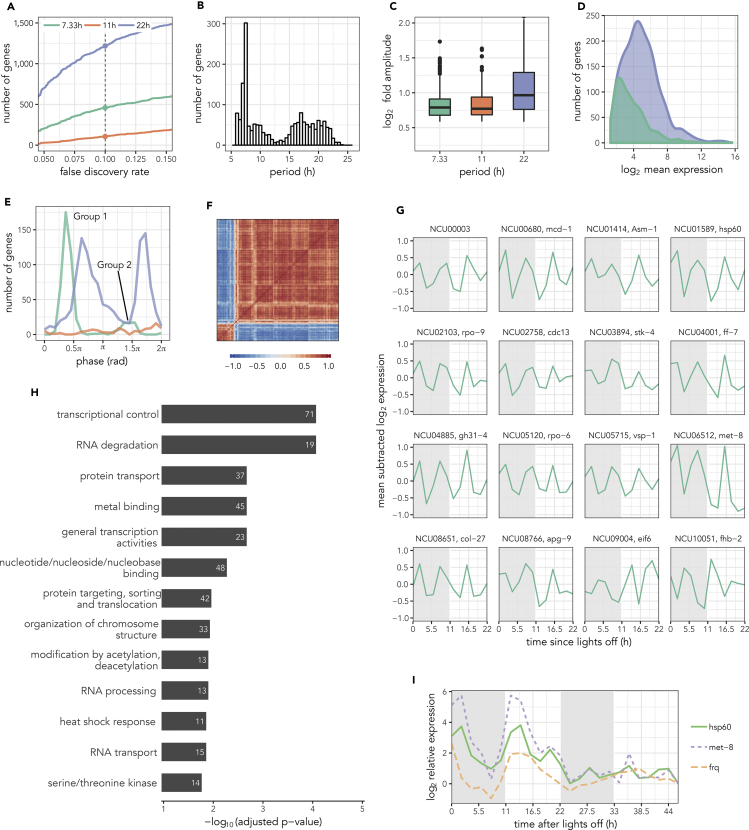
Quantification of 7-hr Transcripts in N. crassa (A–I) (A) The number of rhythmic genes at each period identified by the model-selection-based procedure at different false discovery rate thresholds. The color coding for the different periods is maintained throughout the figure. (B) The distribution of periods of the rhythmic genes as estimated by the ARSER (Wu et al., 2016). The distribution of peak-to-peak fold amplitudes (C), mean expression level (D), and phases (E) of the different rhythmic genes quantified by the model-selection-based procedure. The second harmonic genes have been omitted in (D) for clarity. (F) Correlation-metric-based hierarchical clustering of the mean-subtracted expression profiles of the third harmonic genes. (G) Transcript profiles of selected third harmonic genes, such as transcription factors, kinases, and chromatin remodelers. (H) Top functional categories (FDR<0.05) enriched in the third harmonic genes using FungiFun2 (Priebe et al., 2015). (I) Verification of 7-hr rhythms in two candidate genes using quantitative real-time PCR over a 2-day time course with 2-hr time resolution. The results for met-8 and hsp60 in a WT strain are shown. The circadian clock gene frq is included as a positive control of the quantitative real-time PCR analysis. Expression levels relative to the last time point are plotted for each gene. See also Figures S1 and S2 and Transparent Methods.
Figure 2
Figure 2
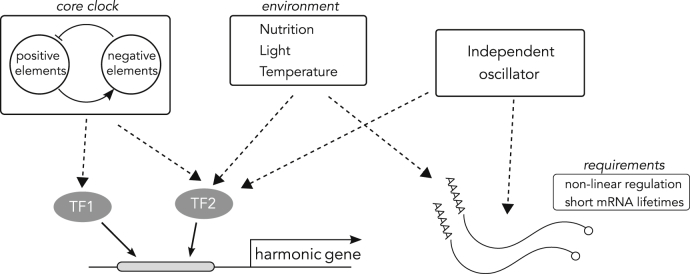
Possible Mechanisms for Generation of Harmonics The harmonics can be generated by combinatorial regulation of periodic factors that are outputs of the circadian clock or periodic environmental inputs, such as light-dark cycles, or by an independent oscillator. The transcripts also need to have sufficiently low stability in order for the harmonics to be observable. See also Figure S3.
Figure 3
Figure 3
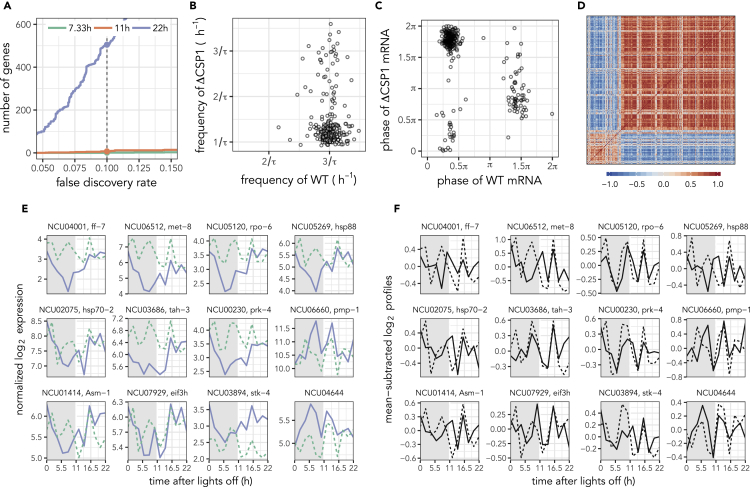
Superimposed Circadian Rhythms in the Third Harmonic Genes in the ΔCSP1 Strain (A) The number of rhythmic genes at each harmonic for different FDR thresholds. (B) The change in frequency (estimated using ARSER) of the third harmonic genes between the wild-type (WT) strain and the ΔCSP1 strain. (C) Comparison of the phases of the third harmonics genes between the WT and ΔCSP1 strains at their respective periods. (D) Pairwise correlation of the gene expression profiles of the third harmonic genes in the ΔCSP1 strain arranged according to the same clustering in Figure 1F. (E) The transcript profiles for selected genes are shown in the WT (dashed) and ΔCSP1 (solid) strains. Colors represent the oscillation periods as in (A). (F) The transcript profiles for the same genes in (E) after subtraction of the induced circadian rhythms in the ΔCSP1 strain (solid) with the profile in the WT strain (dashed) as reference. See also Figure S3.
Figure 4
Figure 4
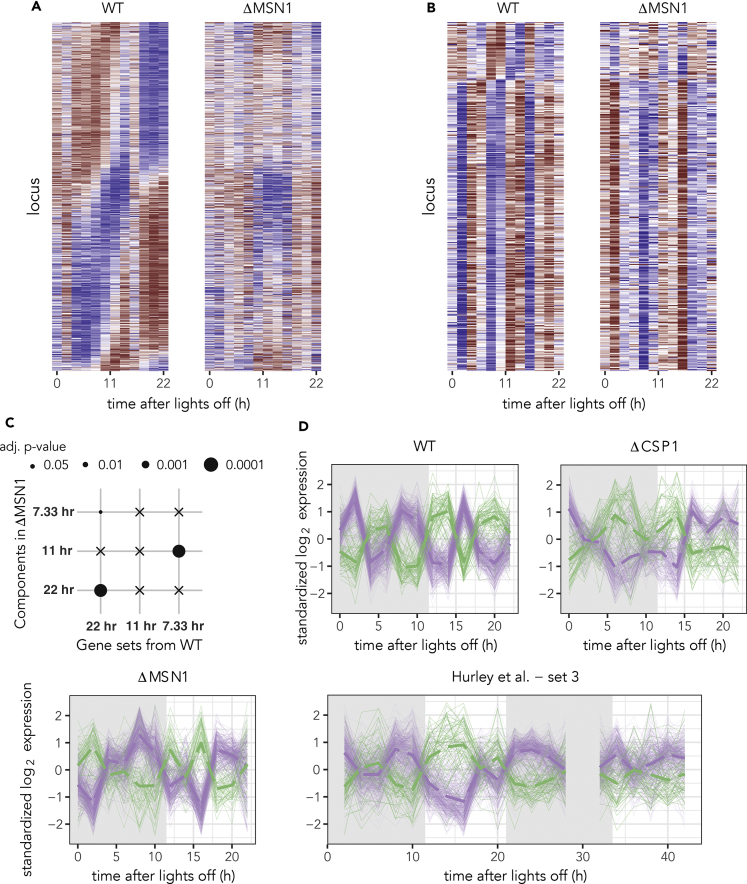
MSN1-Dependent Regulation of Third Harmonic Rhythms and Co-regulation of Anti-phasic Genes (A–D) Heatmaps comparing the expression of the circadian (A) and third harmonic genes (B) (from Figure 1) in the WT and ΔMSN1 strains. The genes are sorted according to their phases in the WT, and a common scale is used for all heatmaps. (C) Competitive gene set testing (Wu and Smyth, 2012) of the different harmonic components in the ΔMSN1 strain within the rhythmic sets identified in the WT strain. Adjusted p-values are rounded up to the four levels shown, and crosses represent no significance (>0.05). (D) The standardized (Z score) expression profiles of the Group 1 (violet) and Group 2 (green) genes in the different genotypes and in the WT dataset from Hurley et al. (2014). The average of the standardized profiles in each group is shown as thick dashed lines. Missing time points were omitted from the plots. See also Figures S4 and S5.

References

    1. Bell-Pedersen D., Cassone V.M., Earnest D.J., Golden S.S., Hardin P.E., Thomas T.L., Zoran M.J. Circadian rhythms from multiple oscillators: lessons from diverse organisms. Nat. Rev. Genet. 2005;6:544–556. - PMC - PubMed
    1. Blum I.D., Zhu L., Moquin L., Kokoeva M.V., Gratton A., Giros B., Storch K.F. A highly tunable dopaminergic oscillator generates ultradian rhythms of behavioral arousal. eLife. 2015;3 - PMC - PubMed
    1. Bray N.L., Pimentel H., Melsted P., Pachter L. Near-optimal probabilistic RNA-seq quantification. Nat. Biotechnol. 2016;34:525–527. - PubMed
    1. Bulla M., Valcu M., Dokter A.M., Dondua A.G., Kosztolányi A., Rutten A.L., Helm B., Sandercock B.K., Casler B., Ens B.J. Unexpected diversity in socially synchronized rhythms of shorebirds. Nature. 2016;540:109–113. - PubMed
    1. Cesbron F., Brunner M., Diernfellner A.C.R. Light-dependent and circadian transcription dynamics in vivo recorded with a destabilized luciferase reporter in Neurospora. PLoS One. 2013;8:e83660. - PMC - PubMed