. 2018 Nov 20;115(10):2026-2033.
doi: 10.1016/j.bpj.2018.10.009. Epub 2018 Oct 16.

Piconewton Mechanical Forces Promote Neurite Growth

Affiliations

Piconewton Mechanical Forces Promote Neurite Growth

Vittoria Raffa et al. Biophys J. .

Abstract

Investigations over half a century have indicated that mechanical forces induce neurite growth, with neurites elongating at a rate of 0.1-0.3 μm h-1 pN-1 when mechanical force exceeds a threshold, with this being identified as 400-1000 pN for neurites of PC12 cells. In this article, we demonstrate that neurite elongation of PC12 cells proceeds at the same previously identified rate on application of mechanical tension of ∼1 pN, which is significantly lower than the force generated in vivo by axons and growth cones. This observation raises the possibility that mechanical tension may act as an endogenous signal used by neurons for promoting neurite elongation.


Figures

Figure 1
Figure 1
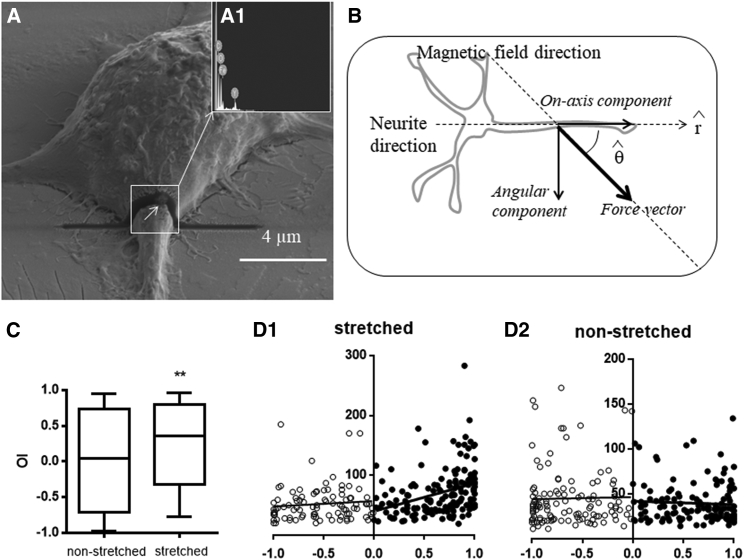
Force generation in the neurite by MNP labeling. (A) SEM imaging and SEM-FIB dual-beam cross section of a differentiated MNP-labeled PC12 cell. A cross section of a neurite showing electron-dense nanoparticles (pointed out by white arrow) that contain iron (inset A1, EDX), n = 6, is shown. (B) The MNPs entrapped in the neurite exert a magnetic force under the effect of an external magnetic field: the on-axis component rˆ along the neurite axis is responsible for stretching the neurite, and the angular component θˆ is responsible for rotating the neurite. (C) A box plot of orientation index (OI = cosθ) in stretched versus nonstretched condition (t-test, p = 0.006). Stretched neurites are preferentially aligned to the force vector, in agreement to our previous observations (20) (D) Neurite length (μm) versus OI. (D1) Stretched condition: the longest neurites are preferentially aligned to the force vector for positive OI (the linear regression analysis gives a slope of 46.72 ± 10.33, whose deviation from 0 is statistically significant, p < 0.0001); the neurite length is not dependent on the force vector direction for negative OI (i.e., the deviation of the slope from 0 is not statistically significant, p = 0.35). (C2) Nonstretched condition: neurite length is constant for both positive OI (i.e., the deviation of the slope from 0 is not statistically significant, p = 0.37) and negative OI (i.e., the deviation of the slope from 0 is not statistically significant, p = 0.06). n = 200. Stretched and nonstretched conditions are M+MNP+ and MMNP+, respectively.
Figure 2
Figure 2
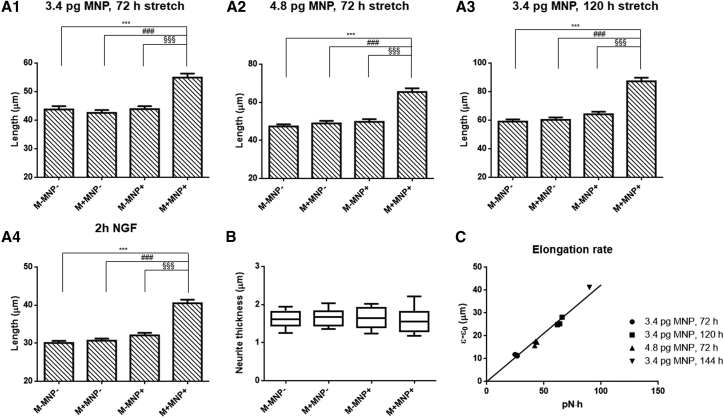
Stretching of PC12 cell neurites by pN forces tested at different stretching times and different MNP loads. (A1–4) Neurite length for stretching conditions “3.4 pg MNP, 72 h,” “3.4 pg MNP, 120 h,” “4.8 pg MNP, 72 h” and “2 h NGF,” respectively. n = 600 (from three independent assays). Kruskal Wallis test, followed by honestly significant difference (HDS) correction: p = 9.3 × 10−20 (A1), p = 1.9 × 10−20 (A2), p = 8.0 × 10−25 (A3), and p = 7.5 × 10−31 (A4). “” is the significance versus the control group (MMNP), “#” is the significance versus the group treated with the magnet (M+MNP), and “§”is the significance versus the group treated with particles (MMNP+). (B) A box plot (10–90 percentile) of neurite thickness (condition “4.8 pg MNP, 72 h”), n = 50. Kruskal Wallis test: p = 0.43. (C) Differential elongation versus estimated force per time. The applied force was calculated according to Eqs 3, 4, and 5. The differential elongation is expressed as the difference of elongation between the stretched and nonstretched conditions. The elongation rate (0.42 ± 0.01 μm h−1 pN−1) was calculated by linear regression analysis (95% of confidence level, p < 0.0001).
Figure 3
Figure 3
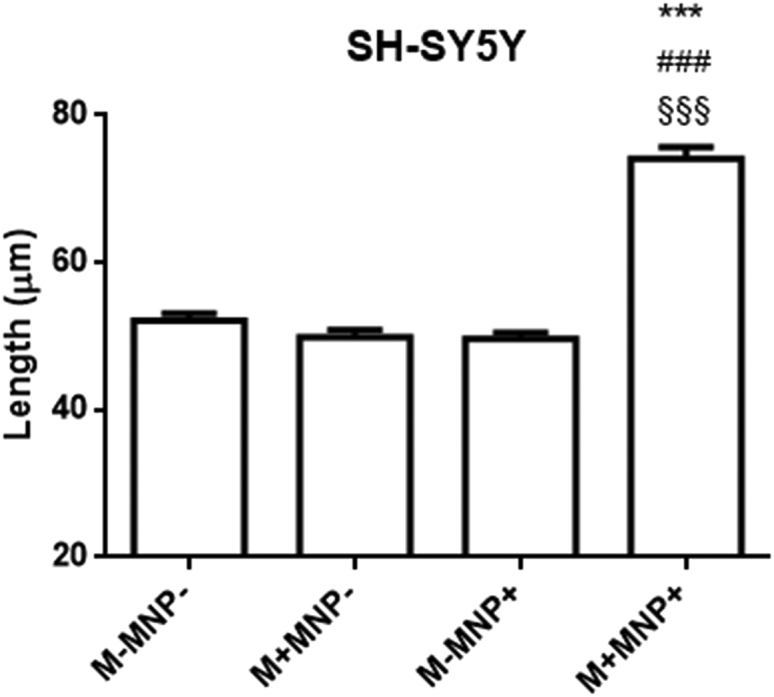
Stretching of SH-SY5Y neurites by pN forces. n = 600 (from three independent assays), Kruskal Wallis test followed by HDS correction. “” is the significance versus the control group (MMNP), “#” is the significance versus the group treated with the magnet (M+MNP), and “§”is the significance versus the group treated with particles (MMNP+). p = 0.
Figure 4
Figure 4
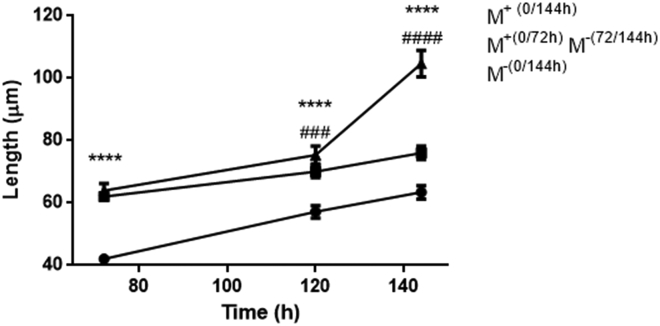
Neurite length (mean ± standard error) versus time. MNP-labeled differentiated PC12 cells were incubated in absence of magnetic field (M−(0/144 h)), in presence of the magnetic field (M+(0/144 h)) or removing the magnetic field after 72 h ((M+(0/72h) + (M−(72/144 h)). Two-way ANOVA, Bonferroni correction: n > 200, is the significance versus the group M−(0/144 h), and # is the significance versus the group (M+(0/72 h) M−(72/144 h)).
Figure 5
Figure 5
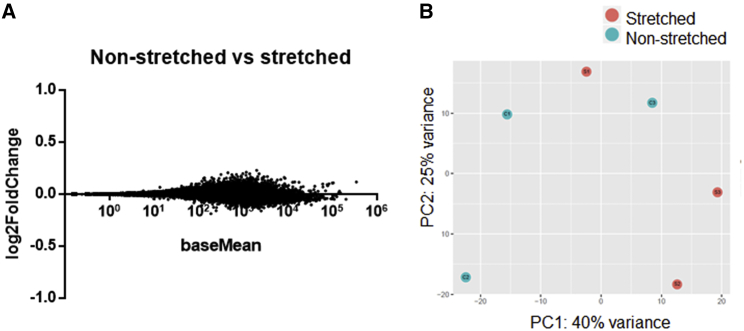
(A) Logarithmic fold change of gene expression (stretched versus nonstretched condition). A value of ±1 (corresponding to a twofold increase) is typically considered a reasonable cutoff for gene dysregulation. (B) A principal component analysis plot. There is no separation between groups, which confirms that stretched and nonstretched samples are identical. The stretched condition is M+MNP+, the nonstretched condition is MMNP+.

References

    1. O’Toole M., Lamoureux P., Miller K.E. A physical model of axonal elongation: force, viscosity, and adhesions govern the mode of outgrowth. Biophys. J. 2008;94:2610–2620. - PMC - PubMed
    1. Suter D.M., Miller K.E. The emerging role of forces in axonal elongation. Prog. Neurobiol. 2011;94:91–101. - PMC - PubMed
    1. Franze K., Guck J. The biophysics of neuronal growth. Rep. Prog. Phys. 2010;73:094601.
    1. Chada S., Lamoureux P., Heidemann S.R. Cytomechanics of neurite outgrowth from chick brain neurons. J. Cell Sci. 1997;110:1179–1186. - PubMed
    1. Fass J.N., Odde D.J. Tensile force-dependent neurite elicitation via anti-beta1 integrin antibody-coated magnetic beads. Biophys. J. 2003;85:623–636. - PMC - PubMed

Publication types

LinkOut - more resources