The Role of Prophylactic Octreotide Following Pancreaticoduodenectomy to Prevent Postoperative Pancreatic Fistula: A Meta-Analysis of the Randomized Controlled Trials
- PMID: 30474064
- PMCID: PMC6193807
- DOI: 10.1055/s-0038-1675359
The Role of Prophylactic Octreotide Following Pancreaticoduodenectomy to Prevent Postoperative Pancreatic Fistula: A Meta-Analysis of the Randomized Controlled Trials
Abstract
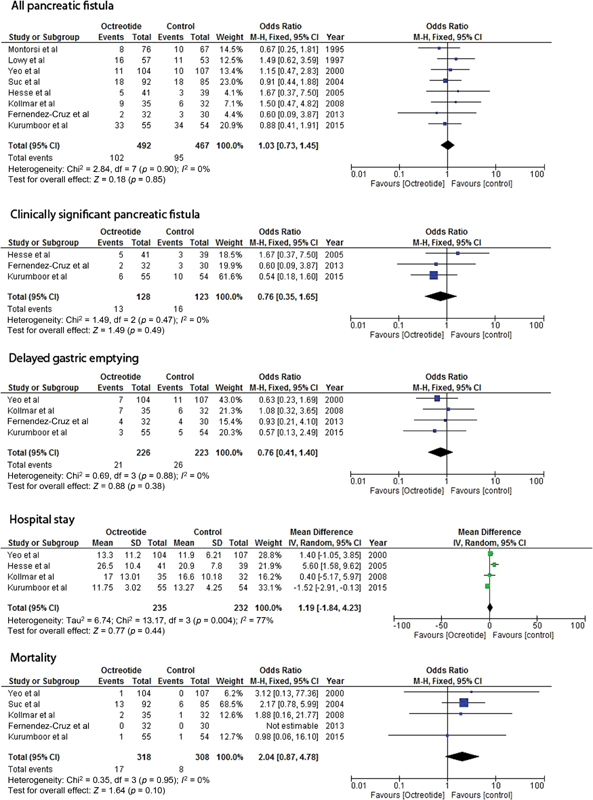
Introduction A postoperative pancreatic fistula (POPF) is a major cause of morbidity and mortality following pancreaticoduodenectomy (PD). A pharmacologic approach using perioperative octreotide, a long-acting somatostatin analog having an inhibitory action on pancreatic exocrine secretion, was proposed to reduce the incidence of the POPF. Despite contradictory results in various randomized controlled trials (RCTs), the prophylactic octreotide has been widely used in the last two decades to reduce the POPF. The present meta-analysis aims to assess the effectiveness of the prophylactic octreotide in preventing the POPF following PD. Methods A literature search was performed in the PubMed for the RCTs that compared the prophylactic octreotide with the placebo following PD published prior to October 2016. Review manager (Cochrane Collaboration's software) version RevMan 5.2 was used for analysis. Those RCTs which had compared the prophylactic Octreotide with placebo to reduce the POPF following PD were considered eligible for the meta-analysis. The low quality (Jadad score of two or less) RCTs or those including mixed pancreatic resections without reporting specific pancreaticoduodenectomy outcomes were excluded. The effect size for the dichotomous and the continuous data was displayed as the odds ratio (OR) and the weighted mean difference (WMD), respectively, with their corresponding 95% confidence intervals (CI). A fixed effect or random effects model was used to pool the data according to the result of a statistical heterogeneity test. The heterogeneity between the studies was evaluated using the Cochran Q statistic and the I 2 test, with p < 0.05 indicating significant heterogeneity. Results There were eight RCTs available for the analysis. A total of 959 patients were included in the meta-analysis-492 received the prophylactic octreotide and 467 patients received the placebo. The prophylactic octreotide was not found to significantly decrease the total number of the POPF (OR, 1.03'; 95% CI: 0.73-1.45; p -value 0.85) or the clinically significant POPF (OR, 0.76; 95% CI: 0.35-1.65; p -value 0.49) compared with the placebo. There was also no difference in the duration of hospital stay (WMD, 1.19; 95% CI:1.84-4.23; p -value 0.44) or the postoperative mortality (OR, 2.04; 95% CI: 0.87-4.78; p -value 0.10) between the two groups. The prophylactic octreotide was also not found to significantly delay the gastric emptying (OR, 0.76; 95% CI: 0.41-1.40; p -value 0.38). Conclusion The present meta-analysis does not support the role of the prophylactic octreotide to prevent the POPF following PD.
Keywords: meta-analysis; octreotide; pancreatic cancer; pancreatic fistula; pancreaticoduodenectomy.
Conflict of interest statement
Figures
References
-
- Bassi C, Dervenis C, Butturini G et al. Postoperative pancreatic fistula: an international study group (ISGPF) definition. Surgery. 2005;138(01):8–13. - PubMed
-
- Montorsi M, Zago M, Mosca F et al. Efficacy of octreotide in the prevention of pancreatic fistula after elective pancreatic resections: a prospective, controlled, randomized clinical trial. Surgery. 1995;117(01):26–31. - PubMed
LinkOut - more resources
Full Text Sources