Review
. 2019 Dec;10(1):481-489.
doi: 10.1080/21505594.2018.1551011. Epub 2018 Dec 3.

Current opinions on autophagy in pathogenicity of fungi

Affiliations
Review

Current opinions on autophagy in pathogenicity of fungi

Xue-Ming Zhu et al. Virulence. 2019 Dec.

Abstract

The interaction between pathogens and their host plants is a ubiquitous process. Some plant fungal pathogens can form a specific infection structure, such as an appressorium, which is formed by the accumulation of a large amount of glycerin and thereby the creation of an extremely high intracellular turgor pressure, which allows the penetration peg of the appressorium to puncture the leaf cuticle of the host. Previous studies have shown that autophagy energizes the accumulation of pressure by appressoria, which induces its pathogenesis. Similar to other eukaryotic organisms, autophagy processes are highly conserved pathways that play important roles in filamentous fungal pathogenicity. This review aims to demonstrate how the autophagy process affects the pathogenicity of plant pathogens.

Keywords: Autophagy; crosstalk; endocytosis; interaction; signaling pathway.


Figures
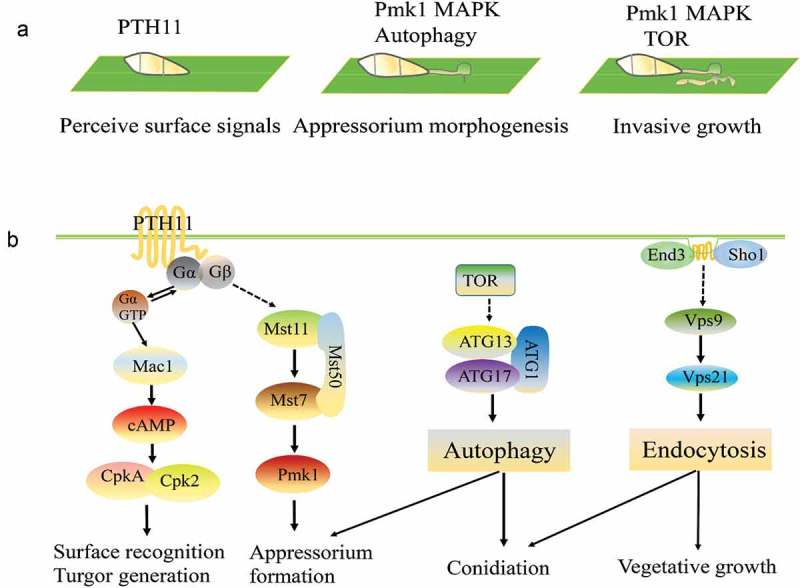
Figure 1.
Figure 1.
Several signaling pathways involved in appressorium formation and pathogenicity in Magnaporthe oryzae. a. The Pmk1 MAPK and autophagy pathways are involved in different stages of the plant infection process. b. Summary of the detection and transmission of fungal pathogenesis-related proteins to the outside signals. Pth11 can recognize surface signals, such as surface hydrophobicity and hardness, and activate downstream Mst11-Mst7-Pmk1 MAPK and endosomal pathways. These two pathways regulate appressorium formation, penetration, and invasive growth. TOR (Target of rapamycin) recognizes extracellular signals, such as nitrogen, glucose and some environmental stresses, and regulates autophagy by controlling the Atg1-Atg13-Atg17 complex.
Figure 2.
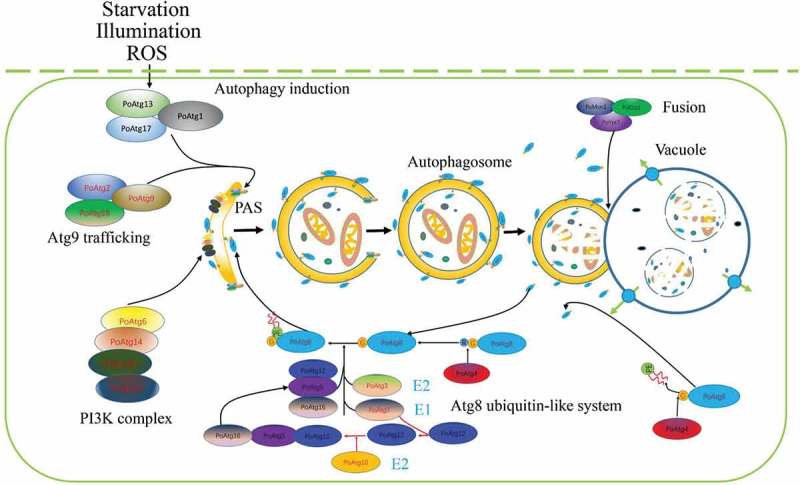
Figure 2.
Autophagy process in filamentous fungi. After the induction of autophagy, an initial sequestering phagophore is assembled at the phagophore assembly site (PAS). Expansion and curvature of the phagophore leads to engulfment of the cargo (cytoplasm containing proteins and organelles) into the double-membraned autophagosome. The fusion of the autophagosomal outer membrane with the vacuolar membrane results in the release of the autophagic body, which is surrounded by the inner autophagosomal membrane. Autophagic bodies and their cargoes are degraded by hydrolytic enzymes, and the degraded products are exported into the cytoplasm for reuse.
Figure 3.
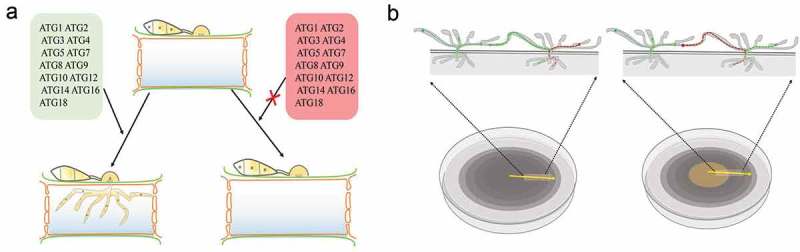
Figure 3.
Autophagy mediates the infection of filamentous fungi and cell survival. a. The deletion of any of the core ATG genes in filamentous fungi results in defects in fungal penetration into the host. The autophagy-deficiency mutants lose their ability to cause disease in their host plants. b. In plate culture, the cells of autophagy-deficiency mutants lose their ability to recycle the materials produced by the cells. As a result, nutrients can no longer be transmitted between hyphal cells, and the middle sections of old hyphae collapse due to nutrient depletion.
Figure 4.
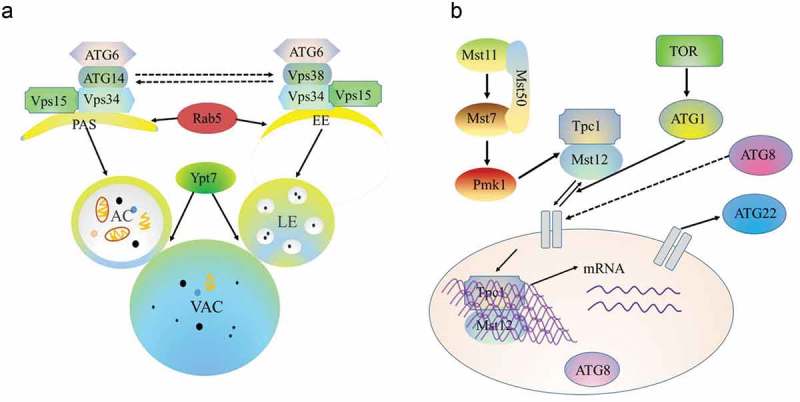
Figure 4.
Crosstalk among autophagy and endocytosis and the Pmk1 MAPK pathway. a. Vps34 recruits Atg6 under the action of Vps38 to induce endosomal endocytosis. Simultaneously, Atg6 is recruited by Vps34 under the action of Atg14 to target the PAS, which participates in the autophagy pathway. Both autophagosome and endosome fusion with the vacuole require the Ypt7 protein. PAS, phagophore assembly site; EE, early endosome; AC, autoplastic vacuole; LE, late endosome; VAC, vacuole. b. In M. oryzae, environmental signals trigger the Pmk1 kinase cascade to control autophagy and activate Tpc1 function. Nuclear-localized Tpc1 then activates the transcription of genes required for polar growth, autophagy, and glycogen degradation.

References

    1. Wang P, Mugume Y, Bassham DC.. New advances in autophagy in plants: regulation, selectivity and function. Semin Cell Dev Biol. 2018;80:113–122. - PMC - PubMed
    1. Liu XH, Gao HM, Xu F, et al. Autophagy vitalizes the pathogenicity of pathogenic fungi. Autophagy. 2012;8(10):1415–1425. - PubMed
    1. Ohsumi Y. Molecular dissection of autophagy: two ubiquitin-like systems. Nat Rev Mol Cell Biol. 2001;2(3):211–216. - PubMed
    1. Nakatogawa H, Suzuki K, Kamada Y, et al. Dynamics and diversity in autophagy mechanisms: lessons from yeast. Nat Rev Mol Cell Biol. 2009;10(7):458–467. - PubMed
    1. Xie Z, Klionsky DJ. Autophagosome formation: core machinery and adaptations. Nat Cell Biol. 2007;9(10):1102–1109. - PubMed

Publication types

Substances