


Analysis of the bond interface between self-adhesive resin cement to eroded dentin in vitro
- PMID: 30475892
- PMCID: PMC6258132
- DOI: 10.1371/journal.pone.0208024
Analysis of the bond interface between self-adhesive resin cement to eroded dentin in vitro
Abstract
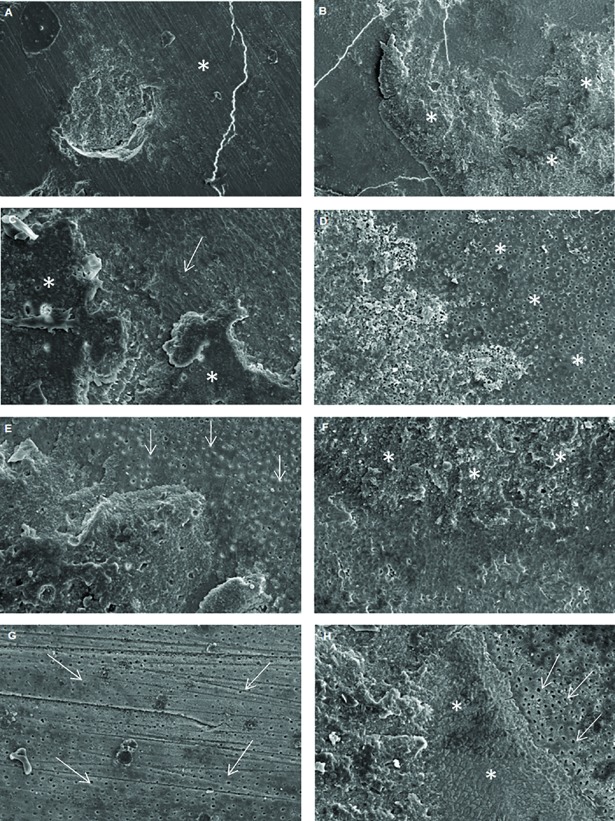
The purpose of this study was to evaluate the bonding interface between a self-adhesive resin cement to in vitro eroded dentin. Seventy-two third molars were used and divided into two groups: sound dentin and in vitro eroded dentin. The in vitro erosion was performed following a demineralization protocol, in which the specimens were immersed in a demineralizing solution for 2 minutes per cycle and remineralizing solution for 10 minutes per cycle for 9 days. Both groups were submitted to four dentin surface treatments: control group (without any treatment), 2% chlorhexidine, 20% polyacrylic acid, and 0.1 M EDTA (n = 9). Blocks of resin-based composite were bonded with RelyX U200 self-adhesive resin cement applied on the pretreated dentin surfaces. The teeth were sectioned into beams (1mm2) and submitted to microtensile bond strength testing to evaluate the bond strength of self-adhesive resin cement to dentin after 24 hours and 8 months of immersion in artificial saliva. Three specimens of each group were longitudinally cut and evaluated using confocal laser scanning microscopy to analyze the dentin/cement interface. Eroded dentin showed higher bond strength values when compared to sound dentin for the 2% chlorhexidine group (p = 0.03), 24 hours after adhesion. When considering eroded dentin, the 0.1M EDTA group showed higher bond strength values with a statistically significant difference only for the control group (p = 0.002). After 8 months of storage, the present results showed that there was no statistically significant difference between the two substrates for all experimental groups (p>0.05). Analysis of the microscopy confocal showed different types of treatments performed on dentin generally increased tags formation when compared to the control group. The eroded dentin showed a significant increase in density and depth of resinous tags when compared to sound dentin. The storage of samples for 8 months seems to have not caused significant degradation of the adhesive interface.
Conflict of interest statement
The authors have declared that no competing interests exist.
Figures


References
-
- Scaramucci T, Hara AT, Zero DT, Ferreira SS, Aoki IV, Sobral MA. Development of an orange juice surrogate for the study of dental erosion. Braz Dent J. 2011; 22(6): 473–478. - PubMed
-
- Barbosa CS, Kato MT, Buzalaf MA. Effect of supplementation of soft drinks tea extract on their erosive potential against dentine. Aust Dent J. 2011; 56(3): 317–321. 10.1111/j.1834-7819.2011.01338.x - DOI - PubMed
-
- Hara AT, Livengood SV, Lippert F, Eckert GJ, Ungar PS. Dental surface texture characterization based on erosive tooth wear processes J Dent Res. 2016; 95(5): 537–542. 10.1177/0022034516629941 - DOI - PubMed
-
- Moretto MJ, Magalhães AC, Sassaki KT, Delbem AC, Martinhon CC. Effect of different fluoride concentrations of experimental dentifrices on enamel erosion and abrasion. Caries Res. 2010; 44(2): 135–140. 10.1159/000302902 - DOI - PubMed
-
- Buzalaf MA, Hannas AR, Kato MT. Saliva and dental erosion. J Appl Oral Sci. 2012; 20(5): 493–502. 10.1590/S1678-77572012000500001 - DOI - PMC - PubMed
Publication types
MeSH terms
Substances
LinkOut - more resources
Full Text Sources
Other Literature Sources
