. 2019 Feb 5;70(3):1005-1016.
doi: 10.1093/jxb/ery415.

Overexpression of thioredoxin m in tobacco chloroplasts inhibits the protein kinase STN7 and alters photosynthetic performance

Affiliations

Overexpression of thioredoxin m in tobacco chloroplasts inhibits the protein kinase STN7 and alters photosynthetic performance

María Ancín et al. J Exp Bot. .

Abstract

The activity of the protein kinase STN7, involved in phosphorylation of the light-harvesting complex II (LHCII) proteins, has been reported as being co-operatively regulated by the redox state of the plastoquinone pool and the ferredoxin-thioredoxin (Trx) system. The present study aims to investigate the role of plastid Trxs in STN7 regulation and their impact on photosynthesis. For this purpose, tobacco plants overexpressing Trx f or m from the plastid genome were characterized, demonstrating that only Trx m overexpression was associated with a complete loss of LHCII phosphorylation that did not correlate with decreased STN7 levels. The absence of phosphorylation in Trx m-overexpressing plants impeded migration of LHCII from PSII to PSI, with the concomitant loss of PSI-LHCII complex formation. Consequently, the thylakoid ultrastructure was altered, showing reduced grana stacking. Moreover, the electron transport rate was negatively affected, showing an impact on energy-demanding processes such as the Rubisco maximum carboxylation capacity and ribulose 1,5-bisphosphate regeneration rate values, which caused a strong depletion in net photosynthetic rates. Finally, tobacco plants overexpressing a Trx m mutant lacking the reactive redox site showed equivalent physiological performance to the wild type, indicating that the overexpressed Trx m deactivates STN7 in a redox-dependent way.


Figures
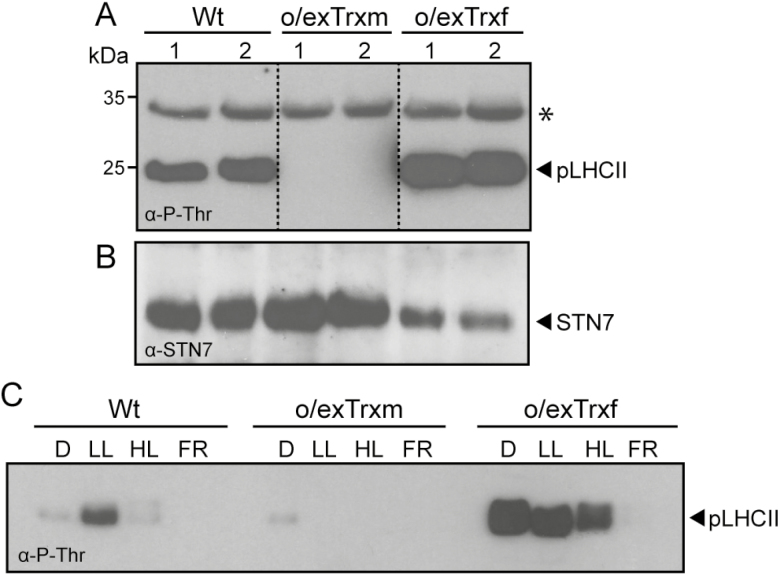
Fig. 1.
Fig. 1.
Effect of Trx m or f overexpression in tobacco chloroplasts on thylakoid protein phosphorylation and STN7 accumulation. (A) Thylakoid protein phosphorylation in Wt, o/exTrxm, and o/exTrxf plants sampled during the light (16 h at 80 μmol m−2 s−1) period. Thylakoid proteins (15 µg) were separated by SDS–PAGE (15%+6 M urea), transferred to a PVDF membrane, and immunoblotted with a phosphothreonine antibody. Phosphorylated LHCII (pLHCII) proteins are indicated. The asterisk represents phosphorylated PSII core proteins (D1 or D2). Molecular weights (kDa) are indicated on the left. (B) STN7 protein accumulation in the samples described in (A). The PVDF membrane was probed with an antibody raised against STN7. (C) LHCII phosphorylation pattern under different light regimes. Wt, o/exTrxm, and o/exTrxf plants were placed in darkness (D) for 8 h and then transferred for 2 h to low light (LL; 80 μmol m−2 s−1), followed by exposure to high light (HL; 800 μmol m−2 s−1) or far red light (FR) for 1 h. At the end of light treatments, the LHCII phosphorylation of isolated thylakoids was analyzed by western blot.
Fig. 2.
Fig. 2.
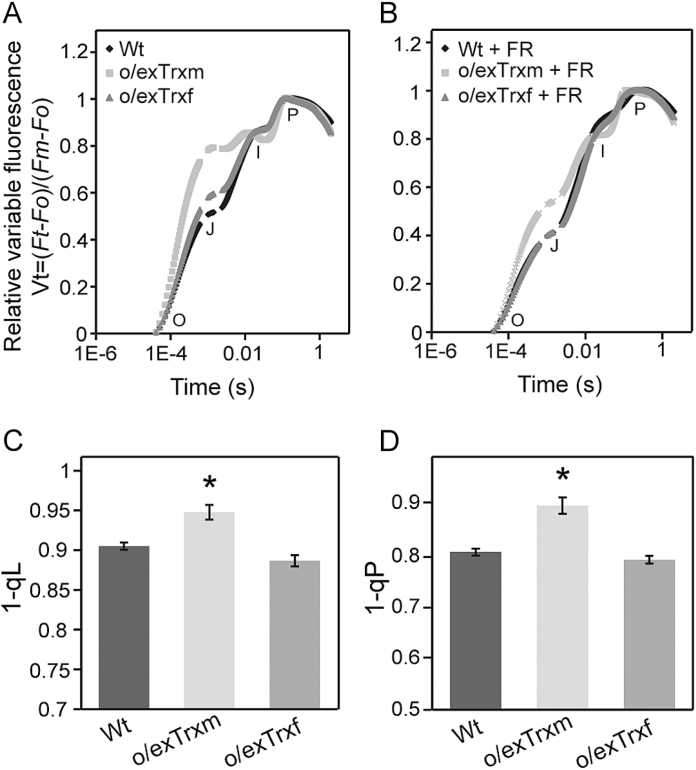
Effect of Trx overexpression on Chl a fluorescence transients in o/exTrxm, o/exTrxf, and Wt tobacco leaves. O, J, I, and P points represent increasing Chl fluorescence values during exposure to a short saturating light pulse. (A) Normalized Chl a fluorescence transients of overnight dark-adapted leaves. (B) Normalized Chl a fluorescence transients of overnight dark-adapted leaves subjected to a 1 min far-red (FR) pulse followed by 30 s of dark adaptation. (C) Redox status of the PQ pool expressed as 1–qL. (D) Redox status of the PQ pool expressed as 1–qP. Data shown are the mean ±SE (n=6 plants for each line). Statistical significance compared with Wt plants is indicated by asterisks (P<0.05, Student’s t-test).
Fig. 3.
Fig. 3.
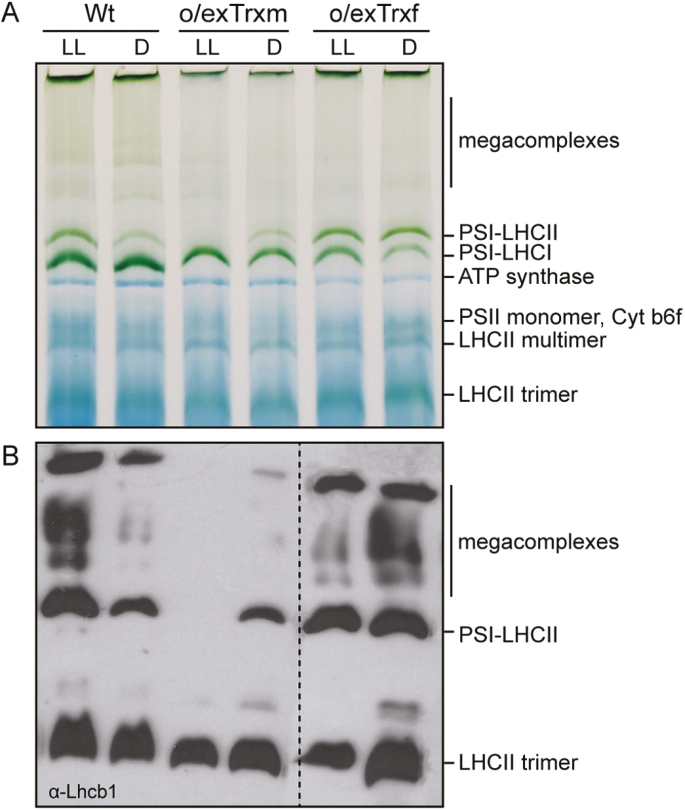
Thylakoid protein complex organization and composition. (A) Thylakoid protein complexes (80 µg) from Wt, o/exTrxm, and o/exTrxf plants were solubilized with 1.5% digitonin and separated by BN-PAGE. Identification of protein complexes was performed in accordance with Järvi et al. (2011) and Wunder et al. (2013b). (B) Lhcb1 protein content in thylakoid complexes. Thylakoid complexes reported above were transferred to a PVDF membrane and immunoblotted against Lhcb1 antibody.
Fig. 4.
Fig. 4.
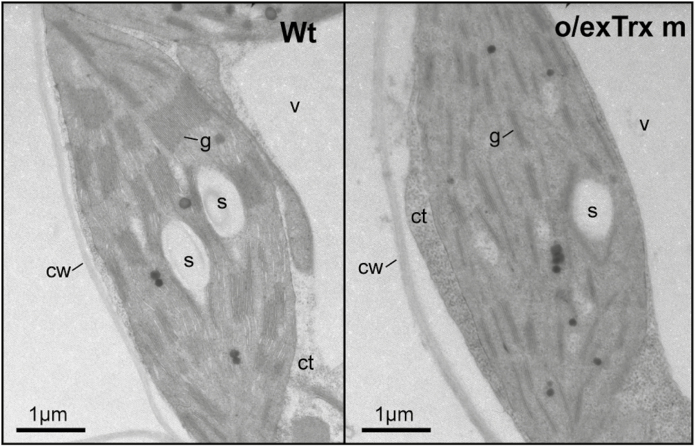
Thylakoid ultrastructure of o/exTrxm plants. TEM was performed to examine leaf mesophyll cells from tobacco Wt and Trx m-overexpressing plants. Representative cross-sections of chloroplasts are shown. v, vacuole; ct, cytoplasm; cw, cell wall; g, grana; s, starch.
Fig. 5.
Fig. 5.
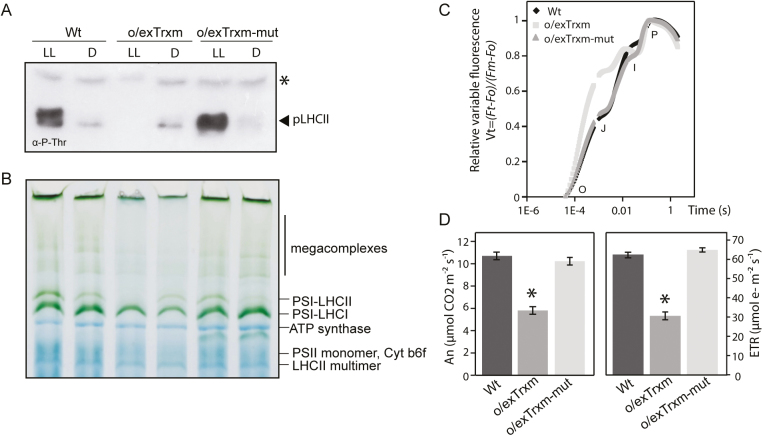
Recovery phenotype in tobacco plants overexpressing the redox mutant variant of Trx m. (A) LHCII protein phosphorylation in Wt, o/exTrxm, and o/exTrxm-mut plants sampled under low light (LL, 80 μmol m−2 s−1) or dark (D) conditions. Thylakoid proteins (15 µg of protein) were separated by SDS–PAGE (15%+6 M urea), transferred to a PVDF membrane, and immunoblotted with a phosphothreonine-specific antibody. The asterisk represents phosphorylated PSII core proteins (D1 or D2). (B) Pigment–protein complexes from thylakoids (80 µg) were separated by BN-PAGE. The identity of protein complexes is shown. (C) Normalized OJIP transients of overnight dark-adapted leaves. (D) Net rate of CO2 assimilation (AN) and the photosynthetic electron transport rate (ETR).
Fig. 6.
Fig. 6.
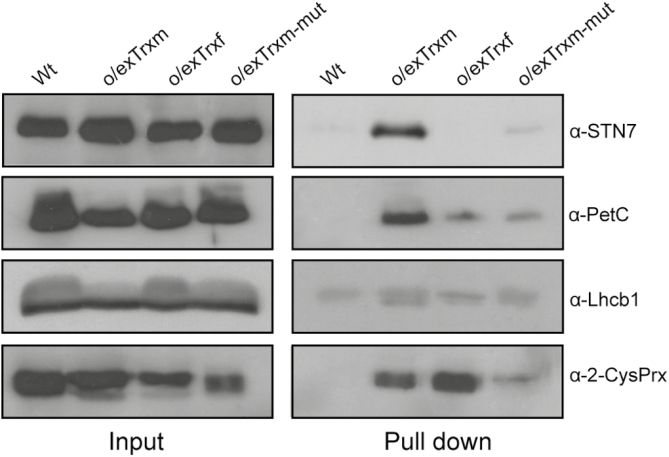
In vivo pull-down assay showing interaction between Trx m and STN7/PetC. Protein complexes from Wt and His-tagged o/exTrxm, o/exTrxf, and o/exTrxm-mut cross-linked chloroplasts were pulled-down with Ni-NTA resin. After washing the beads, bound proteins were eluted by boiling and analyzed, together with input fractions, by western blot using anti-STN7, anti-PetC, anti-2-Cys Prx, and anti-Lhcb1 antibodies.

References

    1. Allen JF. 1992. Protein phosphorylation in regulation of photosynthesis. Biochimica et Biophysica Acta 1098, 275–335. - PubMed
    1. Allen JF. 2003. Botany. State transitions—a question of balance. Science 299, 1530–1532. - PubMed
    1. Allen JF. 2017. Why we need to know the structure of phosphorylated chloroplast light-harvesting complex II. Physiologia Plantarum 161, 28–44. - PubMed
    1. Belkhodja R, Morales F, Quilez R, López-Millán AF, Abadía A, Abadía J. 1998. Iron deficiency causes changes in chlorophyll fluorescence due to the reduction in the dark of the Photosystem II acceptor side. Photosynthesis Research 56, 265–276.
    1. Bellafiore S, Barneche F, Peltier G, Rochaix JD. 2005. State transitions and light adaptation require chloroplast thylakoid protein kinase STN7. Nature 433, 892–895. - PubMed

Publication types

MeSH terms

Substances