


Novel 5'-Norcarbocyclic Pyrimidine Derivatives as Antibacterial Agents
- PMID: 30477147
- PMCID: PMC6321083
- DOI: 10.3390/molecules23123069
Novel 5'-Norcarbocyclic Pyrimidine Derivatives as Antibacterial Agents
Abstract
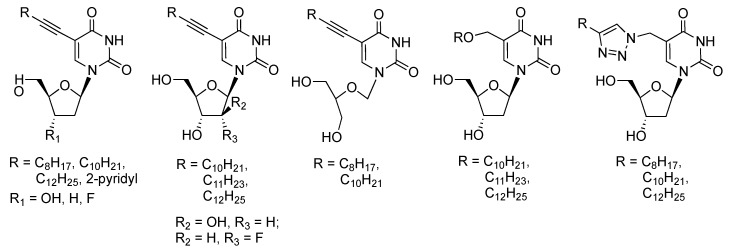
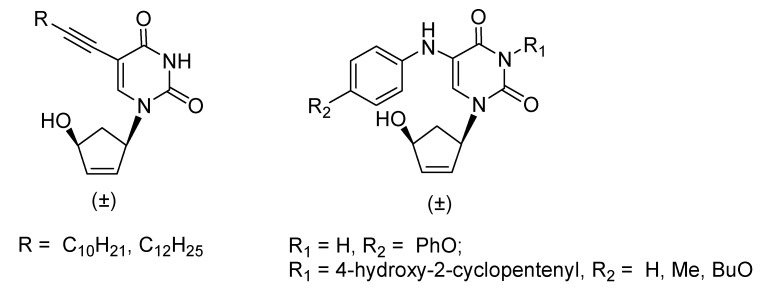
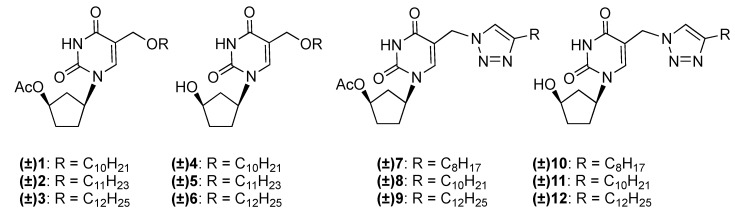
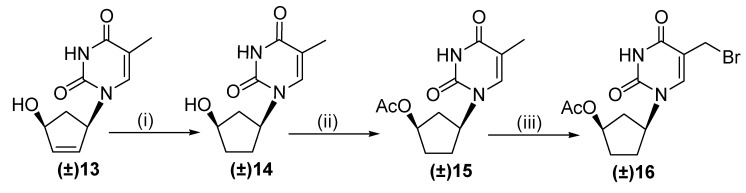
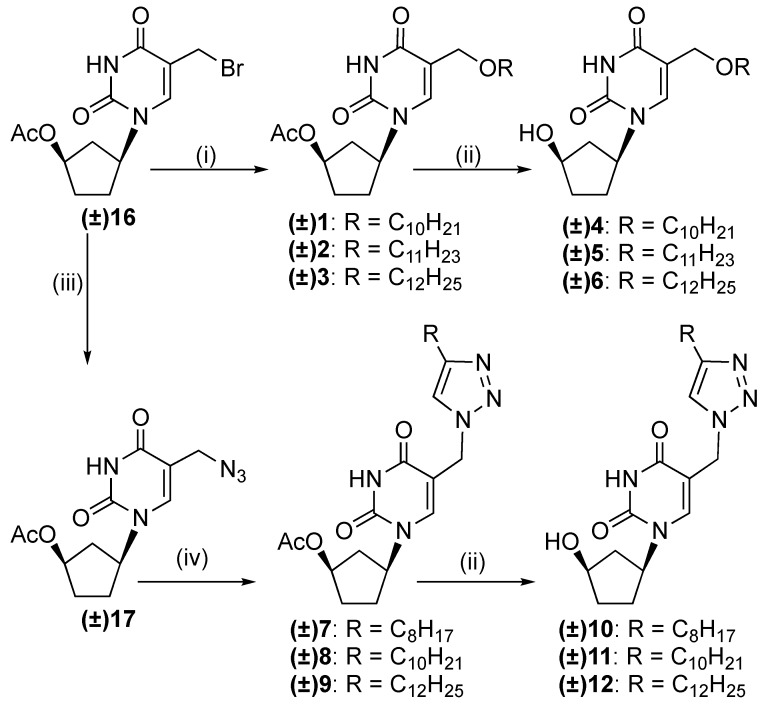
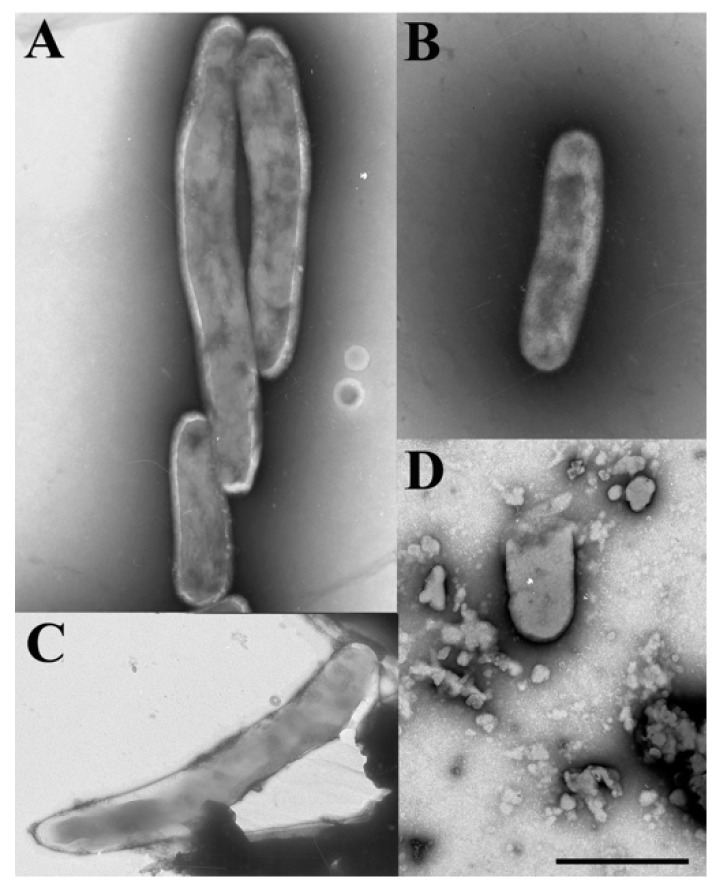
A series of novel 5'-norcarbocyclic derivatives of 5-alkoxymethyl or 5-alkyltriazolyl-methyl uracil were synthesized and the activity of the compounds evaluated against both Gram-positive and Gram-negative bacteria. The growth of Mycobacterium smegmatis was completely inhibited by the most active compounds at a MIC99 of 67 μg/mL (mc²155) and a MIC99 of 6.7⁻67 μg/mL (VKPM Ac 1339). Several compounds also showed the ability to inhibit the growth of attenuated strains of Mycobacterium tuberculosis ATCC 25177 (MIC99 28⁻61 μg/mL) and Mycobacterium bovis ATCC 35737 (MIC99 50⁻60 μg/mL), as well as two virulent strains of M. tuberculosis; a laboratory strain H37Rv (MIC99 20⁻50 μg/mL) and a clinical strain with multiple drug resistance MS-115 (MIC99 20⁻50 μg/mL). Transmission electron microscopy (TEM) evaluation of M. tuberculosis H37Rv bacterial cells treated with one of the compounds demonstrated destruction of the bacterial cell wall, suggesting that the mechanism of action for these compounds may be related to their interactions with bacteria cell walls.
Keywords: 5′-norcarbocyclic nucleosides; Mycobacterium tuberculosis; antibacterial activity; uracil derivatives.
Conflict of interest statement
The authors declare no conflict of interest.
Figures
References
-
- Shmalenyuk E.R., Chernousova L.N., Karpenko I.L., Kochetkov S.N., Smirnova T.G., Andreevskaya S.N., Chizhov A.O., Efremenkova O.V., Alexandrova L.A. Inhibition of Mycobacterium tuberculosis strains H37Rv and MDR MS-115 by a new set of C5 modified pyrimidine nucleosides. Bioorg. Med. Chem. 2013;21:4874–4884. doi: 10.1016/j.bmc.2013.07.003. - DOI - PubMed
MeSH terms
Substances
Grants and funding
LinkOut - more resources
Full Text Sources
Medical
Molecular Biology Databases
