Review
. 2018 Nov 24;18(12):4126.
doi: 10.3390/s18124126.

Optical Biosensors for Label-Free Detection of Small Molecules

Affiliations
Review

Optical Biosensors for Label-Free Detection of Small Molecules

Riikka Peltomaa et al. Sensors (Basel). .

Abstract

Label-free optical biosensors are an intriguing option for the analyses of many analytes, as they offer several advantages such as high sensitivity, direct and real-time measurement in addition to multiplexing capabilities. However, development of label-free optical biosensors for small molecules can be challenging as most of them are not naturally chromogenic or fluorescent, and in some cases, the sensor response is related to the size of the analyte. To overcome some of the limitations associated with the analysis of biologically, pharmacologically, or environmentally relevant compounds of low molecular weight, recent advances in the field have improved the detection of these analytes using outstanding methodology, instrumentation, recognition elements, or immobilization strategies. In this review, we aim to introduce some of the latest developments in the field of label-free optical biosensors with the focus on applications with novel innovations to overcome the challenges related to small molecule detection. Optical label-free methods with different transduction schemes, including evanescent wave and optical fiber sensors, surface plasmon resonance, surface-enhanced Raman spectroscopy, and interferometry, using various biorecognition elements, such as antibodies, aptamers, enzymes, and bioinspired molecularly imprinted polymers, are reviewed.

Keywords: evanescent wave; interferometry; label-free; optical biosensor; optical fiber; small molecule; surface plasmon resonance; surface-enhanced Raman spectroscopy.


Conflict of interest statement

The authors declare no conflict of interest.

Figures

Figure 1
Figure 1
Schematic presentation of assay formats generally used for small-molecule detection. (a) In a direct assay, target analyte binds to the recognition element, e.g., the antibody which is immobilized on the sensor surface; (b) In a competitive assay, the analyte competes with its conjugate for the binding to the immobilized recognition element; (c) In a binding inhibition assay, similarly the analyte and analyte-conjugate compete for the binding, but the analyte-conjugate is the one immobilized on the sensor surface either directly via a linker or as a protein-conjugate. Also, other recognition elements besides antibodies are applied to biosensor development using the same assay formats.
Figure 2
Figure 2
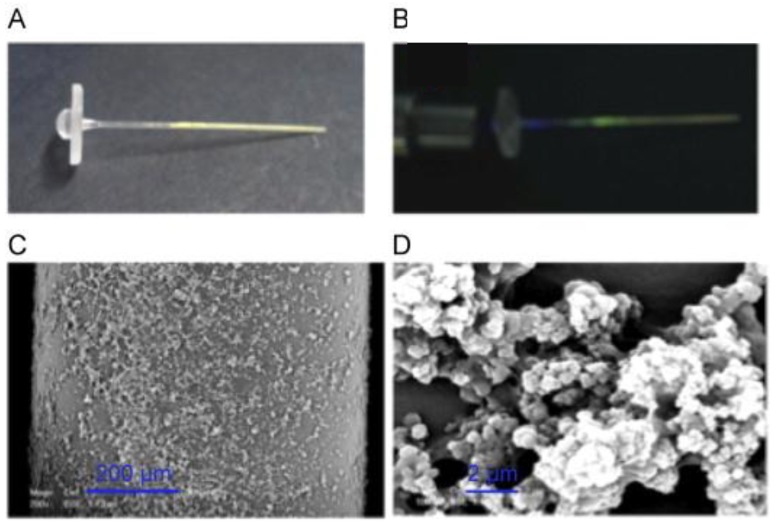
(A) Photograph of the polystyrene evanescent wave fiber optic waveguide coated with fluorescent 2,4-D MIP particles using polyvinyl alcohol as glue. (B) Injection of the light with a fiber optic bundle and collection through the lens (λexc = 410 nm; λem = 515 nm). (C,D) SEM micrographs of the surface of the 2,4-D-MIP-coated optical fiber (reprinted from [45] with permission from Elsevier).
Figure 3
Figure 3
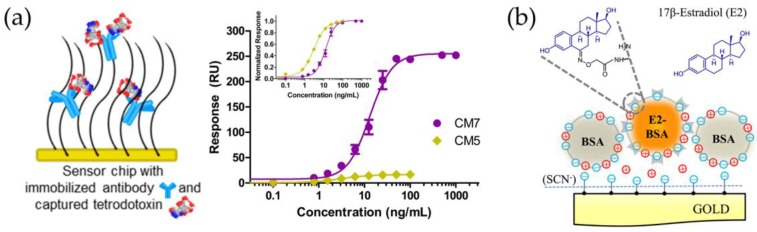
(a) For tetrodotoxin detection, the antibody was covalently immobilized onto carboxymethylated (CM) dextran surface (left). A comparison of high-density CM7 and low-density CM5 surfaces for antibody immobilization (right). (b) Schematic representation of the immobilization of estradiol(E2)-BSA conjugate within the BSA matrix utilizing the electrostatic levitation phenomenon for forming a “fluid”-like interfacial membrane with rotation freedom and in-plane mobility of membrane components ((a), reprinted from [69], copyright (2014) American Chemical Society; (b), reprinted from [86] with permission from Elsevier).
Figure 4
Figure 4
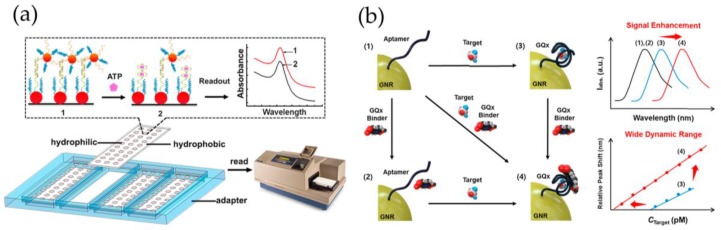
(a) Wall-less LSPR array chip for detection of adenosine triphosphate (ATP) using a normal microplate reader. Plasmonic nanoparticles (NPs) are immobilized on hydrophilic–hydrophobic patterned glass slide and a double-gold NPs system constitute a competitive replacement assay for signal amplification. (b) LSPR sensor for small molecule detection based on (1) aptamer-modified gold nanorods (GNRs), (2) addition of the G-quadruplex (GQx) binder, (3) addition of a target that induces GQx structure, and (4) addition of the target and GQx binder; interaction between the GQx binder and GQx occurs. GQx binder provides signal enhancement and enables a broad dynamic range. (a, reprinted from [113]; b, reprinted from [119], both with permission from Elsevier).
Figure 5
Figure 5
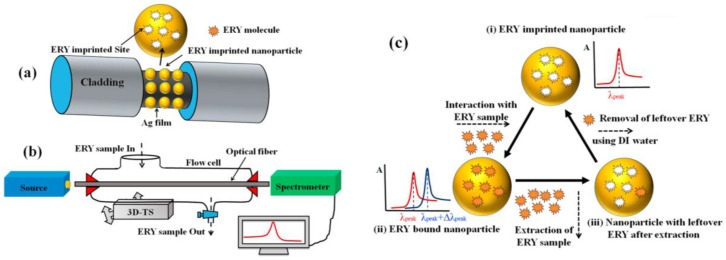
Schematic of (a) fabricated sensing probe for the detection of erythromycin (ERY) using the fiber optic core decorated with the coatings of silver and a layer of ERY imprinted nanoparticles (b) experimental set-up and (c) sensing mechanism. Figure reprinted from [142] with permission from Elsevier.
Figure 6
Figure 6
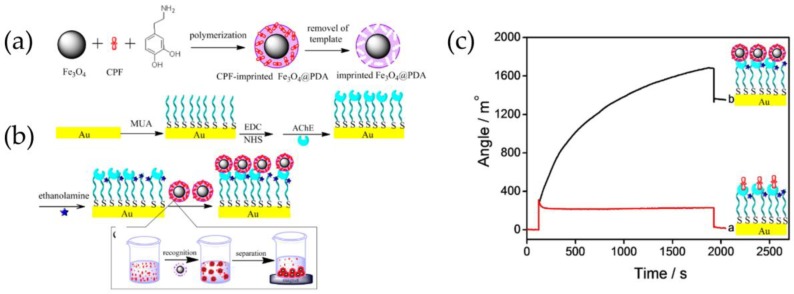
(a) Preparation of magnetic MIPs for chlorpyrifos (CPF) recognition and (b) schematic illustration of the stepwise preparation process of the sensor surface with immobilized AChE. (c) SPR response curve with 10 μM CPF using direct detection of free CPF in PBS (red) and amplification with magnetic MIPs (black). Figure reprinted from [153], copyright (2013) American Chemical Society.
Figure 7
Figure 7
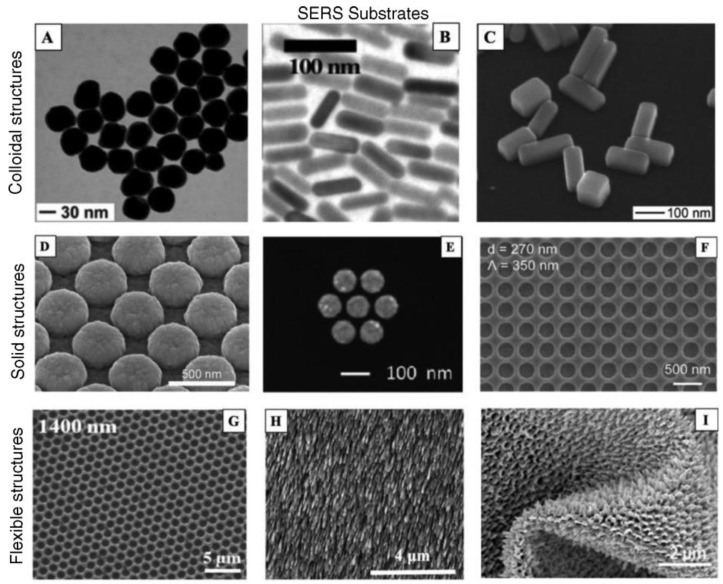
SEM images of different types of SERS substrates. (A) Spherical gold nanoparticles, (B) gold nanorods, (C) silver nanobar, (D) silver plasmonic nanodome array, (E) gold nanocluster, (F) gold nanoholes, (G) silver nanovoids, (H) silver nanocolumnar film, and (I) silver nano-pillars. Reprinted with permission from [158], copyright (2017) De Gruyter.
Figure 8
Figure 8
Schematic of SERS effect for a small molecule on gold nanoparticles (AuNPs). (1) Analyte outside the enhanced magnetic field (red dotted lines), no Raman signal is observed; (2) analyte located within the enhanced magnetic field but at long-distance, and (3) analyte located within a “hot spot”. Reprinted with permission from [159]. Copyright 2015 The Royal Society of Chemistry.
Figure 9
Figure 9
Schematic representation of benzoylecgonine (BZE) detection by SERS using silver-coated carbon nanotubes (CNT@Ag). Direct binding of BZE to AgNPs (green spheres) (a), label-free indirect detection of BZE on CNT@Ag coated with BZE-specific antibody fragment alone (b) and in complex with BZE (c). Corresponding SERS spectra are depicted in the graph on top. Figure reprinted from [169] with permission from The Royal Society of Chemistry.
Figure 10
Figure 10
(A) Schematic representation of the nanocomposite fabricated in this work for the development of a SERS–MIP sensor, using Au@mSiO2 nanoparticles and a branching−functionalization−polymerization approach to produce branched Au@mSiO2@MIP/CIP (molecularly imprinted/control imprinted polymer) nanoparticles; (B) Schematic overview of the rebinding features towards the target molecule. Reprinted with permission from [181]. Copyright 2016 American Chemical Society.
Figure 11
Figure 11
(A) Schematic representation of the host-guest complexation mechanism for pyrene. (B) Top graph: SERS spectra of mixtures of 333 mM anthracene with different concentrations of pyrene; a–h (0, 17, 25, 33, 83, 166, 250 and 333 mM). Botton graph: SERS spectra of mixtures of 333 mM pyrene with different concentrations of anthracene, from a–e (0, 83, 166, 250 and 333 mM). Reprinted with permission from [187]. Copyright 2010 the Royal Society of Chemistry.
Figure 12
Figure 12
Schematic of the most commonly used interferometric configurations: (a) Mach–Zehnder interferometer (MZI), (b) a Young interferometer (YI), (c) porous silicon sensor, (d) backscattering interferometry (BSI), (e) dual-polarization interferometer (DPI), (f) biolayer interferometry. ((ad), reprinted with permission from [201], copyright (2012) American Chemical Society; (e), reprinted wit permission from [214] and (f), reprinted with permission from [215] copyright 2004 and 2017 Elsevier.
Figure 13
Figure 13
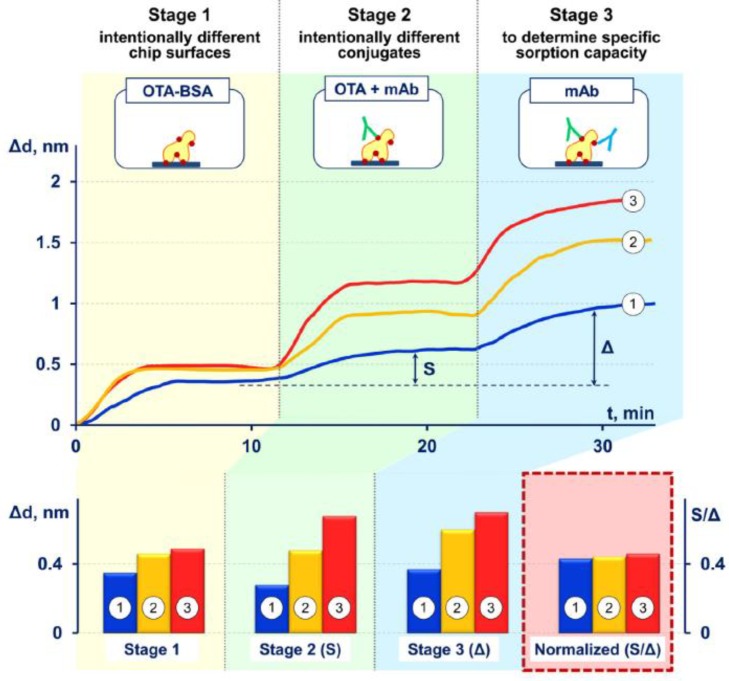
Scheme of reproducibility enhancement of label-free detection of small molecules. Spectral-correlation interferometry (SCI) sensograms for detection of ochratoxin A (OTA, 10 ng/mL) using intentionally different chip surfaces with different conjugates (top). Signal variations at each stage and the normalized signal (bottom). Reprinted with permission from [227]. Copyright 2017 Elsevier.
Figure 14
Figure 14
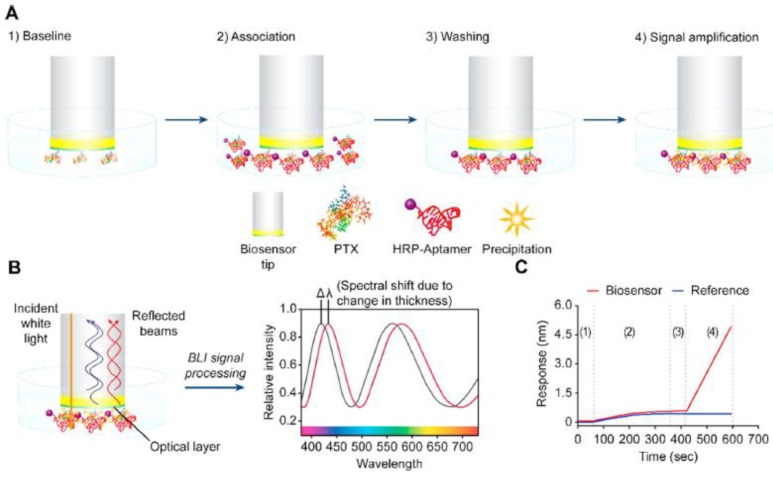
(A) Schematic of the working principles of the biosensor with the competitive assay for palytoxin (PTX) detection using horse-radish peroxidase (HRP)-modified aptamer. (B) Schematic of the biolayer interferometry (BLI)-based detection system and (C) the expected sensor response after each step: (1) baseline (1 min), (2) capture of free HRP-aptamer (5 min), (3) washing (1 min), and (4) signal amplification (3 min). Reprinted with permission from [215]. Copyright 2017 Elsevier.
Figure 15
Figure 15
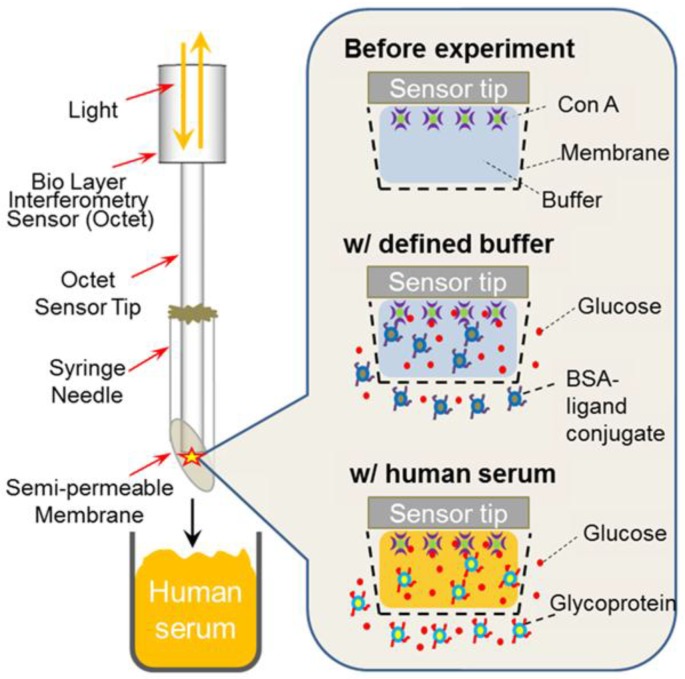
Schematic of the needle-type sensor. A syringe needle was modified and covered with a semi-permeable membrane to fabricate the needle-type sensor. Sensor tip was modified with concanavalin A (ConA) and bovine serum albumin (BSA)-ligand conjugate was kept outside of the semi-permeable membrane. Reprinted with permission from [246]. Copyright 2016 MDPI.

References

    1. Nelson D.L., Cox M.M., editors. Lehninger Principles of Biochemistry. WH Freeman; New York, NY, USA: 2005.
    1. Breitling R., Takano E. Synthetic biology advances for pharmaceutical production. Curr. Opin. Biotechnol. 2015;35:46–51. doi: 10.1016/j.copbio.2015.02.004. - DOI - PMC - PubMed
    1. Stein R.A., Bulboacӑ A.E. Foodborne Diseases. Elsevier; Amsterdam, The Netherlands: 2017. Mycotoxins; pp. 407–446.
    1. Wu F., Groopman J.D., Pestka J.J. Public health impacts of foodborne mycotoxins. Annu. Rev. Food Sci. Technol. 2014;5:351–372. doi: 10.1146/annurev-food-030713-092431. - DOI - PubMed
    1. Johnson E.A., Schantz E.J. Foodborne Diseases. Elsevier; Amsterdam, The Netherlands: 2017. Seafood Toxins; pp. 345–366.