. 2018 Nov 25;23(12):3077.
doi: 10.3390/molecules23123077.

Nitrogen-Fixing Bacteria Associated with Peltigera Cyanolichens and Cladonia Chlorolichens

Affiliations

Nitrogen-Fixing Bacteria Associated with Peltigera Cyanolichens and Cladonia Chlorolichens

Katerin Almendras et al. Molecules. .

Abstract

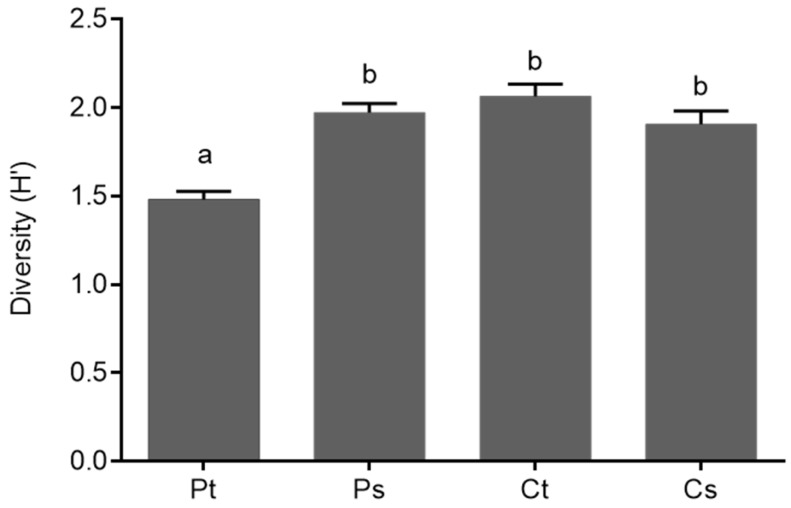
Lichens have been extensively studied and described; however, recent evidence suggests that members of the bacterial community associated with them could contribute new functions to the symbiotic interaction. In this work, we compare the nitrogen-fixing guild associated with bipartite terricolous lichens with different types of photobiont: Peltigera cyanolichens and Cladonia chlorolichens. Since cyanobacteria contribute nitrogen to the symbiosis, we propose that chlorolichens have more diverse bacteria with the ability to fix nitrogen compared to cyanolichens. In addition, since part of these bacteria could be recruited from the substrate where lichens grow, we propose that thalli and substrates share some bacteria in common. The structure of the nitrogen-fixing guild in the lichen and substrate bacterial communities of both lichens was determined by terminal restriction fragment length polymorphism (TRFLP) of the nifH gene. Multivariate analyses showed that the nitrogen-fixing bacteria associated with both types of lichen were distinguishable from those present in their substrates. Likewise, the structure of the nitrogen-fixing bacteria present in the cyanolichens was different from that of chlorolichens. Finally, the diversity of this bacterial guild calculated using the Shannon index confirms the hypothesis that chlorolichens have a higher diversity of nitrogen-fixing bacteria than cyanolichens.

Keywords: Chile; Coyhaique National Reserve; Nothofagus forest; bacterial community structure; chlorolichens; cyanolichens; nifH gene; terricolous lichens.


Conflict of interest statement

The authors declare no conflict of interest.

Figures
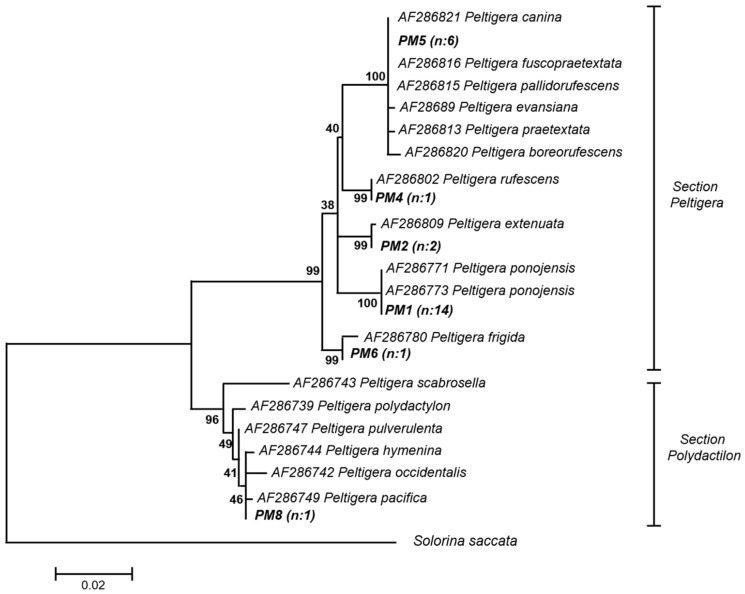
Figure A1
Figure A1
Phylogenetic tree of Peltigera operational taxonomic units (OTUs) by Bayesian inference. Bootstrap support values are indicated at the nodes and the bar indicates the genetic distance. The mycobionts from this study, named as PM followed by a number, are shown in bold. The number of specimens per haplotype is shown in parentheses. The division of the species into sections corresponds to Zúñiga et al. [23]. Solorina saccata (accession number DQ973044) sequence was used as outgroup.
Figure A2
Figure A2
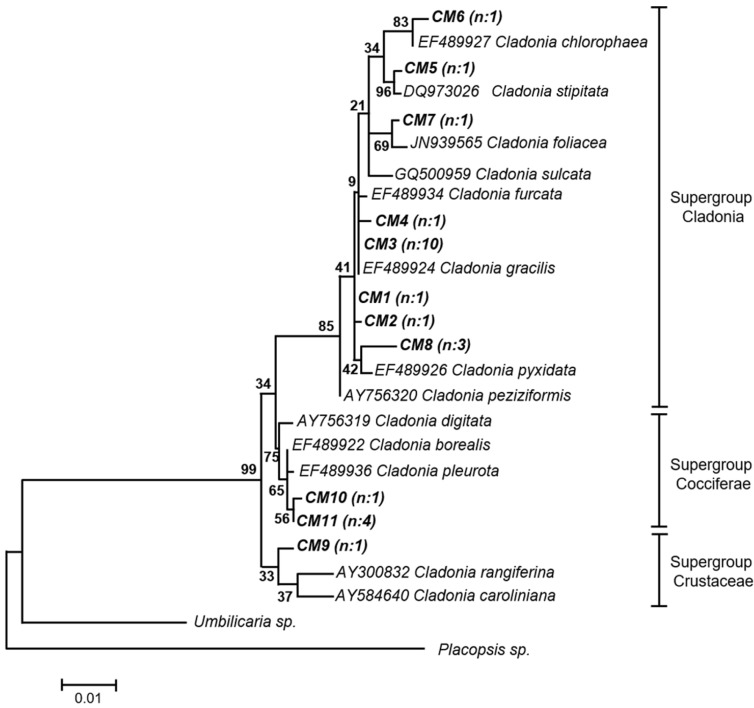
Phylogenetic tree of Cladonia operational taxonomic units (OTUs) by Bayesian inference. Bootstrap support values are indicated at the nodes and the bar indicates the genetic distance. The mycobionts from this study, named as CM followed by a number, are shown in bold. The number of specimens per haplotype is shown in parentheses. The division of the species into supergroups corresponds to Stenroos et al. [73]. Umbilicaria sp. (accession number FN186084) and Placopsis sp. (accession number AY212845) sequences were used as outgroups.
Figure A3
Figure A3
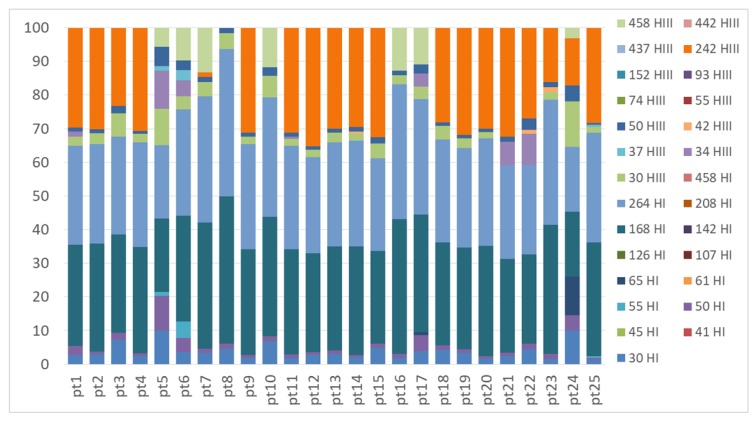
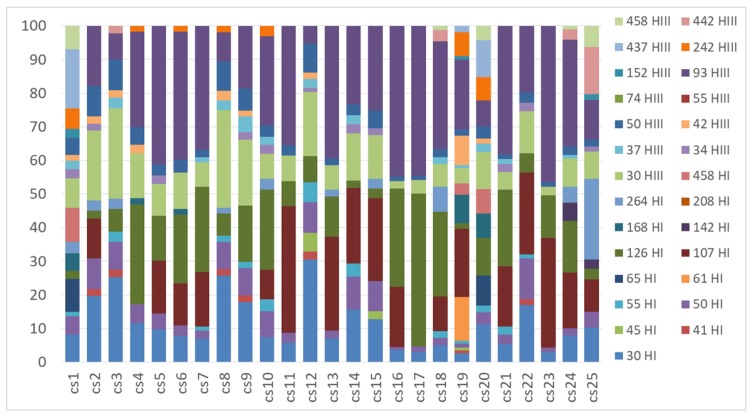
TRFLP profiles of the nifH gene obtained from Peltigera thallus samples with the restriction enzymes HhaI (TRFs indicated in the legend with a number followed by HI) and HaeIII (TRFs indicated in the legend with a number followed by HIII).
Figure A4
Figure A4
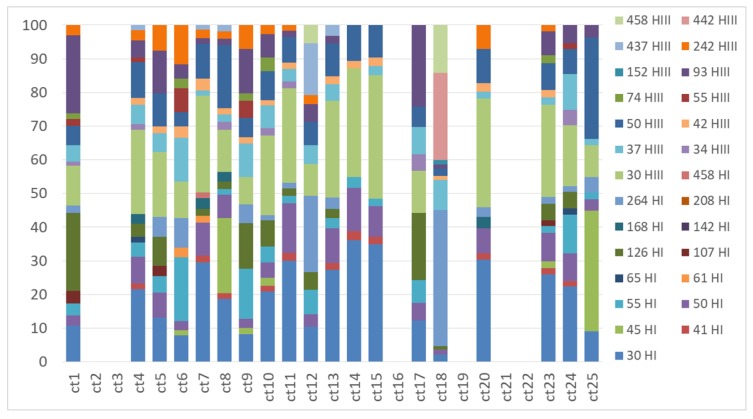
TRFLP profiles of the nifH gene obtained from Cladonia thallus samples with the restriction enzymes HhaI (TRFs indicated in the legend with a number followed by HI) and HaeIII (TRFs indicated in the legend with a number followed by HIII).
Figure A5
Figure A5
TRFLP profiles of the nifH gene obtained from the substrate samples underlying Peltigera lichens with the restriction enzymes HhaI (TRFs indicated in the legend with a number followed by HI) and HaeIII (TRFs indicated in the legend with a number followed by HIII).
Figure A6
Figure A6
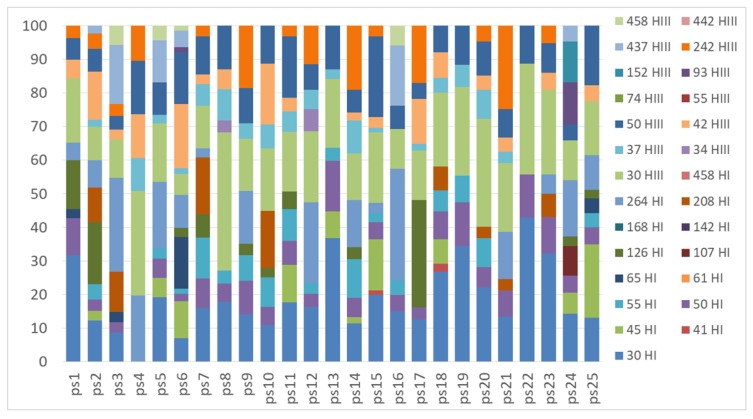
TRFLP profiles of the nifH gene obtained from the substrate samples underlying Cladonia lichens with the restriction enzymes HhaI (TRFs indicated in the legend with a number followed by HI) and HaeIII (TRFs indicated in the legend with a number followed by HIII).
Figure 1
Figure 1
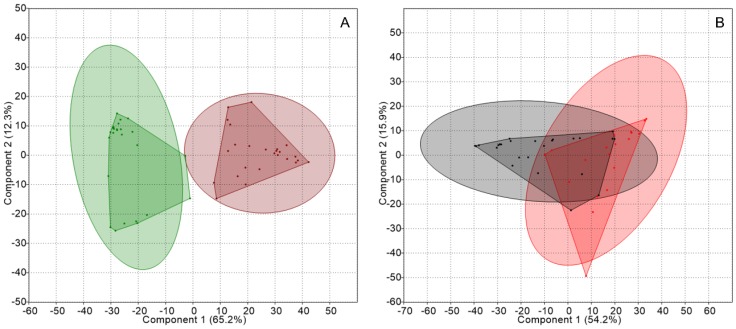
Principal component analyses (PCA) of the genetic structure of the nitrogen-fixing guild associated with thalli and substrates from each lichen genus: (A) Peltigera thalli (green) and substrates (brown), and (B) Cladonia thalli (red) and substrates (gray). Concentration ellipses (ovals surrounding the convex hulls) estimate the region where 95% of population points are expected to fall.
Figure 2
Figure 2
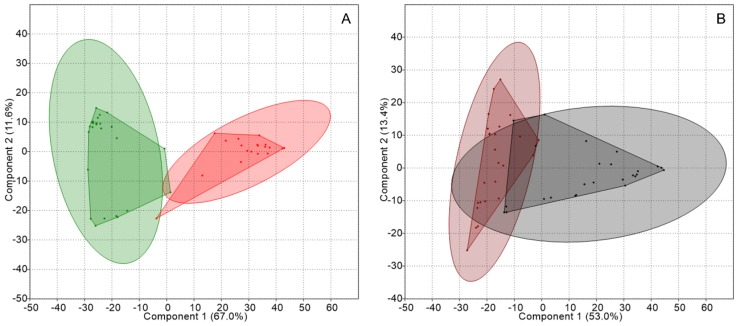
PCA of the genetic structure of the nitrogen-fixing guild associated with thalli and substrates: (A) Peltigera thalli (green) and Cladonia thalli (red), and (B) Peltigera substrates (brown) and Cladonia substrates (gray). Concentration ellipses (ovals surrounding the convex hulls) estimate the region where 95% of population points are expected to fall.
Figure 3
Figure 3
Diversity of nitrogen-fixing bacteria associated with thalli and substrates of Peltigera and Cladonia lichens. Means and standard error are shown. Different letters above the bars represent significant differences (ANOVA-Tukey; p ≤ 0.05). Pt: Peltigera thalli; Ps: Peltigera substrates; Ct: Cladonia thalli; Cs: Cladonia substrates.

References

    1. Nash T.H. In: Lichen Biology. 2nd ed. Nash T.H., editor. Cambridge University Press; Cambridge, UK: 2008.
    1. Petrini O., Hake U., Dreyfuss M.M. An analysis of fungal communities isolated from fruticose lichens. Mycologia. 1990;82:444–451. doi: 10.1080/00275514.1990.12025907. - DOI
    1. Cornejo C., Scheidegger C. Morphological aspects associated with repair and regeneration in Lobaria pulmonaria and L. amplissima (Peltigerales, Ascomycota) Lichenologist. 2013;45:285–289. doi: 10.1017/S0024282912000813. - DOI
    1. Belnap J. Factors Influencing Nitrogen Fixation. In: Belnap J., Lange O., editors. Biological Soil Crust: Structure, Function, and Management. Volume 150. Springer; Berlin/Heidelberg, Germany: 2001. pp. 241–261.
    1. Rai A.N. Cyanolichens: Nitrogen metabolism. In: Rai A.N., Bergman B., Rasmussen U., editors. Cyanobacterian in Symbiosis. Kluwer Academic Publishers; Dordrecht, The Netherlands: 2002. pp. 97–115.

Substances

LinkOut - more resources