


Comparing occasional and persistent frequent attenders in occupational health primary care - a longitudinal study
- PMID: 30477466
- PMCID: PMC6260555
- DOI: 10.1186/s12889-018-6217-8
Comparing occasional and persistent frequent attenders in occupational health primary care - a longitudinal study
Abstract
Background: The aim of the study was to compare occasional and persistent frequent attenders in occupational health (OH) primary care and to identify the diagnoses associated with persisting frequent attendance.
Methods: This is a longitudinal study using electronic medical record data from 2014 to 2016 from an OH service provider. Frequent attenders were defined as patients in the top decile of annual visits to healthcare professionals (frequent attender 10%, FA10). FA10 were categorized to three groups according to the persistence of frequent attendance (1-year-FA, 2 year-FA, and persistent-FA = frequent attenders in all three years). This was used as the dependent variable. We used patient sex, age, employer size, industry and distribution of visits and diagnostic codes to characterize the different frequent attender groups.
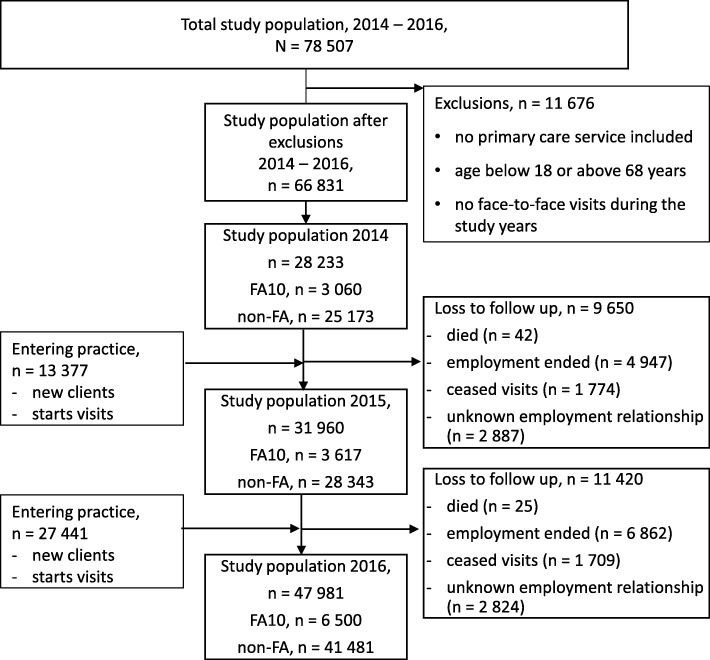
Results: In total, 66,831 patients were included, of which 592 persistent frequent attenders (0.9% of the study population) consulted the OH unit on average 13 times a year. They made altogether 23,797 visits during the study years. The proportion of women and employees of medium and large employers increased among persistent-FAs when compared to the other groups. Multinomial logistic regression accentuated musculoskeletal disorders and to a lesser extent diseases of the respiratory and nervous system and mental disorders. One in five FA becomes a persistent-FA.
Conclusions: Our results indicate that in the context of a working population the association of musculoskeletal disorders and persistent frequent attendance is emphasized. Persistent frequent attenders also create a substantial demand on physician resources. When planning interventions aimed at working age frequent attenders, subgroups suffering from musculoskeletal disorders should be identified as they are associated with persisting frequent attendance.
Keywords: Frequent attender; Health care utilization; High user; High utilizer; Longitudinal studies; Occupational health services; Persistent frequent attendance; Primary health care.
Conflict of interest statement
Ethics approval and consent to participate
The ethics committee of Pirkanmaa Hospital District (ETL R16041) and the National Institute of Health and Welfare (THL/556/5.05.OO/2016) approved the study. Based on Finnish legislation (Personal Data Act, Finland, 22.4.1999) individual consent is unnecessary since no individual could be identified due to the size of the study population.
Consent for publication
Not applicable.
Competing interests
The authors’ declare that they have no competing interests.
Publisher’s Note
Springer Nature remains neutral with regard to jurisdictional claims in published maps and institutional affiliations.
Figures
References
-
- Smits FT, Brouwer HJ, Zwinderman AH, Mohrs J, Smeets HM, Bosmans JE, et al. Morbidity and doctor characteristics only partly explain the substantial healthcare expenditures of frequent attenders: a record linkage study between patient data and reimbursements data. BMC Fam Pract. 2013;14. 10.1186/1471-2296-14-138. - PMC - PubMed
Publication types
MeSH terms
Grants and funding
LinkOut - more resources
Full Text Sources
Research Materials
Miscellaneous
