


Treatment outcomes of proton or carbon ion therapy for skull base chordoma: a retrospective study
- PMID: 30477528
- PMCID: PMC6260885
- DOI: 10.1186/s13014-018-1173-0
Treatment outcomes of proton or carbon ion therapy for skull base chordoma: a retrospective study
Abstract
Background: The usefulness of particle therapy for skull base chordoma has not been established. The aim of this retrospective study was to analyse the treatment outcomes of proton therapy (PT) and carbon ion therapy (CIT) in patients with skull base chordoma at a single institution.
Methods: All patients who underwent PT or CIT with curative intent between 2003 and 2014 at Hyogo Ion Beam Medical Center were included in this study. Twenty-four patients were enrolled. Eleven (46%) received PT and 13 (54%) received CIT. Overall survival (OS), progression-free survival (PFS) and local control (LC) were calculated using the Kaplan-Meier method. Late toxicities were evaluated according to the Common Terminology Criteria for Adverse Events version 4.0.
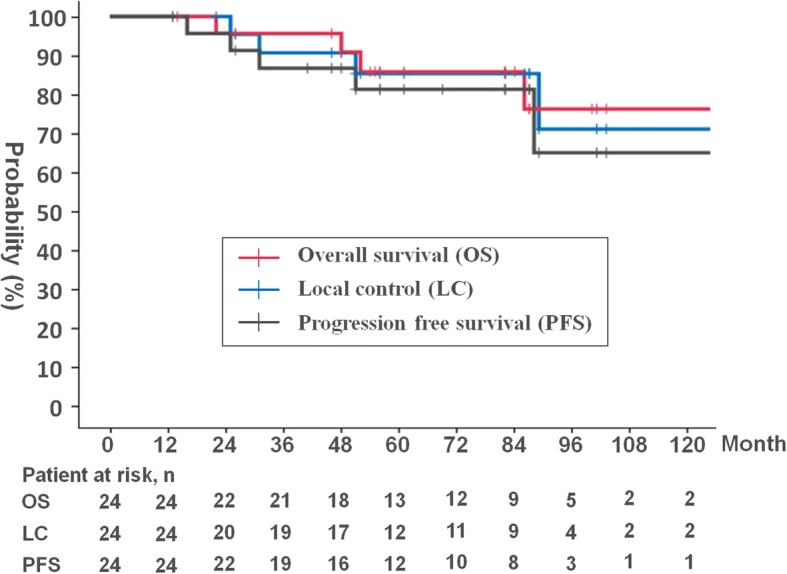
Results: The median follow-up was 71.5 months (range, 14-175 months). The five-year LC, PFS and OS rates were 85, 81, and 86%, respectively. The LC (P = 0.048), PFS (P = 0.028) and OS (P = 0.012) were significantly improved in patients who had undergone surgery before particle therapy. No significant differences were observed in the LC rate and the incidence of grade 2 or higher late toxicities between patients who received PT and CIT.
Conclusions: Both PT and CIT appear to be effective and safe treatments and show potential to become the standard treatments for skull base chordoma. To increase the local control, surgery before particle therapy is preferable.
Keywords: Carbon ion therapy; Late toxicity; Local control; Proton therapy; Radiotherapy; Skull base chordoma; Surgery.
Conflict of interest statement
Ethics approval and consent to participate
All procedures performed in studies involving human participants were in accordance with the ethical standards of the institutional and/or national research committee and with the 1964 Helsinki declaration and its later amendments. In this study, all patients signed a written informed consent which includes the agreement to use of their data. The study was approved by the institutional ethical committee in Hyogo Ion Beam Medical Center.
Consent for publication
Not applicable.
Competing interests
The authors declare that they have no competing interests.
Publisher’s Note
Springer Nature remains neutral with regard to jurisdictional claims in published maps and institutional affiliations.
Figures
References
-
- Mayer IA, Raghavan D, Brecher ML, et al. Textbook of uncommon cancer: John Wiley & Sons, 2006; 614–625.
-
- Fletcher CD, Unni KK Mertens F. Pathology and genetics of tumours of soft tissue and bone, vol. 4. Lyon: Iarc; 2002. 316–317.
MeSH terms
LinkOut - more resources
Full Text Sources
Other Literature Sources
