Review
. 2018 Nov 26;15(1):74.
doi: 10.1186/s12977-018-0457-7.

HIV-1 immunogens and strategies to drive antibody responses towards neutralization breadth

Affiliations
Review

HIV-1 immunogens and strategies to drive antibody responses towards neutralization breadth

Jelle van Schooten et al. Retrovirology. .

Abstract

Despite enormous efforts no HIV-1 vaccine has been developed that elicits broadly neutralizing antibodies (bNAbs) to protect against infection to date. The high antigenic diversity and dense N-linked glycan armor, which covers nearly the entire HIV-1 envelope protein (Env), are major roadblocks for the development of bNAbs by vaccination. In addition, the naive human antibody repertoire features a low frequency of exceptionally long heavy chain complementary determining regions (CDRH3s), which is a typical characteristic that many HIV-1 bNAbs use to penetrate the glycan armor. Native-like Env trimer immunogens can induce potent but strain-specific neutralizing antibody responses in animal models but how to overcome the many obstacles towards the development of bNAbs remains a challenge. Here, we review recent HIV-1 Env immunization studies and discuss strategies to guide strain-specific antibody responses towards neutralization breadth.


Figures
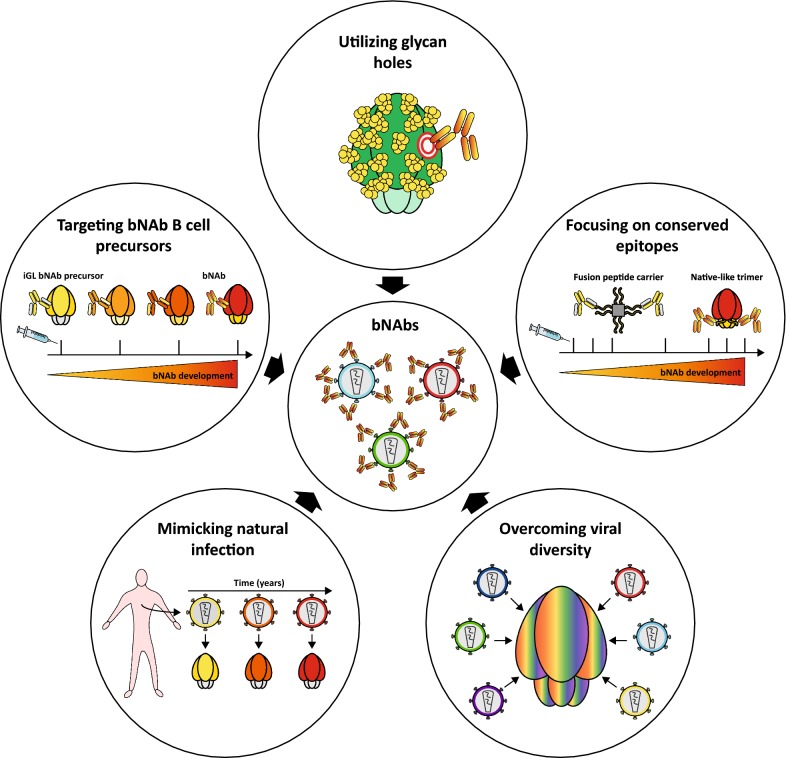
Fig. 1
Fig. 1
Strategies to induce broadly neutralizing antibodies. A schematic overview of various HIV-1 immunogen design strategies to drive autologous neutralizing antibody responses (NAb) towards the development of broadly neutralizing antibodies (bNAbs). Various immunogen strategies are currently exploited to drive the autologous NAb responses towards neutralization breadth and consist of (i) the selective removal of glycans to focus antibody responses towards a specific site of interest such as the CD4bs (ii) immunogens to guide the antibody response towards conserved sites such as the fusion peptide (iii) mosaic or consensus antigens to overcome the viral diversity of the circulating HIV-1 viruses worldwide (iv) lineage immunogens resembling virus evolution in HIV-1 infected elite neutralizers to recapitulate natural infection (v) immunogens targeting the inferred germline (iGL) precursors of bNAbs followed by further immunizations to guide the affinity maturation pathway towards the development of bNAbs. Importantly, one HIV-1 immunogen design strategy does not exclude the others and to efficiently induce bNAbs by vaccination, the integration of all different strategies into one coordinated vaccination regime is most likely required

References

    1. Plotkin SA. Correlates of protection induced by vaccination. Clin Vaccine Immunol. 2010;17:1055–1065. doi: 10.1128/CVI.00131-10. - DOI - PMC - PubMed
    1. Taylor BS, Sobieszczyk ME, McCutchan FE, Hammer SM. The challenge of HIV-1 subtype diversity. N Engl J Med. 2008;358:1590–1602. doi: 10.1056/NEJMra0706737. - DOI - PMC - PubMed
    1. Lynch RM, Shen T, Gnanakaran S, Derdeyn CA. Appreciating HIV type 1 diversity: subtype differences in Env. AIDS Res Hum Retrovir. 2009;25:237–248. doi: 10.1089/aid.2008.0219. - DOI - PMC - PubMed
    1. Gaschen B, Taylor J, Yusim K, Foley B, Gao F, Lang D, et al. Diversity considerations in HIV-1 vaccine selection. Science. 2002;296:2354–2360. doi: 10.1126/science.1070441. - DOI - PubMed
    1. Checkley MA, Luttge BG, Freed EO. HIV-1 envelope glycoprotein biosynthesis, trafficking, and incorporation. J Mol Biol. 2011;410:582–608. doi: 10.1016/j.jmb.2011.04.042. - DOI - PMC - PubMed

Publication types
