


Effects of lipoic acid on walking performance, gait, and balance in secondary progressive multiple sclerosis
- PMID: 30477834
- PMCID: PMC6263172
- DOI: 10.1016/j.ctim.2018.09.006
Effects of lipoic acid on walking performance, gait, and balance in secondary progressive multiple sclerosis
Abstract
Background: Gait and balance impairment is common in secondary progressive multiple sclerosis (SPMS). Lipoic acid (LA), an over-the-counter antioxidant, is effective in MS animal models and may improve walking speed, but effects on mobility are unreported.
Objective: Examine the effects of 1200 mg daily oral dose of LA versus placebo (PLA) on gait and balance in a 2-year, randomized, double-blind pilot study.
Methods: 134 participants were screened for eligibility before assignment to LA (n = 28) or PLA (n = 26). Included here were, 21 participants with SPMS who took LA (N = 11) or PLA (N = 10) capsules for 2 years (enrolled May 2, 2011 - August 14, 2015) and completed all tasks without the use of an assistive device. Participants completed the Timed Up and Go (TUG) and quiet standing tasks every 6 months while wearing inertial sensors (APDM Opals) to quantify mobility.
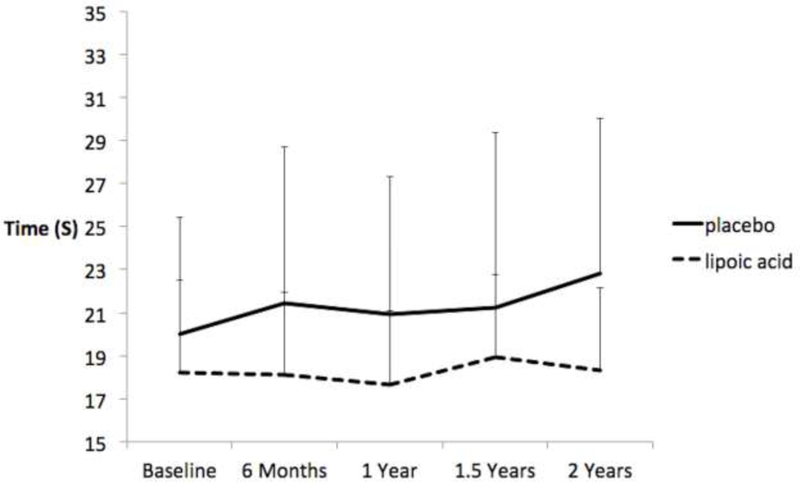
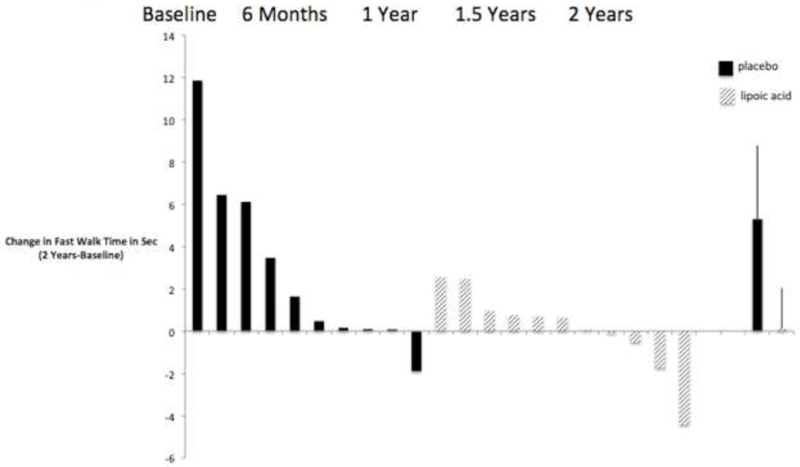
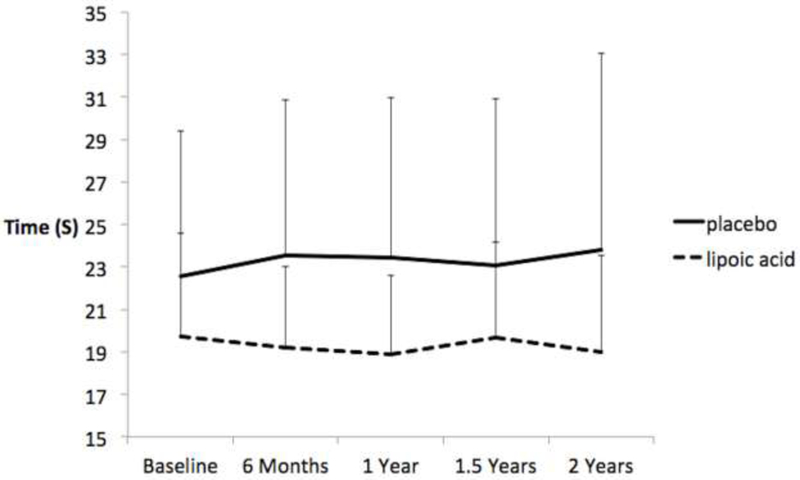
Results: LA had a medium effect on time to complete TUG at 2 years (g = 0.51; 95% CI = -0.35, 1.38). In a subset of 18 participants with less disability (EDSS < 6, no use of ambulatory device), turning time was significantly shorter with LA (p = 0.048, Δ= 0.48 s). No differences in balance metrics were found between groups.
Conclusions: LA had an effect on walking performance in people with SPMS, particularly in those with lower baseline disability.
Trial registration: Lipoic Acid for Secondary Progressive Multiple Sclerosis https://clinicaltrials.gov/ct2/show/NCT01188811?term=spain+lipoic+acid&rank=1 NCT0118881.
Keywords: Antioxidant; Inertial sensors; Posture; Rehabilitation; Sway; Timed up and go.
Copyright © 2018 Elsevier Ltd. All rights reserved.
Conflict of interest statement
Conflict of Interest
B. Loy and B. Fling declare no conflicts of interest. OHSU and Dr. Horak have a significant financial interest in ADPM, a company that may have a commercial interest in the results of this research and technology. This potential institutional and individual conflict has been reviewed and managed by OHSU. D. Bourdette received travel funding from National Multiple Sclerosis Society, Consortium of MS Centers, and Paralyzed Veterans of America; serves on the editoral board for
Figures

References
-
- Heesen C, Bohm J, Reich C, Kasper J, Goebel M and Gold SM. Patient perception of bodily functions in multiple sclerosis: gait and visual function are the most valuable. Multiple sclerosis 2008; 14: 988–91. - PubMed
-
- Cameron MH and Lord S. Postural control in multiple sclerosis: implications for fall prevention. Curr Neurol Neurosci Rep 2010; 10: 407–12. - PubMed
-
- Confavreux C, Vukusic S, Moreau T and Adeleine P. Relapses and progression of disability in multiple sclerosis. The New England Journal of Medicine 2000; 343: 1430–8. - PubMed
-
- Soyuer F, Mirza M and Erkorkmaz U. Balance performance in three forms of multiple sclerosis. Neurological Research 2006; 28: 555–62. - PubMed
Publication types
MeSH terms
Substances
Associated data
Grants and funding
LinkOut - more resources
Full Text Sources
Other Literature Sources
Medical
