


Evaluating science communication
- PMID: 30478063
- PMCID: PMC6475409
- DOI: 10.1073/pnas.1805863115
Evaluating science communication
Abstract
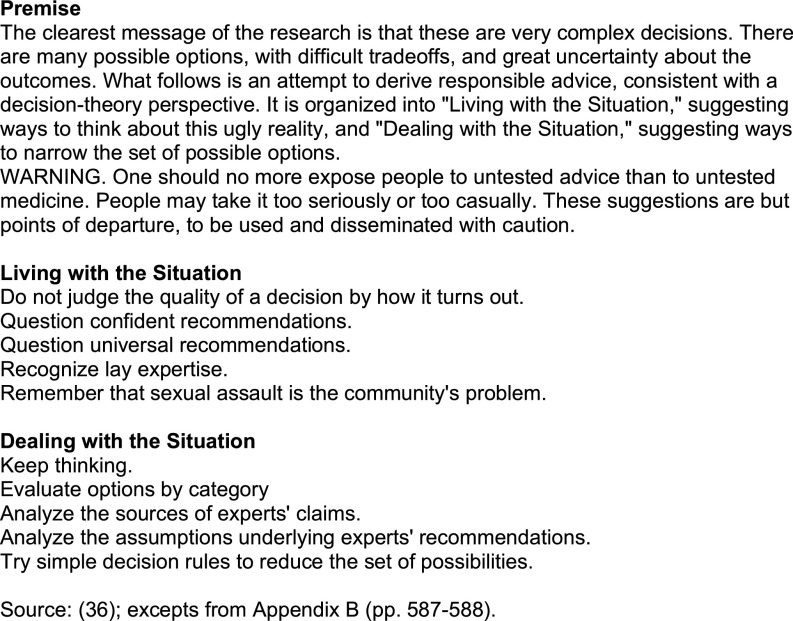
Effective science communication requires assembling scientists with knowledge relevant to decision makers, translating that knowledge into useful terms, establishing trusted two-way communication channels, evaluating the process, and refining it as needed. Communicating Science Effectively: A Research Agenda [National Research Council (2017)] surveys the scientific foundations for accomplishing these tasks, the research agenda for improving them, and the essential collaborative relations with decision makers and communication professionals. Recognizing the complexity of the science, the decisions, and the communication processes, the report calls for a systems approach. This perspective offers an approach to creating such systems by adapting scientific methods to the practical constraints of science communication. It considers staffing (are the right people involved?), internal collaboration (are they talking to one another?), and external collaboration (are they talking to other stakeholders?). It focuses on contexts where the goal of science communication is helping people to make autonomous choices rather than promoting specific behaviors (e.g., voter turnout, vaccination rates, energy consumption). The approach is illustrated with research in two domains: decisions about preventing sexual assault and responding to pandemic disease.
Keywords: decision making; evaluation; pandemics; science communication; sexual assault.
Conflict of interest statement
The author declares no conflict of interest.
Figures


References
-
- National Research Council . Communicating Science Effectively: A Research Agenda. National Academy Press; Washington, DC: 2017. - PubMed
-
- Fischhoff B, Scheufele D. 2018 The science of science communication III. Proc Natl Acad Sci USA, in press.
-
- Simon HA. Administrative Behavior. Macmillan; New York: 1947.
MeSH terms
LinkOut - more resources
Full Text Sources
