. 2019 Jan;4(1):144-154.
doi: 10.1038/s41564-018-0291-7. Epub 2018 Nov 26.

Revisiting the initial steps of sexual development in the malaria parasite Plasmodium falciparum

Affiliations

Revisiting the initial steps of sexual development in the malaria parasite Plasmodium falciparum

Cristina Bancells et al. Nat Microbiol. 2019 Jan.

Abstract

Human to vector transmission of malaria requires that some blood-stage parasites abandon asexual growth and convert into non-replicating sexual forms called gametocytes. The initial steps of gametocytogenesis remain largely uncharacterized. Here, we study this part of the malaria life cycle in Plasmodium falciparum using PfAP2-G, the master regulator of sexual conversion, as a marker of commitment. We demonstrate the existence of PfAP2-G-positive sexually committed parasite stages that precede the previously known committed schizont stage. We also found that sexual conversion can occur by two different routes: the previously described route in which PfAP2-G-expressing parasites complete a replicative cycle as committed forms before converting into gametocytes upon re-invasion, or a direct route with conversion within the same cycle as initial PfAP2-G expression. The latter route is linked to early PfAP2-G expression in ring stages. Reanalysis of published single-cell RNA-sequencing (RNA-seq) data confirmed the presence of both routes. Consistent with these results, using plaque assays we observed that, in contrast to the prevailing model, many schizonts produced mixed plaques containing both asexual parasites and gametocytes. Altogether, our results reveal unexpected features of the initial steps of sexual development and extend the current view of this part of the malaria life cycle.


Conflict of interest statement

COMPETING INTERESTS STATEMENT

The authors declare no competing interests.

Figures
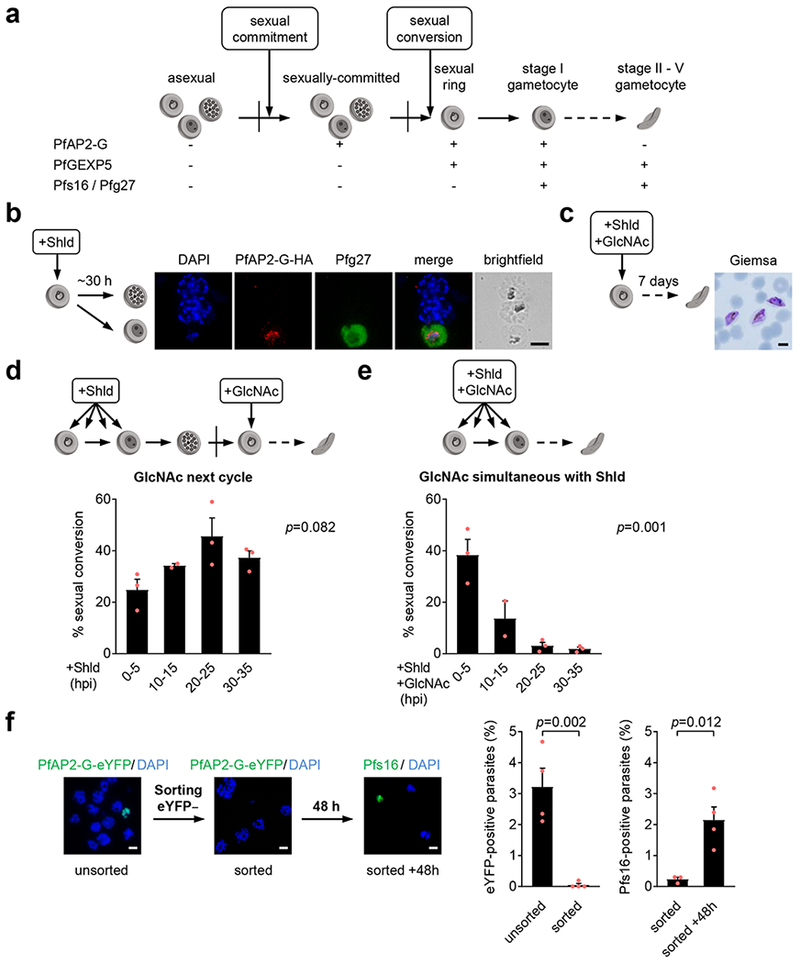
Figure 1.
Figure 1.. Gametocytes can form at the same cycle of PfAP2-G activation.
a, Proposed nomenclature for the initial steps and stages of sexual differentiation. Sexual conversion is marked by the onset of gametocyte-specific expression of proteins absent from any replicating blood stages (asexual or sexually-committed). Sexual commitment is defined as a cell state that deterministically results in sexual conversion at a later point. Currently, sexually-committed forms are morphologically undistinguishable from their asexual counterparts. Sexual rings, which have also been named as ring gametocytes or gametorings, are still morphologically indistinguishable from asexual rings, but they mature into stage I gametocytes. Expression of known protein markers for the different stages is shown. Vertical lines indicate reinvasion. b, E5-HA-DD cultures with PfAP2-G stabilized at the ring stage (+Shld) form stage I gametocytes before reinvasion. Gametocytes were detected as mononucleated parasites positive for the early gametocyte marker Pfg27. Similar results were obtained in four independent experiments. Scale bar, 5 µm. c, Gametocytes develop from E5-HA-DD cultures treated simultaneously with Shld and GlcNAc at the ring stage. Similar results were obtained in five independent experiments. Scale bar, 5 µm. d-e, Sexual conversion (proportion of parasites that differentiate into gametocytes, see Methods) in E5-HA-DD cultures with Shld added at different h post-invasion (hpi). GlcNAc was added at the ring stage of the next cycle to determine total sexual conversion (d) or simultaneously with Shld to measure SCC (e). Individual data points, mean and SEM from three independent biological replicates (except for 10-15 hpi, n=2) are shown. p values were calculated using one-way ANOVA. f, FACS-sorted PfAP2-G-eYFP-negative schizonts of the E5-eYFP line produce gametocytes within the first cycle after reinvasion. Bar charts show the proportion of PfAP2-G-eYFP-positive schizonts in unsorted controls and sorted samples, and the proportion of Pfs16-positives among pigmented parasites (within 3 h of sorting and 48 h later), as determined by IFA. In each experiment, >1,000 parasites of each sample were counted. Values are the average of four independent experiments, with S.E.M (except for Pfs16 “sorted”, n=3). p values were calculated using a two-tailed unpaired t-test with equal variance. Scale bar, 5 µm.
Figure 2.
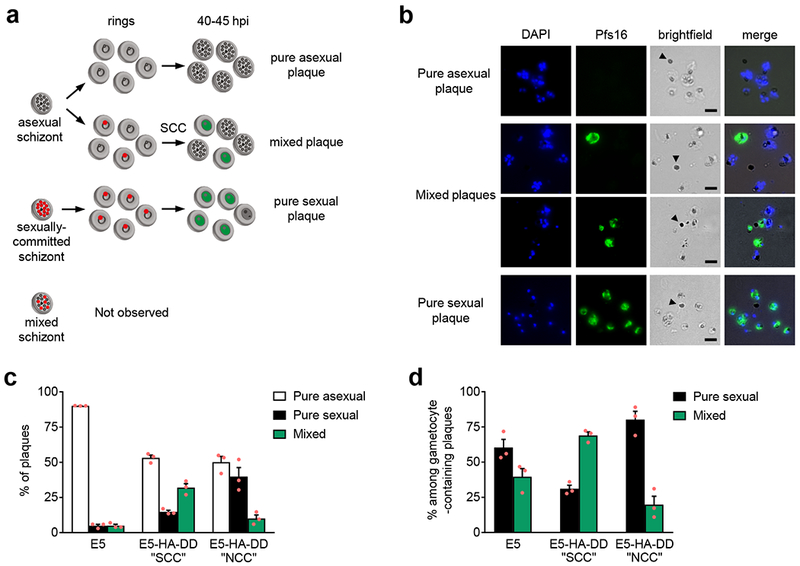
Figure 2.. Plaque assays reveal that some individual schizonts generate mixed sexual and asexual plaques.
a, Schematic of the possible types of plaques originated from schizonts expressing or not expressing PfAP2-G (expression indicated by red nuclei). Early gametocytes expressing the Pfs16 marker are indicated in green. Mixed plaques can arise from asexual schizonts if some rings activate PfAP2-G expression and convert within the same cycle (SCC route). b, Representative IFA images of pure asexual, mixed, and pure sexual plaques. Asexual parasites are multinucleated schizonts, Pfs16-negative and contain a large hemozoin pigment, whereas gametocytes are mono-nucleated, Pfs16-positive and have small hemozoin pigment granules. Arrowheads indicate free hemozoin pigment (residual body) from the parental schizont that originated the plaque. Single nucleated parasites without hemozoin pigment or Pfs16 signal are merozoites that failed to develop. Images are representative of four independent experiments, each including at least three different samples. Scale bar, 5 µm. c, Distribution of plaque types in the wild type line E5, E5-HA-DD treated with Shld at 0-5 hpi (favoring the SCC route), and E5-HA-DD treated at ~30 hpi of the previous cycle (favoring the NCC route). At least 100 plaques of each culture were counted in each experiment. d, Distribution of pure and mixed plaques only among plaques containing ≥1 Pfs16-positive parasite. At least 100 plaques of each culture containing ≥1 sexual parasite were counted in each experiment. In panels c and d, values are the average of three independent biological replicates (red dots), with S.E.M. The distribution of plaque types in panels c and d was significantly different between E5, E5-HA-DD-SCC and E5-HA-DD-NCC (p=0.000 using a two-tailed Fischer’s exact test).
Figure 3.
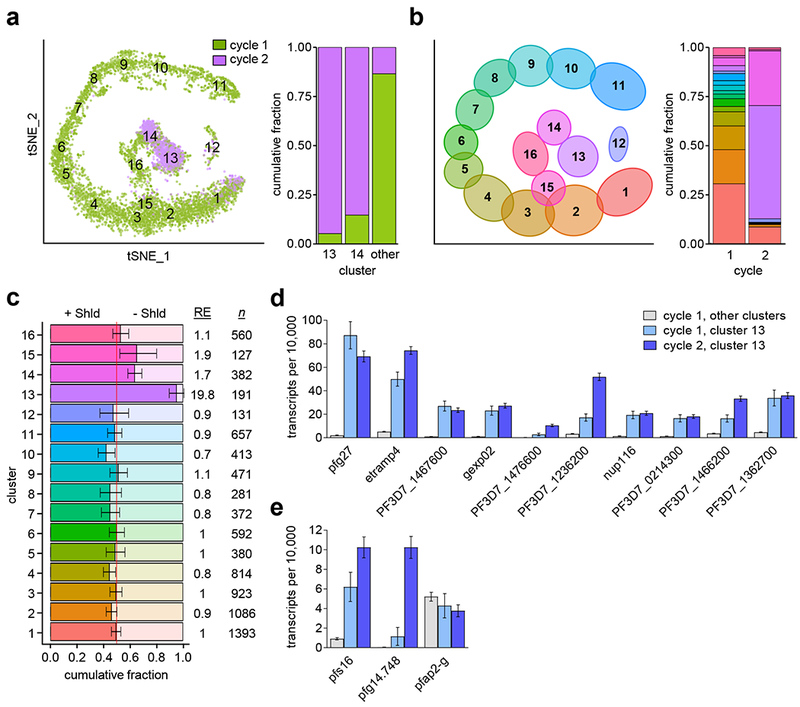
Figure 3.. Single-cell RNA-seq identification and characterization of same cycle conversion (SCC) gametocytes.
a, Cluster analysis of previously published single-cell transcriptomics data from parasites of the E5-HA-DD line treated with Shld at ~4-16 h post-invasion (hpi) and isolated at ~30, ~36 or ~42 hpi of the same cycle (cycle 1) or at ~42 hpi of the next cycle (cycle 2, stage I gametocytes). See Supplementary Figure 6 legend for a detailed definition of tSNE axes. The plot at the right shows the proportion of parasites from cycle 1 and cycle 2 in selected clusters (normalized per number of cells in each sample) from the analysis of 7,472 cells (5,736 from cycle 1 and 1,736 from cycle 2). The cycle 1 versus cycle 2 composition of cluster 13, cluster 14, and the combined remaining clusters were all non-randomly distributed (all p<1×10⁻¹⁵, two-sided Exact Poisson test). b, Distribution of cells from cycle 1 (Shld-treated and untreated) and cycle 2 between the different clusters from the analysis of 10,509 cells. Cycle 1 values are normalized to account for the number of cells analyzed at each time point. c, Relative abundance of cycle 1 Shld-treated (bright shading) or untreated (pale shading) cells within each cluster. Abundance is normalized to account for the number of cells collected at each treatment condition. Numbers at the right show the relative enrichment for treated cells within each cluster (RE) and the number of cells in each cluster (n). Error bars indicate 95% confidence interval based on two-sided Exact Poisson test. d, Average expression of cluster 13 cycle 2 gametocyte markers (also see Supplementary Table 3 and Supplementary Fig. 6–7) shown for Shld-treated cycle 1 cells outside of cluster 13 (5,552 cells) or within cluster 13 (184 cells), and for Shld-treated cycle 2 cluster 13 cells (1,003 cells). Expression is normalized to 10,000 transcripts per cell. Mean and estimated 95% confidence intervals are shown. e, Same analysis for additional gametocyte markers.
Figure 4.
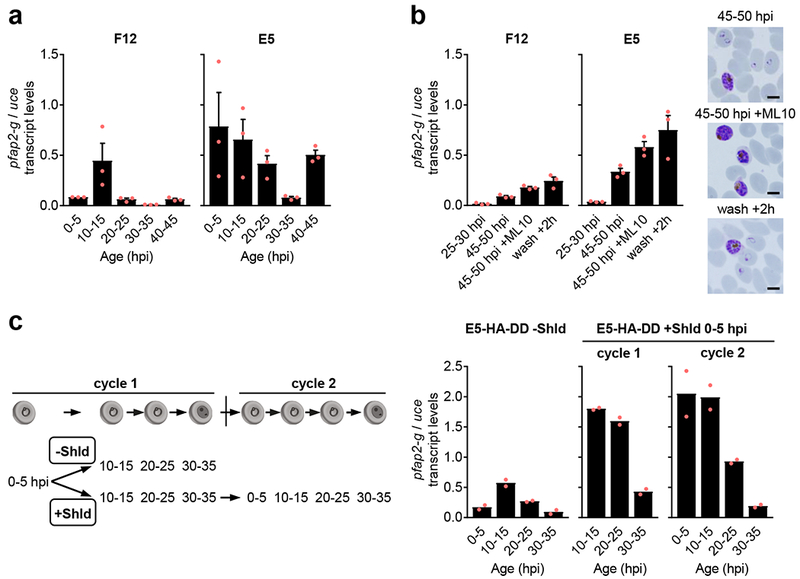
Figure 4.. Temporal dynamics of pfap2-g transcript levels.
a, Reverse transcription-quantitative PCR (RT-qPCR) time-course analysis of pfap2-g expression in tightly synchronized cultures of the non-transgenic parasites lines F12 and E5. Parasite age is expressed in h post-invasion (hpi). b, Expression of pfap2-g in cultures in which 80 nM ML10 was added at 25-30 hpi, and in control cultures without the inhibitor. At 45-50 hpi ML10-treated cultures contained only mature schizonts, whereas control cultures already contained abundant rings. ML10 was washed out of treated cultures and RNA collected 2 h later, when substantial re-invasion had occurred (“wash +2 h”). Images of Giemsa-stained smears of the different preparations (representative of three independent experiments) are shown. Scale bar, 5 µm. c, Time-course analysis of pfap2-g expression in cultures of the E5-HA-DD line maintained in the absence of Shld (-Shld) or with Shld added at 0-5 hpi. Re-synchronization to a 5 h age window was performed between cycles 1 and 2. In cycle 1, pfap2-g expression was significantly higher in the presence of Shld compared to the -Shld condition at all time points analyzed (p=0.002, 0.002 and 0.027 at 10-15, 20-25 and 30-35 hpi, respectively, using a two-sided t-test with equal variance). In all panels, transcript levels were normalized against ubiquitin-conjugating enzyme (uce). Values are the average of two (c) or three (a-b) independent biological replicates (red dots). Error bars in panels a-b are S.E.M.
Figure 5.
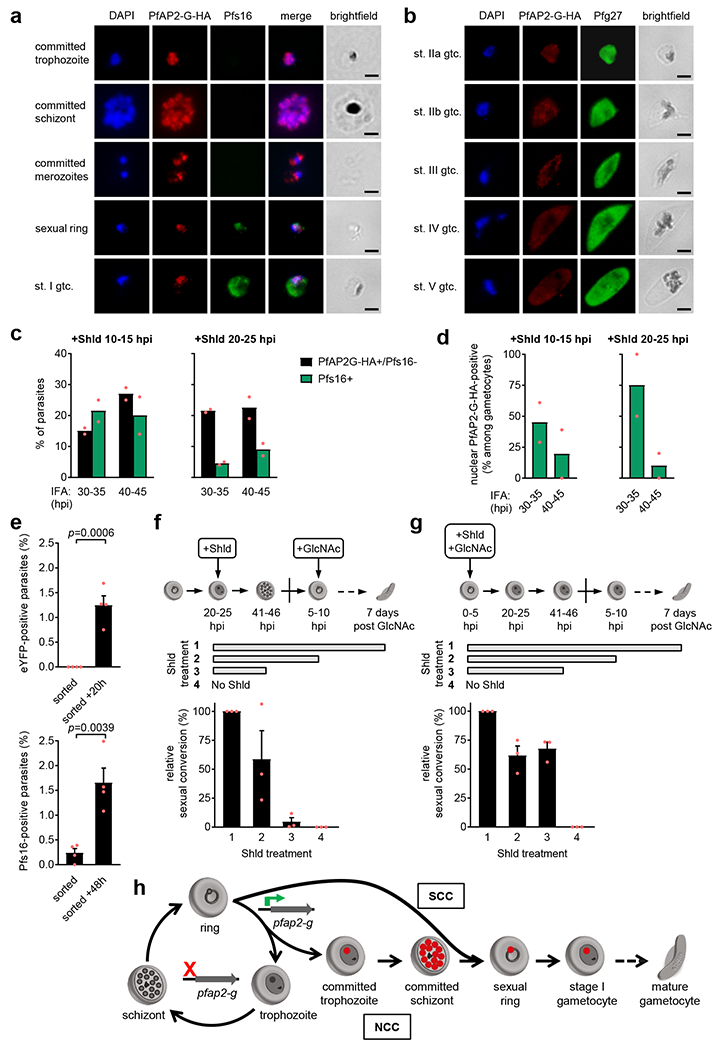
Figure 5.. PfAP2-G expression dynamics.
a, IFA analysis of PfAP2-G-HA and the early gametocyte marker Pfs16 in E5-HA cultures. Images are representative of six independent experiments. Scale bar, 2 µm. b, IFA analysis of PfAP2-G-HA and the gametocyte marker Pfg27 in E5-HA GlcNAc-treated gametocyte cultures. Images are representative of three independent experiments. Scale bar, 2 µm. c, IFA analysis of PfAP2-G-HA and the gametocyte marker Pfs16 at different h post-invasion (hpi) in Shld-treated E5-HA-DD cultures. d, Proportion of stage I gametocytes (Pfs16-positive) positive for PfAP2-G-HA nuclear signal. In panels c and d, values are the average of two independent biological replicates (red dots). e, IFA analysis of PfAP2-G-eYFP expression in rings arising from FACS-sorted eYFP-negative schizonts of the E5-eYFP line. IFA was performed 3 h (“sorted”) and 20 h (“sorted +20h”, ≤20 hpi rings) after sorting. Pfs16-expression and p values were determined as in Fig. 1f. Values are the average of four independent experiments (red dots), with S.E.M. f, Sexual conversion in E5-HA-DD cultures treated with Shld at 20-25 hpi and with GlcNAc at 5-10 hpi of the following cycle. Shld was removed at the times indicated by the horizontal bars. Gametocytemia was determined at day 7 after GlcNAc addition by analysis of Giemsa-stained smears. “Relative sexual conversion” is the level of sexual conversion (%) relative to the condition in which Shld is present all the time. g, Same as in panel f, but GlcNAc was added simultaneously with Shld at 0-5 hpi to obtain only gametocytes formed by the SCC route. For consistency with panel f, age is expressed as if parasites continued the replicative cycle. In panels f and g, values are the average of three independent biological replicates, with S.E.M. h, A new model of the P. falciparum life cycle in the human blood. Red circles indicate nuclear PfAP2-G expression. When PfAP2-G expression is activated early during the ring stage, gametocyte differentiation proceeds without additional replication (same cycle conversion, SCC). In contrast, when PfAP2-G is activated later, parasites go through one additional round of replication as committed forms before differentiating into gametocytes (next cycle conversion, NCC).

Comment in

  • Commitment Isn't for Everyone.
    Josling GA, Llinás M. Josling GA, et al. Trends Parasitol. 2019 Jun;35(6):381-383. doi: 10.1016/j.pt.2019.03.012. Epub 2019 Apr 30. Trends Parasitol. 2019. PMID: 31053335 Free PMC article.

References

    1. Alano P Plasmodium falciparum gametocytes: still many secrets of a hidden life. Mol Microbiol 66, 291–302 (2007). - PubMed
    1. Baker DA Malaria gametocytogenesis. Mol Biochem Parasitol 172, 57–65 (2010). - PMC - PubMed
    1. Bousema T & Drakeley C Epidemiology and infectivity of Plasmodium falciparum and Plasmodium vivax gametocytes in relation to malaria control and elimination. Clin Microbiol Rev 24, 377–410 (2011). - PMC - PubMed
    1. Josling GA & Llinas M Sexual development in Plasmodium parasites: knowing when it’s time to commit. Nat Rev Microbiol 13, 573–587 (2015). - PubMed
    1. Meibalan E & Marti M Biology of Malaria Transmission. Cold Spring Harb Perspect Med 7 (2017). - PMC - PubMed

REFERENCES THAT APPEAR ONLY IN THE METHODS

    1. Cortés A, Benet A, Cooke BM, Barnwell JW & Reeder JC Ability of Plasmodium falciparum to invade Southeast Asian ovalocytes varies between parasite lines. Blood 104, 2961–2966 (2004). - PubMed
    1. Delves MJ et al. Male and female Plasmodium falciparum mature gametocytes show different responses to antimalarial drugs. Antimicrob Agents Chemother 57, 3268–3274 (2013). - PMC - PubMed
    1. Delves MJ et al. Routine in vitro culture of P. falciparum gametocytes to evaluate novel transmission-blocking interventions. Nat Protoc 11, 1668–1680 (2016). - PubMed

    1. Roncales M, Vidal-Mas J, Leroy D & Herreros E Comparison and Optimization of Different Methods for the In Vitro Production of Plasmodium falciparum Gametocytes. J Parasitol Res 2012, 927148 (2012). - PMC - PubMed
    1. Brancucci NM, Goldowitz I, Buchholz K, Werling K & Marti M An assay to probe Plasmodium falciparum growth, transmission stage formation and early gametocyte development. Nat Protoc 10, 1131–1142 (2015). - PMC - PubMed

Publication types

MeSH terms