


Review
doi: 10.1038/s41588-018-0295-5.
Epub 2018 Nov 26.
A primer on deep learning in genomics
Affiliations
- PMID: 30478442
- PMCID: PMC11180539
- DOI: 10.1038/s41588-018-0295-5
Item in Clipboard
Review
A primer on deep learning in genomics
Nat Genet.
2019 Jan.
Abstract
Deep learning methods are a class of machine learning techniques capable of identifying highly complex patterns in large datasets. Here, we provide a perspective and primer on deep learning applications for genome analysis. We discuss successful applications in the fields of regulatory genomics, variant calling and pathogenicity scores. We include general guidance for how to effectively use deep learning methods as well as a practical guide to tools and resources. This primer is accompanied by an interactive online tutorial.
Conflict of interest statement
competing interests
M.H. is an employee of Peltarion.
Figures
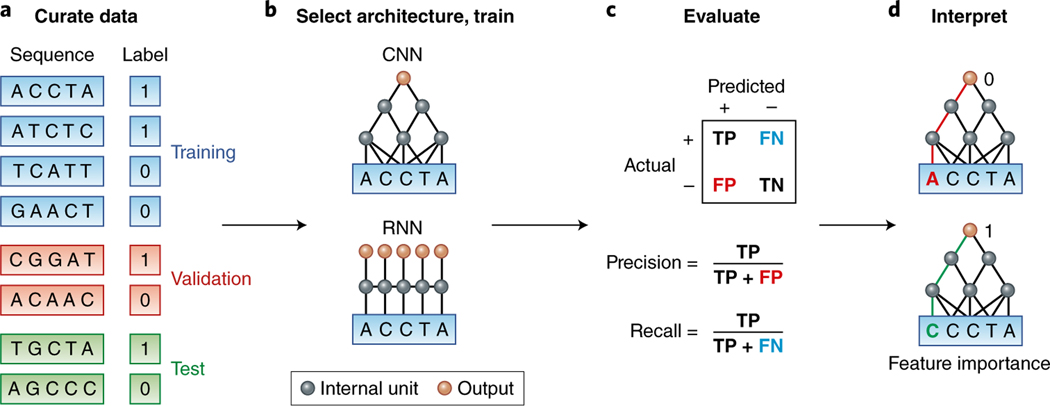
a, A dataset should be randomly split into training, validation and test sets. The positive and negative examples should be balanced for potential confounders (for example, sequence content and location) so that the predictor learns salient features rather than confounders. b, The appropriate architecture is selected and trained on the basis of domain knowledge. For example, CNNs capture translation invariance, and RNNs capture more flexible spatial interactions. c, True positive (TP), false positive (FP), false negative (FN) and true negative (TN) rates are evaluated. When there are more negative than positive examples, precision and recall are often considered. d, The learned model is interpreted by computing how changing each nucleotide in the input affects the prediction. The interactive tutorial illustrates the four steps of this workflow (see URLs).
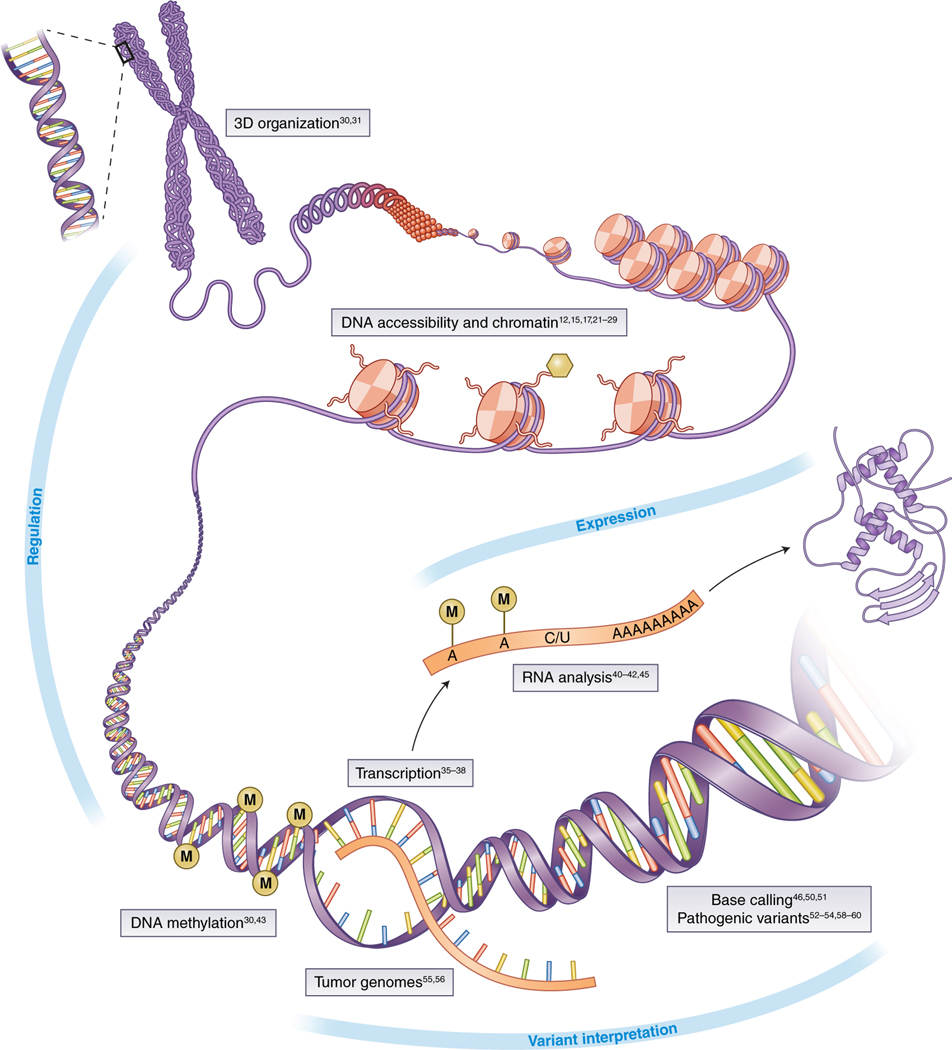
The boxes highlight several application domains and references discussed in the text. Image adapted with permission from ref. , Springer Nature.
References
-
- Yue T. & Wang H. Deep learning for genomics: a concise overview. Preprint at https://arxiv.org/abs/1802.00810 (2018).
-
- Camacho DM, Collins KM, Powers RK, Costello JC & Collins JJ Next-generation machine learning for biological networks. Cell 173, 1581–1592 (2018). - PubMed
Publication types
MeSH terms
Grants and funding
LinkOut - more resources
Full Text Sources
Other Literature Sources
